| Author |
 Replies: 354 / Views: 19,597 Replies: 354 / Views: 19,597 |
|
|
|
Pillar of the Community
 3660 Posts |
Thanks for the overly kind, if unjustified kind words Nut. The photos that I posted are not of a 19th century Morgan & Orr, but of a 20th century press of European design. The clock, (I mean the feeder assembly) is very similar though. Okay, lets get started then Gene. I do wish that Russ could have been here to share insight, as one of the coins that I wanted to talk about belongs to him, unless there is another twohawks running around loose. This all started and stopped a few months ago when I saw a photos in a post about a coin that I found to be interesting because it had the stereotypical seam around the edge, yet the obverse and reverse images indicated that the coin was authentic. I had initial thoughts about the creation of the seam and other aspects as I recall that were extremely silly and far fetched. I will keep looking for the post and paste a link to it if I can. I did save one picture of it, and shared it with my buddy Roger B. Now Roger was one of the first people that I got to know when I started looking at coins and paper money almost a year and a half ago. I remember that we got into terrible arguments about how things happened, and I thought that this guy is the most arrogant person I have ever encountered. He found me to be amusing at best, and was always polite, courteous and gentlemanly despite my rude and vicious attacks. Anyway, we became quite close because I actually did greatly respect his knowledge of coins and history. It was sometime later that I found out that he was the foremost numismatic researcher alive today, well known author of coin books, and had already forgotten more than I would ever know about coins. So, who better to discuss the anomaly imaged below than him? I had initially thought that this might be caused by a cracked collar, but had reservations because the possible crack was just a little too straight. The second photo, was supplied to me by Roger via a link to another forum (that he occasionally lurks to gather ideas for articles and books). After composing myself from my fit of rage for linking me there, we discussed the differences between the two coins and the possibilities, as well as the impossibilities of each. We arrived at total agreement as to the causes, but I thought that just to liven up the forum here, I might solicit thoughts of those here, as to what caused these two very different looking 'seams' (one straight, one not). Possibly there will be a few folks who will dismiss them both as counterfeits. First the coin of unknown owner: 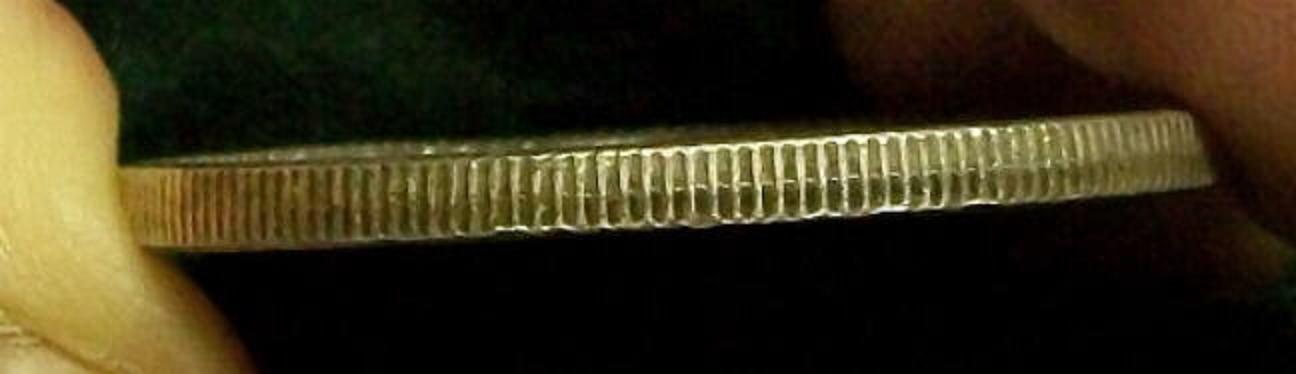 Next, the coin that I believe is owned by Russ: 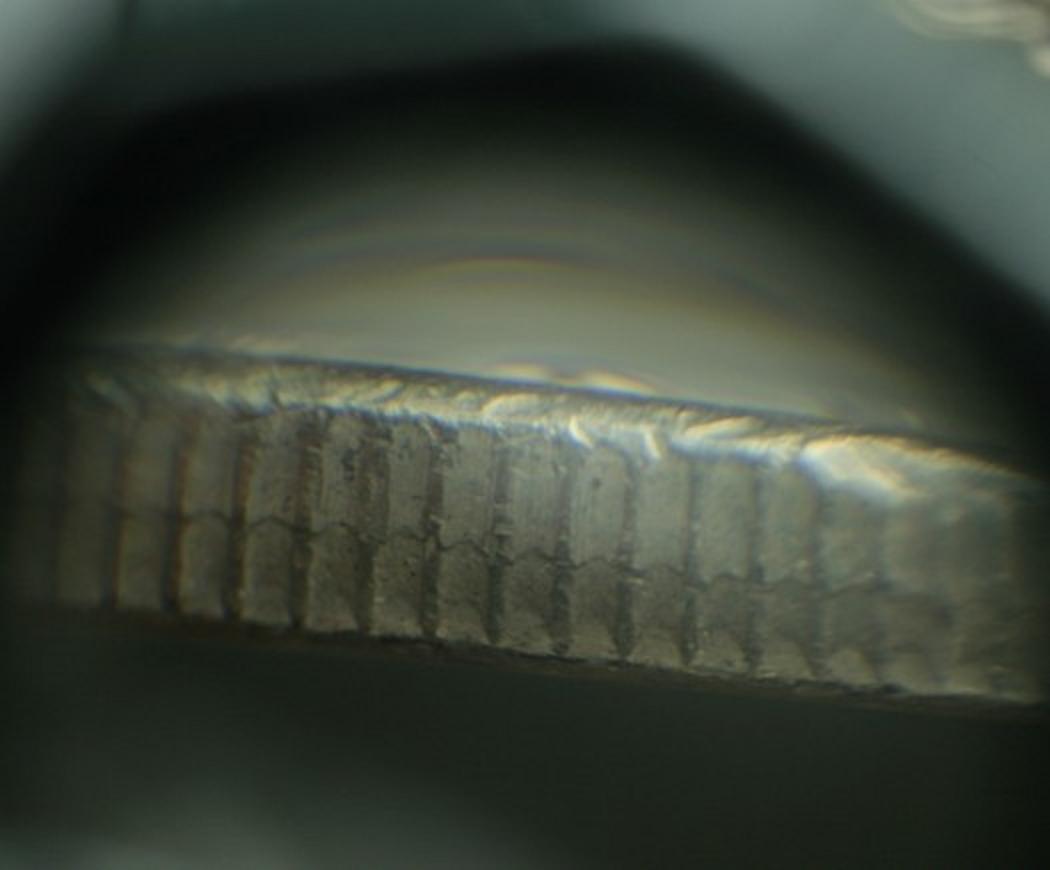 |
|
Pillar of the Community
United States
3076 Posts |
very very interesting....the crack is somewhat sedimintary(geologically speaking)....or a lamination error within the collar...my meaning in the end is, the process of annealing was to correct the molecular structure and basically making any faults within the metal disappear, making the whole piece of metal consistently void of flaws that would fail under the high pressures of the coin press..., hence the need for high grade steel.... This didn't happen on these collars......which was a question I had wondered about as the upper and lower dies failed, why not the collar, other than a breakage we know as Cuds.... |
|
Pillar of the Community
3660 Posts |
It is my belief that the 'seam' on the first coin was caused by the hole punch not being repositioned correctly between annealings. While the same possibilities existed with the hubbing of an obv/rev die, the effect on these dies would have been a doubled die, rather than what I envision on the collar.
The lower photo shows what I believe to be a cracked collar effect.
|
|
Pillar of the Community
United States
3076 Posts |
I think I see where you are going, in that the annealing process was not a one time deal so each time they had to re-size or punch the hole. the poor annealing job allowed that collar to crack in the middle...
|
|
Pillar of the Community
3660 Posts |
Yeah, sort of. Annealing was not an exact science, and temperatures were estimated by the color of the steel. The grain density of the ore, the temperature of metal, duration at that temperature, and the rate of cooling of the steel were all critical factors that turned out many times to be a hit or miss process. No two dies were created equal, and had individual identities and Achilles heels. Some were not suitable for prolonged use, some were, and those that were saw great amounts of wear and re-polishings. The more brittle dies cracked at clashings, the softer did not, but these softer dies took on clash marks from the harder dies that they were paired with.
In order to anneal a die every day, for ten days, would mean that the die would be taken out of the press 8 or 9 times and then have to be repositioned exactly after each annealing. Simple enough since the die would have a design depression left in it from the previous hubbing. Set the die on the hub, lock it into the press, retract the plunger, and strike. Same with the hole punch. but even easier, seat the punch into the circular outline left by the previous strike, lock into place, and strike again.
|
|
Pillar of the Community
United States
3076 Posts |
well my friend, your forensic analogy addresses many of the issues of the the making of the dies..and the times, and the known failures due to there understanding how to produce the dies and collars and there admitted troubles.....one must remember there technology of the time...
bye the eye...The Morgan series was plagued with failures..and the reason was there in-abillity to control the process....but one must remember that was in the late 1800's
|
|
Pillar of the Community
3660 Posts |
I'll tell ya Gene, I sure did not mean to get into the annealing thing , or much of the other stuff that we covered here. It was simply my intent to provide a head start on possible revisions for someone. You are well aware that I don't know the first thing about vams (the identification of the coins themselves, what the value or scarcity of them are), but I do know other things that other folks don't think twice about because they don't care about it. There is no profit to be made in the things that I know about, there is no sense of self satisfaction. I thought that if someone knew that a certain 1887 P VAM contained the characteristics of a cracked collar, other examples of that particular VAM could be checked for the same characteristic. Some may have it, some may not (depending on when the collar was changed out). I do believe that this condition is VAM specific though. If I am correct, the later struck coins would show this more than the earlier stuck coins. The same with the 1883 CC coin with what I believe is a punching abnormality. In this case though, the earlier struck coins would show his characteristic better as I might expect the collar to wear thereby diminishing the effect on later struck coins. All this based on what I believe to the the causes of these effects on these two coins. Then again, I could be totally wrong, and they may both be counterfeits (but I really don't think so). |
|
Moderator
 United States
23522 Posts |
This thread is an ongoing blast to read.  I've seen the same "seam" as in your first pic, zeewool, in a few differing Morgans. Never gave it a lot of thought, but either I've seen a bunch of cast counterfeits, or it's a recurring problem in Morgan mintage. |
|
Pillar of the Community
3660 Posts |
Heh, heh.....Dave, unless you didn't bother to look at the obv / rev, I'll bet that there was not much doubt in your mind about the counterfeits actually being counterfeits.
|
|
Pillar of the Community
United States
3076 Posts |
not to bring up annealing, but I guess I will boldly step out on the platform..(way up there so I don't get slapped silly)..and suggest that annealing is at the very heart of quite a few vams...It's a well known fact that they had tremendous troubles in producing dies that would last. During the process different parts of the coin expanded and contracted differently, And the dies show the results of the process doubling, tripling ect.. when most look at vams the look at the cause and effect, or rather they generally agree with the cause, its MUCH more focused on the effects, by which vams are catagorized..Other than Cuds and denticle impressions, the collar really isn't looked at.. and there is no reason to think that there can only be 2 errors for the collar die... and speaking of denticle impressions if part of the collar had broken off and was impressed into the die....would not the reeded edge be missing on those coins struck after the break? I should guess the stopped the press and changed the collar... but would not have a few got thru into circulation? Great Post as always ZEE |
|
Pillar of the Community
3660 Posts |
Doubling and tripling is a result of hubbing rather than annealing. Yes, I would have to agree that probably the edge of the coin is rarely scrutinized by most folks. I can't really imagine a piece of the collar actually breaking off, but it is a possibility I guess. In such an event, I would suspect that the effect would be a huge blob of metal (like a Cud) on the edge of the coin. I have never seen or heard of such a thing, but I am still a novice when it comes to the actual coins themselves. As for whether such an event would have escaped the attention of the operator, my guess would be that it probably would. Cuds actually are broken areas of either the obv or rev die, as the reeding on Cud coins is still intact. Denticle impressions Gene? Denticle impressions? Yes you really are boldly stepping out on the platform. Very boldly indeed. I haven't even thought about them in many, many months now, but they are no mystery to me. I absolutely do 'know' exactly what caused them, and it was not any of the ridiculously ignorant excuses given by the "experts". You are still my bestest VAM buddy, but please don't get me started on a topic that I feel so fervently about. Sorry for that Gene, I will regain my composure.  Edited by zeewool
07/24/2010 01:18 am
|
|
Pillar of the Community
United States
3076 Posts |
 HEHEHE I am smiling, thats the most plausible explaination of denticles that I have heard..and you are right.. the reeding is still there..which wouldn't be if the collar had broken and danced across the die!...Maybe that's why few reply to my posts there. I have asked to many questions that the answer's don't fit? But I do like to keep an open mind...for a mindless blob...would that be a Cud? more like crud lol... |
|
Pillar of the Community
3660 Posts |
Are you saying that someone actually suggested that pieces of a broken collar are the cause of denticle impressions?
Few reply to your questions of causes of certain features because nobody knows or cares. The experts are experts in identification of die pairs, and there are quite a few folks who are amazingly good at it.
I am Okay now Gene, and you've got my interest meter pegging. So what are some of the other current theories on the causes of denticle impressions?
Edited by zeewool
07/24/2010 01:46 am
|
|
Pillar of the Community
3660 Posts |
|
|
Pillar of the Community
United States
3076 Posts |
Is that the correct term? struck thru collar?, I'll keep my meager $76 bucks...
any way no ones really touched the denticle thing in a very long time...I always wondered, why the rim of the coin was not also indented and only the dentil's?seams like there should have been some obvious "arc" marks, yet only the dentiles are there?
|
| |
Replies: 354 / Views: 19,597 |








 First Page
 Previous Page


 Posted 07/22/2010 9:06 pm


