| Author |
 Replies: 15 / Views: 15,996 Replies: 15 / Views: 15,996 |
|
|
New Member
France
5 Posts |
Louis XIV coins found, 4 coins 3 with a 32mm diameter and one with a 40mm diameter. Dates 1651 to 1662. Pictures to follow. I would like to know if anyone has any more information on these coins as to how much they would be worth in modern day currency? Many thanks. Sorry if this is in the wrong forum but I'm new to this.  Moved to main World Coins forum - Sap Moved to main World Coins forum - Sap |
|
|
|
Valued Member
United States
365 Posts |
We surely need pictures and dates and mintmarks to tell you anything much about these coins. I'll check back again!
Cheers,
SeriousCERES
|
|
Bedrock of the Community
Australia
21789 Posts |
Welcome to the CCF! People such as yourself are much appreciated on this Forum!
I have a few French coins and a good introductory reference to the subject:
'COINAGE IN FRANCE from the Dark ages to Napoleon, by Nicholas Mayhew, publ. by Seaby London, 1988. That, along with Krause books covering the last 4 centuries, gives me a basic help to the coinage of France.
If we have questions about French coinage, your opinion would be much appreciated here.
Do you know of any other good specialist websites regarding French coinage and translate into English? I regret that I am a dunce in French.
I have a brother in law who lives in Ajat, a small village about 150 kilometres East of Bordeaux. His son is in the Belgian Diplomatic Service, currently in Japan as a translator, and can speak 8 languages.
|
|
Moderator
 Australia
16960 Posts |
Quote:
Sorry if this is in the wrong forum but I'm new to this. No worries - I just moved it to the right place for you.  And we'll need more information about your coins or, preferably, pics, to give you an idea of what you've got. The metal they're made of, the date and the mintmark are all important in identifying the coin, and the value of old coins depends on their condition -worn or harshly cleaned coins are worth less than coins in better condition. Don't say "infinitely" when you mean "very"; otherwise, you'll have no word left when you want to talk about something really infinite. - C. S. Lewis
|
|
New Member
 France
5 Posts |
Not my coins I'm afraid but some guy who found in his 300 year old house while digging the floor up! I will try and get some pictures of them. I do believe they are made of silver. 1651 1656 1662 1663. The 1663 is the biggest at 40mm not sure of the weight. The other 3 are 32mm. The marking is LVD XIIII DG FRET. NAV. REX. on the other side they are BENEDICTVM "1651" SIT NOMEN DOMINI. Exactly the same picture as above. The 40mm 1663 is exactly the same as this coin but it has a L directly under the shield. 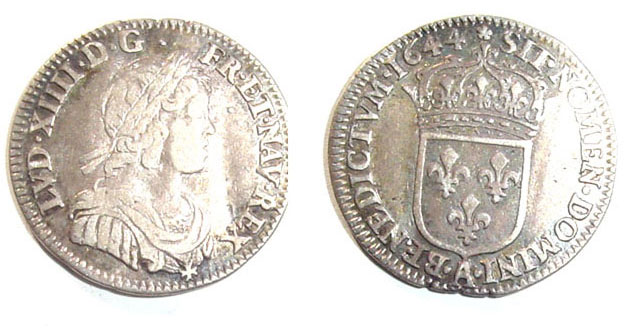 |
|
Pillar of the Community
United States
2120 Posts |
That coin Looks like an ECU to me. and if its 40-41mm it would be a 1 ECU, right, not a fractional ECU?
|
|
New Member
France
5 Posts |
|
|
New Member
United Kingdom
41 Posts |
ECU is what they call the French currency at the time. I think there is a fair bit of value to the collection he found. I am not an expert on French coins so anybody care to comment on value?
|
|
Pillar of the Community
United States
2120 Posts |
Quote:
ECU is what they call the French currency at the time Now I'm still learning about pre-revolutionary france, but I don't think this is quite true. Correct me if I'm wrong but; Yes, ECUs were used as a currency, but they were not issued as currency. SOLs, DENIERs, and LIVREs we're the currency of the time. ECUs were used as jetons which I think were used on a type of counting board. However since ECUs were commonly made of Silver, they were usable in purchase for goods at about a rate of 10 SOLs to 1/12 ECU and 44 SOLs to 1/2 ECU This is just my take in my broken search to try to understand ECUs better. *Edit* although taken from http://en.wikipedia.org/wiki/French_livre,it seems an ECU fits in between SOLs and LIVREs. So I'm probably wrong on my interpretation. Prehaps its a false association with ECUs and Jetons. Edited by Namachieli
09/20/2010 1:47 pm
|
|
Pillar of the Community
United States
2120 Posts |
I honestly can't wait to see what some of the experts say, cause this may answer a lot of questions for me.
SAP, I'm looking at you. ;)
|
|
Pillar of the Community
Luxembourg
588 Posts |
Ecu was the main French denomination during the reign of the Louis kings they were indeed
The gold coins were called Louis d'or and the small denominations were Liard and Sol.
According to Krause:
3 Deniers = 1 Liard
4 Liards = 1 Sol
20 Sols = 1 Livre
6 Livres = 1 Ecu
4 Ecus = 1 Louis d'or
I would wonder if this exchange rate was always respected in real life.
The 5 francs coins issued during the 19th century were also called ecu in memory of the large silver coins of old times.
|
|
New Member
France
5 Posts |
So does anyone have any idea what denomination the large 40mm silver coin above is?
|
|
Pillar of the Community
Luxembourg
588 Posts |
|
|
New Member
France
5 Posts |
And what would the 32mm coins be? and how much would that work out in modern day currency? Just trying to get a picture of who ever had these coins all them years ago and why he might have buried them under the floor! Thanks
|
|
Pillar of the Community
Luxembourg
588 Posts |
The 32mm coin is a half ecu.
I don't know about that time, but in the 19th century an unqualified worker had to work for about two days to earn 5 francs which had approximately the same silver contents.
Maybe just one important remark: do not try to clean the coins you have found! Cleaning can (almost) always been detected and will destroy more or less important part of the value.
The letter under the shield indicates where the coin has been minted.
A stands for Paris, L for Bayonne.
|
|
Pillar of the Community
United States
2703 Posts |
The 1663-L ecu is the scarce juvenile bust type. If it is in nice condition (VF-EF) without adjustment marks it could be worth a few hundred dollars. The exact value depends critically on the condition of the coin. 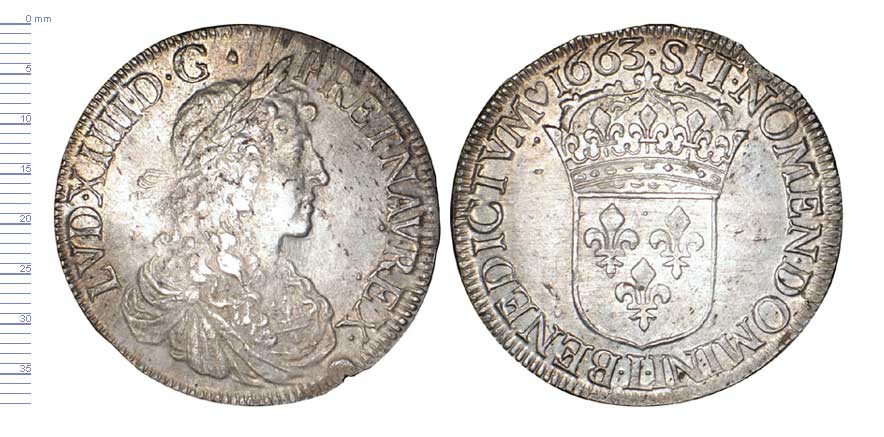 Patrick Guillard, a prominent dealer in Paris, has this EF-40 listed on ebay with a starting price of 540 euros (US$785.67). Note however that this is an exceptional piece. There are just a few trivial adjustment marks at 1h on the obverse and some remaining luster. Most ecus of this type do not come this nice and command this high of a price. Many have distracting adjustment marks (scratches made by the Mint on the flan before striking to adjust the weight) and are worth much less. In his book, George Sobin estimates the relative value of F:VF:EF for this type as 1:2:3. So if your coin grades Fine (F) without adjustment marks then it should retail at about $785/3 = $262. If your coin grades very fine (VF) without adjustment marks then it should retail for about $524. |
| |
Replies: 15 / Views: 15,996 |
|










 Posted 09/20/2010 04:50 am


