| Author |
 Replies: 23 / Views: 3,400 Replies: 23 / Views: 3,400 |
|
Valued Member
United States
487 Posts |
I have a few ASE that I bought at or below melt. They are toned pretty bad. Should one try to clean them or just leave them a lone? What would one use to clean a coin? Edited by rastatodd
10/30/2010 12:06 pm
|
|
|
|
Bedrock of the Community
United States
20049 Posts |
NEVER clean coins! Just leave them like they are.
|
|
Valued Member
India
265 Posts |
please dont clean coins
warm wishes.
|
|
Valued Member
United States
426 Posts |
Most of the time its better to leave them be, but if the toning is super ugly, spotty, crusty then you can always give them a quick dip in ez est. Please note that if you do it too much you can be left with a ugly dull grayish coin.
|
|
Bedrock of the Community
Australia
21792 Posts |
Here is a success but one in which I would NOT recommend!
Some years ago, I found in a junk box what was barely recognisable as a coin. I asked the dealer his opinion. He said that there was a vague possibility that it may be silver, and may be ancient, do I want to buy it? I said "OK" but how do I clean it for identification? I decided to buy it and take the gamble. It cost me the princely sum of $7 at the time.
The dealer said if I wanted to risk the complete loss of the item, he had a weak solution of hydrochloric and sulphuric acid mixture, and to place the item in it for a few minutes. After two minutes, it looked as if it may possibly be an ancient silver tetradrachm. He weighed it at about 13.5 grammes. He asked if I wanted to continue, I said "yes".
He diluted the acid solution down to about 20 to 1 to what it was previously, to slow down the reaction. This way, it would be possible to stop when it had been far enough. After about half an hour, his experience said to take it out of the acid.
He passivated it with a quick wash in a mild alkaline solution, rinsed with water and dried it.
The coin turned out to be a magnificent find; I still have it.
What is the coin? It is a silver tetradrachm of Ptolemy X11 in about nearly EF condition, and is worth perhaps $250 today.
|
|
Bedrock of the Community
United States
20049 Posts |
In that case there wasn't much else you could do. When coins are that encrusted there's little choice. I can't believe he did that for you, especially since he sold the coin to you. Why didn't he just conserve it first and then sell it for more money? LOL
I don't recommend anyone use mineral acids unless they know exactly what they are doing. Also, "Cleaning" heavily encrusted coins like this is exception and not the norm. Mineral acids WILL damage all coins!
|
|
Valued Member
 United States
487 Posts |
Thanks to all that have posted, it helps to ask if one doesn't know.
|
|
Bedrock of the Community
United States
20753 Posts |
Quote:
In that case there wasn't much else you could do. When coins are that encrusted there's little choice. I can't believe he did that for you, especially since he sold the coin to you. Why didn't he just conserve it first and then sell it for more money? LOL
I don't recommend anyone use mineral acids unless they know exactly what they are doing. Also, "Cleaning" heavily encrusted coins like this is exception and not the norm. Mineral acids WILL damage all coins!
 Of course on the internet anyone can say anything and it may or may not be exactly the complete or actual story. In that instense MAYBE. However, I too think it's odd that if someone knew how to fix that coin, then why not do it himself? Then sell it for a higher amount? Odd too that a coin dealer would have such an Acidic mixture available. In most instances where a coin is cleaned, it gets ruined. Not always but as a rule today cleaning anything old is a NO-NO. |
|
Valued Member
Greece
70 Posts |
Most of the times cleaning coins is not recommended but sometimes its a matter of preference or a must. But what one means by cleaning, it can be something innocent like the first four steps described below or the more heavy duty solutions that require to know what you are doing or else better don't try it at home!
First I would rub it with a velvet cloth piece that would remove fingerprints, easy dirt, etc... If still ugly, brush it with a toothbrush using soap and hot water, that would remove the more persistent dirt. If still not happy, rub it with your fingers using baking soda powder + few drops of water until it gets muddy. Soda will not damage the coin, only the dirt. You can also soak coins in olive oil for one or more days, I have tried this with excellent results with bronze/copper coins. Now for more heavy duty solutions and for those who know what they are doing, chemicals sometimes combined with a tool of some kind that can help remove that ugly spot that have become one with the coin. You can always practice with cheap coins and possibly master the art of cleaning coins after some effort studying and practicing, and money buying cleaners,tools,etc... Unless someone is a dealer, with few exceptions, I don't think he would bother too much with cleaning, especially with chemicals and tools, its boring and risky.
|
|
Bedrock of the Community
United States
12437 Posts |
Georgioscoins,
that may be good advice for cleaning crusty ancients but NONE of those techniques should be used on coins of a more recent vintage. Any type of mechanical rubbing will cause hairline scratches, especially with the use of baking soda(an abrasive).
|
|
Valued Member
Greece
70 Posts |
Baking soda is a very mild abrasive...
|
|
Valued Member
Greece
70 Posts |
Biokemist6, the ''NONE of those techniques should be used'' includes the use of velvet cloth and soap with hot water ?
Sometimes a coin with slight scratches is more pleasant to the eye than something that doesn't look like a coin at all.
|
|
Pillar of the Community
United States
3294 Posts |
More pleasant to the eye or not, those slight scratches are going to reduce the value.
|
|
Valued Member
Greece
70 Posts |
As a general rule this is correct but all rules have exceptions. nod2003, have a look at this coin and tell me if it worth more like this or with the green spot under Penny cleaned? 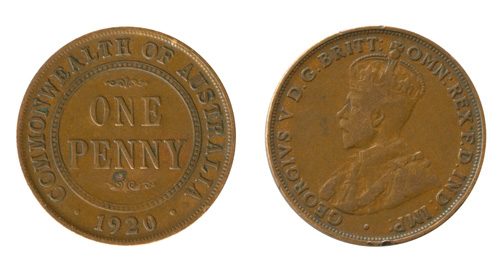 |
|
Bedrock of the Community
United States
12437 Posts |
Yes, a velvet cloth will still leave hairlines as would any other type of physical wiping of the coin. Soaps can also cause problems with a coin and should be avoided. You may consider baking soda to be a very mild abrasive but rubbing it on a coin is not much different than using 100 grit sandpaper. Regarding the 1920 Aussie Penny, that spot can be removed with wet chemical methods that will not harm the coin at all.
Remember that an ugly coin may not always be ugly if it can be treated with proper conservation but a cleaned harshly hairlined coin is damaged for life.
Edited by biokemist6
11/01/2010 5:38 pm
|
|
Pillar of the Community
Philippines
1156 Posts |
I clean my coins only if there is possibility of any baterial infection, moulds or fungi contamination 1. just dip it 5 secs in tepid mineral water and pat dry w/clean cotton cloth 2. then dip for another 10 secs in rubbing alchohol to rid any surface oils and bacteria and pat dry w/cotton cloth 3. repeat step 1 That's about it, a very mild surface metal bacterial cleaning, its a tropical hot place here and bacteria has a way of surviving in any surface  |
| |
Replies: 23 / Views: 3,400 |







 Posted 10/30/2010 7:25 pm





