| Author |
 Replies: 90 / Views: 6,318 Replies: 90 / Views: 6,318 |
|
|
|
Moderator
 United States
23522 Posts |
|
|
Pillar of the Community
 3660 Posts |
Thanks very much Dave....I had read the link before, and don't feel that either theory is even plausible.
I really do appreciate the image that you linked to, and feel that it is neither doubling of any type, or die wear... that is deliberate tooling of the die (or more likely the master die).... I believe that this was a primitive act of sharpening the details on a die (called 'touch up') after hubbing , except that is a pretty extreme case, and it seems to me that the engraver displayed a poor choice of gravers (or little skill).
|
|
Moderator
United States
23522 Posts |
I agree that neither of the theories presented in the link stand up to examination. Regarding the first, if you "shave" the sides of a punch, it chamfers the die. It doesn't "shelve" it unless you "shelve" the punch. Imagine how much work that would be.
The second is patently obvious - if you go over what you've punched a second time, moving the punch a little, the doubling won't be regular around the whole periphery of the device.
My working theory of die wear is rather weak, given the regularity of Longacre doubling mentioned in the article, but "Longacre doubling" is not always that nicely, neatly rounded. Nor did it cease in 1886, nor did it cease in 1869 when Longacre died. It's common on Indian Heads, seen on others, and not universal to any series or year.
The infrequency of finding it makes me think it was not a deliberate part of the production process. That, and deliberately adding it to a die would be an insane amount of painstaking work.
Not that my idea is stronger; my point is, I think this one's a mystery still awaiting a solution.
|
|
Pillar of the Community
United States
3076 Posts |
SO am I to understand in a quick over glance, that longacre doubbling is a term applied to an over 100 years ago process? or result in minting?
|
|
Moderator
United States
23522 Posts |
Generally speaking, Gene, it's called what it is because it appears on coins of Longacre's design. Some people are sure why it happens - I'm not one of them.
|
|
Pillar of the Community
3660 Posts |
Good points Dave... I agree with them all.... You have caused me to reconsider the tooling thing (not give it up, but reconsider)...  Yeah, what Gene said.... is this Longacre stuff still going on? |
|
Moderator
United States
23522 Posts |
Don't quote me, but if memory serves I've seen it associated with a Jefferson nickel someplace. Does an annealing process lead to metal of perfect structural uniformity throughout (to the effective depth of the annealing)? |
|
Pillar of the Community
3660 Posts |
Heh,heh, possibly, but I kinda doubt that might have happened in 1880. No, I think that I am sticking with the tooled master die thing.... I don't really think that it would taken that much time to do, or have taken that long either (given the appearance of the coin).... I doubt that Barber or Morgan did it, but possibly a young intern engraver? |
|
Pillar of the Community
United States
3076 Posts |
I have heard this term applied to many a denomination..as an exact accepted cause..yet even with the Morgan series which has all types of problems...why would this be new? or even so,, less understood and never applied to the morgan series...its like thinking of the new concept of "TRAIL DIES''''better and far know in understandings from the CBH dollars
|
|
Pillar of the Community
3660 Posts |
I was pretty sure that I saw the rim Cud thing without an associated crack..... it just took me a while to remember where.... (one of my own coins).... This one has a clashed/rotated reverse as well.... pretty neat coin, all in all. 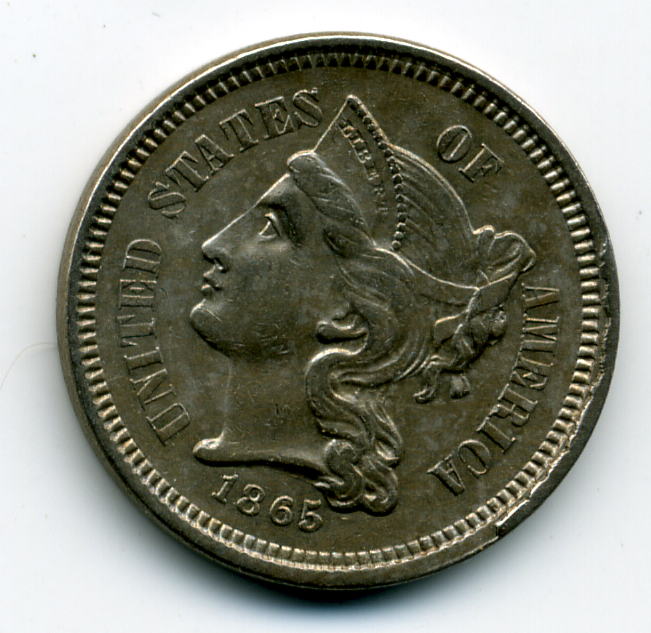 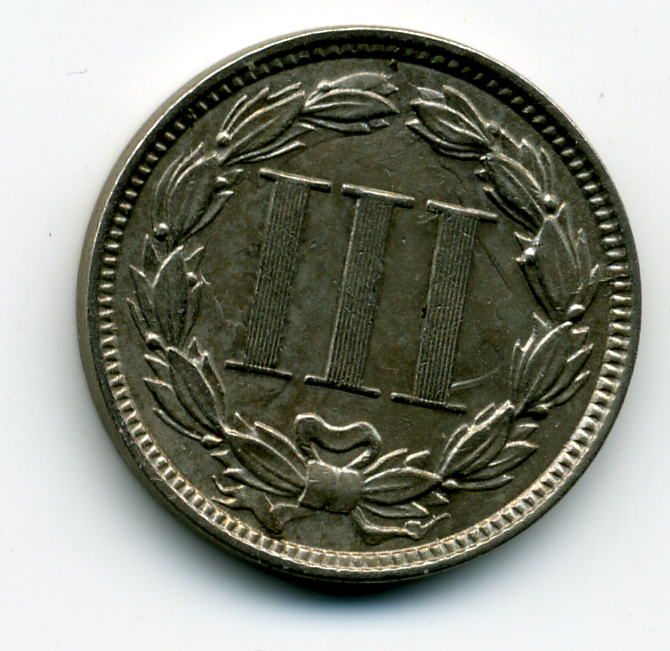 |
|
Moderator
United States
23522 Posts |
Unsurprising to see on a 3CN. Nickel coins seem particularly susceptible to rim crumbling. The only examples of rim crumbling I own have been smooth-edge types like Jeffersons and Lincolns (also known for it). I'd like to see a heavily-crumbled reeded-edge to see if the collar was involved (or perhaps causative).
|
|
Pillar of the Community
3660 Posts |
I doubt that the reeding would have been much of a factor.... the precise inside dimensions of the collar bottom versus the precise outside dimensions of the die rim would be the critical factors in my judgment.
I'll bet those smaller dies (like the silver 3 cent pieces) must have been relatively fragile.
|
|
Pillar of the Community
3660 Posts |
Quote:
a heavily-crumbled reeded-edge I am pretty certain that I have seen them.... I'll be on the look out. |
|
Moderator
United States
23522 Posts |
Quote:
I am pretty certain that I have seen them.... I'll be on the look out. I know they exist - just haven't been able to study them in any organized fashion from simple photographs. Just to throw out an idea: What would a catastrophic collar failure - fragmentation - do to a die which suddenly struck a piece of the collar which had intruded into the striking area? Might it break off a piece of the die? Might it form "denticle-like" impressions on a die? |
|
Pillar of the Community
3660 Posts |
Well, I thought that I would be sure to find something in the ongoing epic Morgan dollar thread.... but I didn't.... so probably the best thing for me to do is capitulate right now, and consider my idea as just more foolishness..... I saw lots of stuff, but upon blow up, it was probably just PMD.... I did find a couple that were promising, but not on any grand scale.... The reverses of Jeffreyice's 1883-O, and SeatedNut's 1880 v-6... that is the best I could do. As far as the broken collar thing goes, I have considered the possibility of just such a thing before, so I don't really need to rethink it too much now.... I envision the collar as a ring with very slightly protruding vehicle radiator like fins (vertically) surrounding the inside of the ring.... My guess would be if a piece of that fell into the strike area, that not much of an impression at all would be transferred to either die, as the piece would be embedded into the coin that was being struck (I have seen coins with metal fragments embedded in them).... If no planchet were present, I think that the collar fragment would leave a nondescript gouge rather than denticle like impressions in either die, as only denticles should leave denticle like impressions in a die.... 1878-S v-17 for example.... I don't care who or how many folks say otherwise, those impressions were caused by a die fragment of denticle impressions caught between planchetless dies.... there is no other possibility, not tilted dies, not drunks banging dies together, not any other notion of nonsense. |
| |
Replies: 90 / Views: 6,318 |








 First Page
 Previous Page


 Posted 01/03/2011 11:59 pm


