| Author |
 Replies: 41 / Views: 8,175 Replies: 41 / Views: 8,175 |
|
|
|
Pillar of the Community
 United States
2168 Posts |
I know, but the only thing is that back when the Kennedy halves were authorized, it was a mad rush to do so. I do want to find out if this coin is real though. Like I said if a fake, a perfect fake, mixed with 1964 halves in basically 'junk silver' Hopefully I can find out soon because it surely sounds like a fake or very rare misstrike. Thanks to all of you for the help and advice! |
|
Pillar of the Community
United States
3077 Posts |
i wish ya luck angel
BTW did I say welcome to the forum ?
|
|
Pillar of the Community
United States
2168 Posts |
The reverse of this coin appears to be exactly as pictured in this forum. I didn't know there were 2 types. Hopefully I will have my answer soon.
|
|
Pillar of the Community
United States
2168 Posts |
Thank you for the welcome! This is a very interesting and informative website, so regardless I will be here looking at others view on investing/prices/coins and maybe even I will take a look at the stamp area. Thanks again for the help.
|
|
Pillar of the Community
United States
3077 Posts |
cant wait to see the picture hope the kids can help ya out
|
|
Pillar of the Community
United States
2168 Posts |
Yes, but to be honest,a photo of the front will look like a 1964 Kennedy half and the reverse looks like a Franklin half. Anyway, there was a post of 2 different reverse sides for the Franklin. I didn't see that when looking here at the pictures of Franklin halves. Just wondering if anyone else knows what this is about. |
|
Bedrock of the Community
United States
12437 Posts |
Look very closely at the inner rim on both sides, you should be able to find a seam from the machining work. This is just one variation of a trick coin, Kennedys are frequently used but I have never seen one mated with a Franklin, the other side is usually a foreign coin as to alleviate any confusion over an illegitimate "error".
|
|
Pillar of the Community
United States
2168 Posts |
Thanks. I will when I can with a stronger magnifying glass. If it is cut and put back together, will the cut marks be on both sides or just one? Just wondering. If a 'put together coin' is there any value or is it less than an actual half? Just wondering. Thanks
|
|
Pillar of the Community
United States
7629 Posts |
I will try to clear this up as much as I can with a detailed post...
1. There is only about a 0.000001% chance your coin is genuine as struck from the U.S. Mint. The remainder of the 100% is that your coin is a 'put-together' coin as others have described. The reason why I can this with certainty is that it has been nearly 50 years and not one single other example exists...coins are struck by dies that are affixed to a press, and generally strike tens of thousands of examples without the machine being touched. Even if there were only 10,000 strikes with the same configuration as when this coin was struck, where are the other 9,999? Given that this would be a completely unique example of a yet unheard-of error type (mule with different year's type), it is immediately VERY suspect. Anyone who HAS been around coins for a number of years would know there are no confirmed cases of a United States issued coin with major types on the two sides that were not minted in the same year.
2. There's no sense in getting into minor variations or exact weights. This sort of thing only serves to confuse the OP and cause them to go through more than is necessary - basically the 'type' of the reverse doesn't make any difference at all, and any machine put-together coin 'could' weigh the same amount as a normal coin or it could be of a different weight. Weighing it proves nothing at all.
3. The coin was put together, pretty much 'end of story'...the ONLY direction this really needs to go for the time being is educating the OP in what to look for in a 'put together' coin. If anyone here has good, close-up photos of a few 'put together' coins, now would be the time to post them.
4. There is also no sense in having a coin dealer look at it. Most coind dealers don't know much more about this than an average collector, to be quite honest - they get way too much credit for their own merit. In fact, over 75% of all dealers know LESS about coins than the average collector. Most are just widget sellers, and if there's not profit or gain in it for them, they couldn't care less.
This entire post is meant in the nicest way possible to say the following:
The OP is not a coin collector - or at least is a novice coin collector, and is respecfully-so 'technically challenged'. While there is nothing at all wrong with that, they do not know what they have, don't have the equipment to image it and came here for advice - expecting to get good advice...or at least hoping so. Turning them to dealers, scales, and trying to teach them about types is just leading them on a wild goose chase.
Really - this follows under the heading, "if it walks like a duck, quacks like a duck - don't test it to see if it's a chicken...it's a DUCK". Now just help the OP figure out how to SEE that it's a DUCK.
|
|
Pillar of the Community
United States
7629 Posts |
Now, to the OP (original poster)... Machined coins are USUALLY two different coins. One coin is hollowed out to make a cup, and the other coin is shaved down to fit in the cup. This can be done with a level of precision that requires magnification to see...not an electron microscope, but at least a good 5X loupe (magnifier). So to answer one of your questions, the seam would usually only be on one side. An answer to another one of your questions is that if both coins were the same condition at the time they were worked, the result would remain together under the same environmental conditions thereafter, and would tone and wear the same. Since both Franklin and Kennedy (1964) half dollars were 90% silver made from the same size and weight blanks, there would be no other expected inconsistency in their surfaces when compared...like color, how they tone, etc. Another really good test to see if the coin is genuine is that both Franklin half dollars and 1964 Kennedy half dollars were minted using blanks of the same weight, metallic composition, size and thickness. Being that, they will "sound" - "ring" the same on a table. If you have a number of other 1964 Kennedy half dollars or ANY Franklin half dollar of about the same condition as your suspect coin, there's a good, quick test you can conduct. Let your suspect coin and another - normal looking - coin settle on a table and listen to them. The 'put-together' coin will definitely sound different. Part of this is the loss of solidity in the coin - it's basically two pieces, and the hollow will make it sould different. When looking for the seam between the two parts, look right at - exactly right at - the inside of the raised 'rim' of the coin. If there is ANY fold, crease, hollow, or line there that sinks into the coin - there's your seam. Be sure to check both sides for this, because we don't really know which is the cup and which is the filler...and it could well be either. If there ABOSOLUTELY is NO seam at all, and the coin rings the same (same loudness and same tone) as any other 1964 half dollar - get back with us. Something else is going on that needs to be investgated. Edited by coppercoins
02/28/2011 5:18 pm
|
|
Pillar of the Community
United States
2168 Posts |
Thanks for the information. The sound test is true, the coin sounds different. However, I did look at it with a 10 power loop and compared to actual Kennedy and Franklin and I'll tell you the back is perfect, the front looks perfect as well I tried to study them together using the magnification and except for about 1/4 inch on in the 11 o'clock position around the Kennedy side a small scratch looking and very slight mark- that is it and hardly noticable without the loop. Thanks for your help. Any idea on the value of this such as same as a regular coin or more/less? The coin has very little wear, if any. Thanks.
|
|
Bedrock of the Community
United States
62064 Posts |
Here is what they look like taken apart: 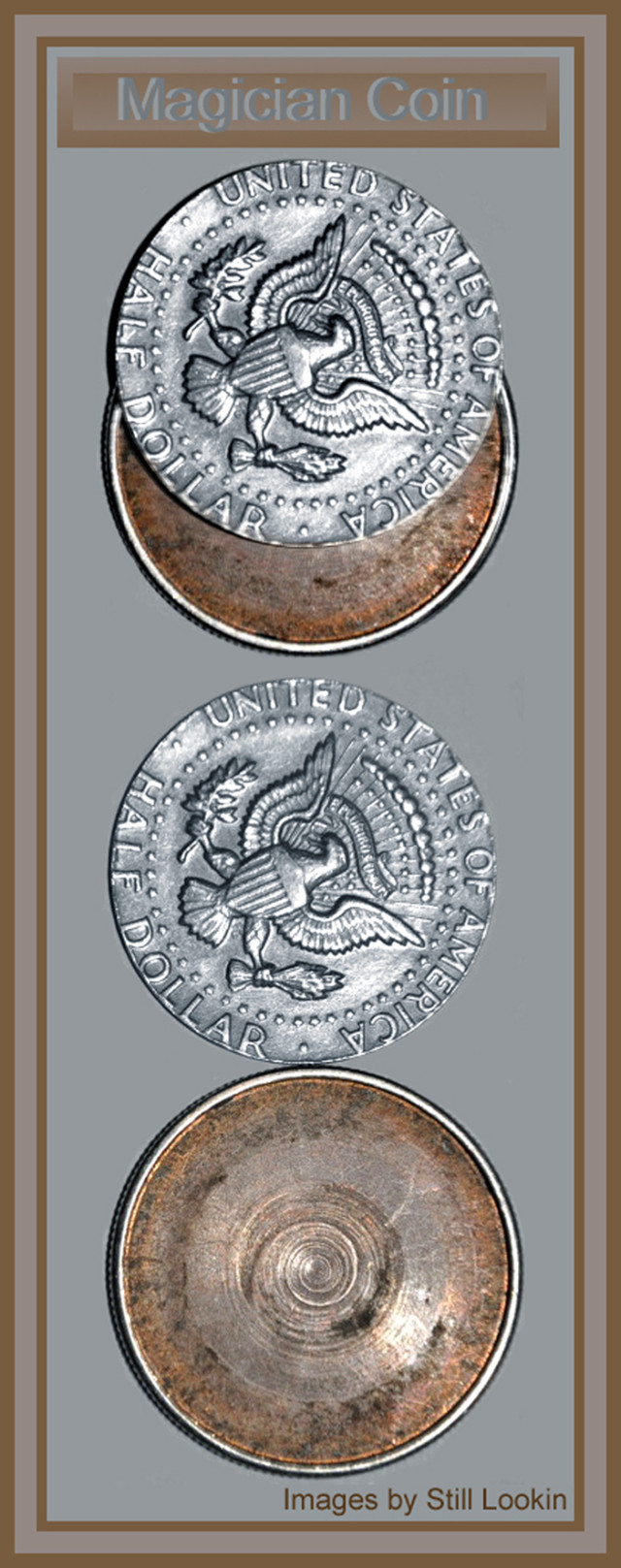 You can see the rim is present, but next to the rim is that area the add on can be detected. |
|
Pillar of the Community
United States
2168 Posts |
In reply to the discription of me, no I really haven't been collecting coins since back when silver was taken out of circulation. Over the years after 1965 I obtained many silver coins and kept them all. I really didn't keep up on mistrikes etc and when I saw this coin in the mix the other day decided to see if such errors were out there. I did have a few rolls from back when the Kennedy half was minted and just opened those a few months ago. I'm sure there are many out there still in the original bank rolls like mine. Anyway thanks for the help on this, but my question on value of this 'tampered with' coin was not addressed. Does anyone have an idea on its worth? thanks again to all. |
|
Bedrock of the Community
United States
12437 Posts |
At a minimum, you have silver value since it would have been made from two genuine half dollars. However, it should be worth a bit more than silver value as a trick coin/novelty- maybe $20 or so.
|
|
Rest in Peace
United States
9104 Posts |
Quote:
There is also no sense in having a coin dealer look at it. Most coind dealers don't know much more about this than an average collector, to be quite honest - they get way too much credit for their own merit. In fact, over 75% of all dealers know LESS about coins than the average collector. Most are just widget sellers, and if there's not profit or gain in it for them, they couldn't care less.
As an experienced dealer who used to be fairly active in errors, I'm not offended by this comment in the least. It's bad enough when someone comes in with some fake treasure that they got an "expert" opinion on from their neighbor, a minimum wage bank teller or the like, but it's REALLY a PITA when they were told by a coin dealer it "could" be genuine (which always turns into "is" genuine) instead of admitting ignorance. Especially so when they call you a ripoff when you tell them Confederate notes don't say "facsimile", because their neighbor told them it was worth thousands of dollars. I'm waiting on a return call from a lady with a fake Baldwin $20. How do I know it's fake? Her mom, who was obviously not a serious collector, gave it to her 70 years ago. Anyone care to guess the odds of a frequently reproduced (two on ebay this morning) extremely rare coin just happening to be the only coin mom had, thousands of miles from where it was made, and mom not realizing it was worth five figures when she gave it to her dottir? Back to the OP, it's a variation of the scotch and soda magic trick, a Franklin plug in a Kennedy shell, and if you'd drop it and a couple other halves four inches onto a hard surface, I could tell you which one it is blindfolded, because it has a gap inside it. I leave you for now with one of my favorite questions: "Yeah, but how much would it be worth if it was real?" (Usually about a fantasy of something that never existed in the first place). Well, gee, I'd trade you even up for my 88 Chevy, if it was a new Rolls Royce. Once in awhile, this answer sinks in. |
| |
Replies: 41 / Views: 8,175 |





 First Page


 Posted 02/27/2011 10:51 pm





