| Author |
 Replies: 16 / Views: 11,656 Replies: 16 / Views: 11,656 |
|
Valued Member
United States
347 Posts |
Forgive my excitement on this as well as many others and thanks for the input guy's! I'll tell you the who , what, where, how much, and God knows why later, but for now, all I need is the ansewer to this : Kennedy half dollar, - 'Silver tone surface's, - All 'Silver' edge, - Weight - 11.5 gr. . Does'nt add up to me. Scale's checked, checked, and checked again. also checked w/ a 1gr. weight. What , if anything, should I think? I am in the know of what silver coins properties are, and this color and edge stops in '64 on all of my silver coins ! ! Oh, just comparred it to the 57 D Quarter I just picked up and the thickness is the SAME. sorry again. I'm thinking hard on this one. It's a 1969 D by the way.    Edited by joe finds
11/01/2009 02:28 am
|
|
|
|
Pillar of the Community
United States
2529 Posts |
What you have is a 40% silver half dollar! the norm for 1969! 1964's are 90% silver and weigh 12.5 grams, 1965-1970 are 40% silver and weigh 11.5 grams! Silver was retained at a reduced rate only in half dollars during those years (although you can see the darker copper colored core on the edge of alot but not all of the coins) Us half dollar roll searchers still find many of these. This year alone I've gathered over 450 from circulation and searching rolls! With a melt value currently at $2.40 each you can see why so many of us roll search half dollars!  Edited by ratman4762
11/01/2009 01:26 am
|
|
Pillar of the Community
United States
3507 Posts |
As stated, a normal 1969 D half that is a 40% overall silver composition. There is an outer portion of 80% silver bonded to an inner core that is just over 20% silver. Both portions are alloyed with copper.
In any case when the math is done, the overall composition is 40% silver. It should weigh 11.5 grams. This is the norm from 1965 to 1970. There are some later dates that were also made for some sets that are of this composition too. The silver clad bicentennial 1976 S uncirculated version is an example.
This is a case where a good book would help as many do give you the weight of the individual coins.
Thanks,
Bill
|
|
Valued Member
 United States
347 Posts |
So, page 166 in Ken potters book , where is says "1965 -1970 Weight: 11.64 Grams" is incorrect?
|
|
Pillar of the Community
United States
2529 Posts |
Don't know about that Joe. PCGS website says 11.5. Even if it was 11.64, 11.5 would be an acceptible weight variance
|
|
Valued Member
United States
347 Posts |
Can anyone show me the 'Edge' of a 1969 D. or should I ask "Do you see copper in the edge of this coin from this year"?
|
|
Pillar of the Community
United States
2529 Posts |
AS I previously stated, you can see copper on some but not all of the coins. Actually IMO you can see the copper on alot if not most of the edges. I get a little bummed out when I crack open a roll and spot the silver edge hoping for a 90% and turns out to be just a nice 40%.
|
|
Pillar of the Community
United States
2529 Posts |
Yep! a 40% Kennedy half dollar! If I saw the edge of that in a roll I'd be hoping it was a 90%. |
|
Pillar of the Community
United States
1359 Posts |
The edge is fine, thats the way the edges looked up to 1970. Now there is a VERY RARE 1971 with the same composition and weight but the edge will show the copper too, make sure you overlook and weigh the 71s
|
|
Bedrock of the Community
United States
62064 Posts |
Here is a way to do a silver test and it only cost you a single layer of facial tissue. 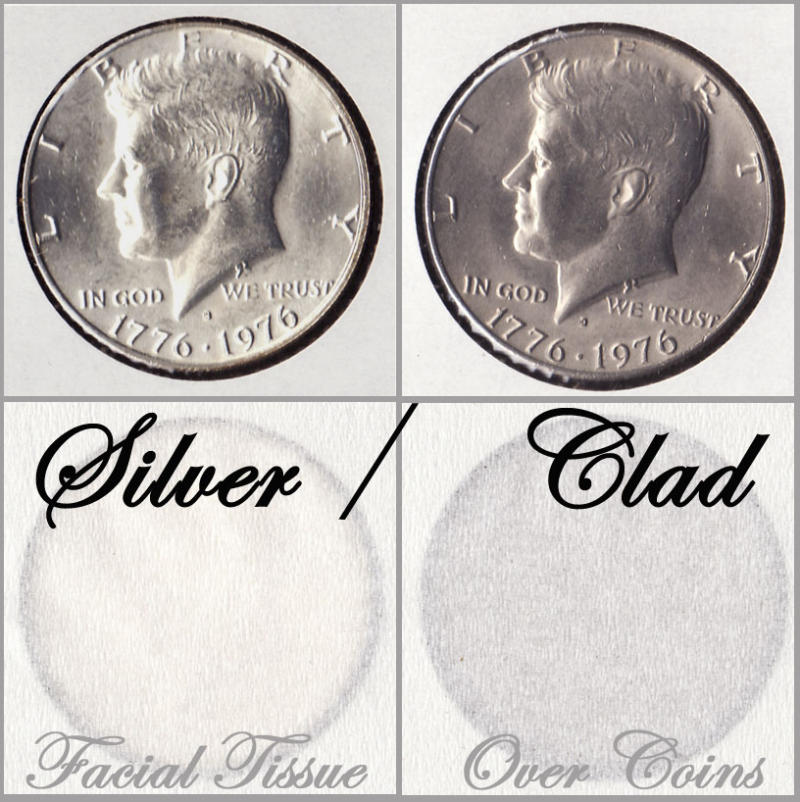 ADDED: On Statehood Quarters some edges will look like that. Some are silver S mints, but some P & D mint coins are plated with another substance buy the bottom feeder TV coin outlets. Some are spent. Platinum or gold plated. (There not, just BU coins plated) Edited by coop
11/01/2009 11:50 am
|
|
Pillar of the Community
United States
1359 Posts |
I knew that wax paper worked but didnt know the tissue one. Thanks for that because I dont have any wax paper!!
|
|
Pillar of the Community
United States
2529 Posts |
I never really understood the need for the tissue test. Anybody can learn quickly to easily spot the difference (I was 10 years old when I learned) and the tissue test can't detect if a coin has been plated. |
|
Valued Member
United States
457 Posts |
That tissue test is something huh? I would most likely weigh the coin before I applied the tissue test! Then I'd try the tissue. Who, where and how did someone come up with the tissue test anyway? It has struck my funny bone and I can't stop laughing. It is rather ingenious. I take it that the wax paper reveals similar results. I'll be sure to keep this in mind in the future. |
|
Bedrock of the Community
United States
17884 Posts |
When the 40% coins are new the 79% copper 21% silver center core is close to the same color as the outer layers. It doesn't really become clearly visible until the copper in the alloy has oxidized some. This often does not happen until the coin has had some handling/wear.
|
|
Pillar of the Community
United States
1348 Posts |
|
|
Rest in Peace
United States
9104 Posts |
a drop of nitric acid will bubble up green on a 40% coin edge. not recommended, but down and dirty.
|
| |
Replies: 16 / Views: 11,656 |








 Posted 11/01/2009 01:24 am


