| Author |
 Replies: 22 / Views: 4,349 Replies: 22 / Views: 4,349 |
|
|
|
Pillar of the Community
United States
7629 Posts |
Don't have much time to dive into this full-force right now - I have a family wanting me to spend time with them... A die dent, while very minor and acceptable and not really any sort of error, variety, or die variety, would most easily be calssified as a die error since it is something that happens to the die after it is hung for use. A die variety is known to exist on the die during the creation of the die, thus has to be on the die when it is first hung on the press to make coins. Die errors include clash marks, overpolishing that removes devices, Cuds, and other irreversible things that "occur" to the die...which is THE difference between die errors and die varieties. Die errors happen to otherwise normal dies. Die varieties are not normal when they are made. Don't paint it with too broad a brush - just because it is narrowed down to a die does NOT make it a die variety. |
|
Valued Member
 United States
213 Posts |
I had said let someone who is schooled in logic group these numismatic terms and definitions, but the following is even better. I want to past along an observation from a zoologists friend who read my post. After some thought she said " in the accepted Numismatic grouping, having Cuds, Clashes, Abrasions, Die cracks, Die Dents, Die Gouges, and Die Chips grouped in with Errors, is a Zoology equivalent to grouping Whales in with Fish. Fish are vertebrates that live in water and breathe with gills. Whereas Whales are marine mammals that live in the ocean and breathe air. One breathes water and lays eggs, and the other breaths air and gives birth to live young". In the case of Cud, Clashes......etc., these are all specific to a certain Die, whereas Errors are only specific to the coin itself. The Danester |
|
Valued Member
United States
213 Posts |
I mentioned Ron Pope's new Abraded Die Variety book, and that most Buffalo nickel Collectors consider these as Die Varieties. 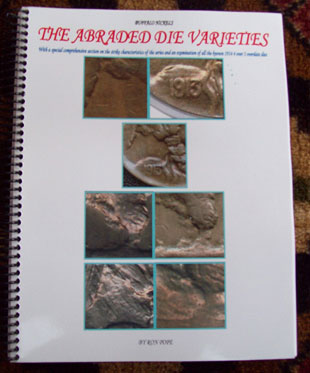 Now, consider VAM'ers, they also treat Cuds, Die Cracks, Die Dent, Die Chip etc., as Die Varieties and give them VAM #'s. The one below is 1880-P VAM-1C discovered by George Powell, July 2002. And, maybe better discribe as a Die Dent in this case. 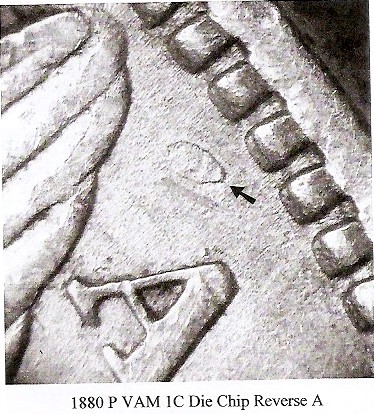 Anything that identifies a specific die (DDO, RPM, Abraded Die, Die Crack, Die Chip, Die Dent etc.) is like DNA or a finger-print and qualifies as a Die Variety (or Production-Die Variety) - it's repeatable every time the Die strikes a planchet. The Danester |
|
Pillar of the Community
United States
7629 Posts |
I'm not sure how to help further. You seem to fail to understand that die varieties are mistakes made during the die manufacture process. Die errors are something that develops on the die after it is placed into use making coins. Die varieties are there before any coins are struck. Die errors occur during the striking process. The difference is night and day.
It makes perfect sense to me that a non-collector would not understand the difference, just as any collector could not understand the difference without first understanding the coin making process employed by the mint. That understanding of the minting process should actually be the prerequisite before arguing points that honestly have no real validity.
The primary reason WHY they are so different is that it boils down to something that happens with tools in a machining process without further inspection (die errors) and something that happens during the process to create the tools, which are very closely inspected before they are used (die varieties). EVERY die is inspected under a loupe or microscope before they are placed into service. They are not looked at again until there is a problem. Obviously one could have easily been prevented, and the other is actually expected to happen.
Before attempting to classify a coin as a die variety or a die error, one simple question clears the whole thing up - is there a chance that the die that minted the coin was indeed a normal die at one time and struck coins that were unidentifiable as anything other than completely normal? If the answer is yes, then you have a die error (if what you have is even significant enough to classify as an error at all). If no, then it's a die variety.
|
|
Valued Member
United States
213 Posts |
Chuck, all that you say is correct, and it's not that I don't understand the accepted definitions. My contention hear is grouping like things, and a couple new terms that if really thought-out "back when", might have been as I suggest. If we were to sort a master group {Set} of balls that were painted or not painted, and made of iron or rubber. And, then define the property of bouncing as a key feature, where all rubber balls go into a single group {Sub-set} regardless if they are painted or not. Then we would have two other groups {Sub-sets} - 1.) Painted iron balls, and what's left over 2.) Non-painted iron balls. In the case of or current accepted numismatic groupings and terms, we have "bouncing balls" mixed up with iron balls. I'm defining the key feature in the group sort as anything that is specific to a certain Die - that's the "bounce" here. After all, that is why we all use our Loupe to look at coins to see the Die "DNA" and "Fingerprints". That's the real rush - it is for me anyway. The rubber balls are then our Die Varieties and Production-Die Varieties. To continue the analogy, the painted iron balls are the Types (Type, Sub-Type, and Minor-Type), and what's left over, the non-painted iron balls are the Errors (Planchet and Strike). I am not disagreeing with what you are saying, I've studied the die making process... you are quoting the current numismatic scripture, and it's all correct. I am saying the concept of "Specific to a Die" (flaws and accidents) is the key feature - the Die Variety or Production-Die Variety. And, maybe scientifically we can do it better - our groupings and terms. Also, when I took a tour of the Denver Mint many years ago in the late 1970's, I saw a foreman walk over to a coin hopper and check the on-going production with his Loupe. Dang! That's probably why they pulled the 1916/1916 DDO Buffalo nickel Dies so quickly. I don't think I can add anymore on the subject. I'll let others give their opinion. I hope this at least encourages everyone to put on their numismatic thinking caps. If you agree with me, I'm pretty sure we will be like those whose said birds were dinosaurs early on.  The Danester Edited by Danester
04/19/2011 4:35 pm
|
|
Bedrock of the Community
United States
62064 Posts |
Your putting too much thought into cataloging common stuff that no one would buy. You time might be better spent on searching for the stuff that others will buy.
|
|
Valued Member
United States
213 Posts |
Coop, well your post was a real "buzz-kill". No replys in the last 11-Days - you really know how to kill a thread. lol  Here is something I think we all can agree on is wrong. I found this quote on the pcgs web site - http://www.pcgs.com/articles/articl...d=313&type=1" Bruce Amspacher - September 10, 1999" " Mint errors. The term encompasses a wide range, and is frequently misused to describe coins that aren't really errors at all, but varieties that were intentionally made. For instance, the 1942/1 Mercury dime is a die variety, but not a mint error as there is no error involved: it was deliberately created. The 1955/55 Doubled Die Lincoln Cent, in contrast, was minted by accident and fully qualifies as a true mint error. There are some coins that stretch the boundaries of mint errordom (to coin a word)......." This writer used another definition to separate errors from die varieties. He says die varieties are intentional, while errors are accidents. He then goes on to give examples with questionable statements of what is intentional and what is an accident. The Danester |
| |
Replies: 22 / Views: 4,349 |
To participate in the forum you must log in or register.
Disclaimer: While a tremendous amount of effort goes into ensuring the accuracy of the information contained in this site, Coin Community assumes no liability for errors. Copyright 2005 - 2026 Coin Community Family- all rights reserved worldwide. Use of any images or content on this website without prior written permission of Coin Community or the original lender is strictly prohibited.
Contact Us | Advertise Here | Privacy Policy / Terms of Use
|
| Coin Community Forum |
© 2005 - 2026 Coin Community Forums |
| It took 0.25 seconds to rattle this change. |
 |
|








 First Page


 Posted 04/18/2011 04:05 am


