| Author |
 Replies: 18 / Views: 2,958 Replies: 18 / Views: 2,958 |
|
Valued Member
United States
184 Posts |
|
|
|
|
Pillar of the Community
United States
4132 Posts |
MD is Machine Doubling (also known as MDD or Machine Doubling damage.) It means the doubling occurred during striking of the coin. It is very common, so it's usually not collectible unless there's something particularly spectacular about it. If anything, it reduces the collectible value of the coin because it's considered a poor quality strike. DDO or DDR is a doubled die. The doubling happened when the die was made, creating a collectible variety. |
|
Valued Member
 United States
184 Posts |
I perfectly understand that. But how do you know the difference when looking at the coin? HAHA I know I know put them on here lol. Any good details or hints to look for?
|
|
Moderator
 United States
196469 Posts |
|
|
Valued Member
United States
200 Posts |
Familiarize yourself with shelving vs. notching, key determinant. not that easy to figure out, but if you look at examples of each, you'll begin to see the differences. Notching determines {at least} a true DD, where shelving denotes MD. Coppercoins' post really helps.
Edited by Tam
07/18/2011 6:10 pm
|
|
Valued Member
United States
184 Posts |
great resources and explanation thanks tam and jbuck.
|
|
Pillar of the Community
United States
4132 Posts |
Edited by CaptainFwiffo
07/18/2011 6:09 pm
|
|
Valued Member
United States
184 Posts |
haha what the heck. I've never seen that before. That is pretty sweet.
|
|
Pillar of the Community
Philippines
606 Posts |
Doubling in MD is flat vs doubling in either DDO / DDR which are extra, moderate and light in thickness with heavy, moderate to light notchings and separated lines.This is only my 1 cent opinion. Yours maybe different. |
|
Pillar of the Community
United States
744 Posts |
this is one of my favorites..... I have been told that chattering or a vibration occurs as the planchet is being struck that creates some Machine Doubling.... 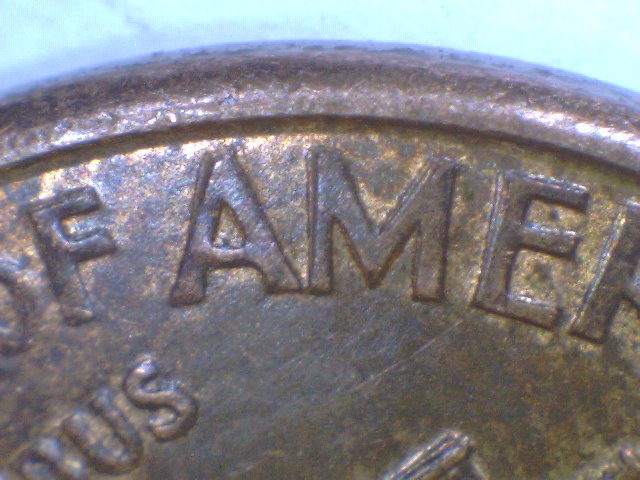 |
|
Valued Member
United States
184 Posts |
haha grrr I went through a lot of coins thinking I had some DDO but now I'm thinking most are MD. I'll have to get a closer look and probably gotta buy something to help me get a closer look. |
|
Valued Member
United States
184 Posts |
That is a good pic of MD wild bill.
|
|
Pillar of the Community
United States
2651 Posts |
This is how I understand it...Both are a type of Doubling...Machine Doubling happens when the dies move and cause the doubling...this causes the flat shelf....Doubled-Dies are actually already on the dies (not sure how they get there) but when its struck...there is no flat shelf...the doubling is the same thickness on both doubled parts.....now I will read all the above links! lol....
|
|
Bedrock of the Community
United States
62064 Posts |
Jayman: The dies are hubbed to place the design on the die. Before the single squeeze process the dies were annealed and pressed with a hub. They were allowed to rest a day and then hubbed again. Some dies are hubbed a few times others like the larger dies may be hubbed as many as 10 times. The die may have a different hubbing from a die that was not the same hub as used before. Or the hub may have hubbed many dies the day the firest die is created. The hub may have changed shape (warped) or the devices are now distorted from hub wear. When a die is made, they just don't make one die. Hundreds could have been made. The second hubbing could hae rotated from the first hubbing. So each die might be affected or just one die could have been affected. These should be caught when a sample is struck and observed. SOmetimes they are missed and started production. 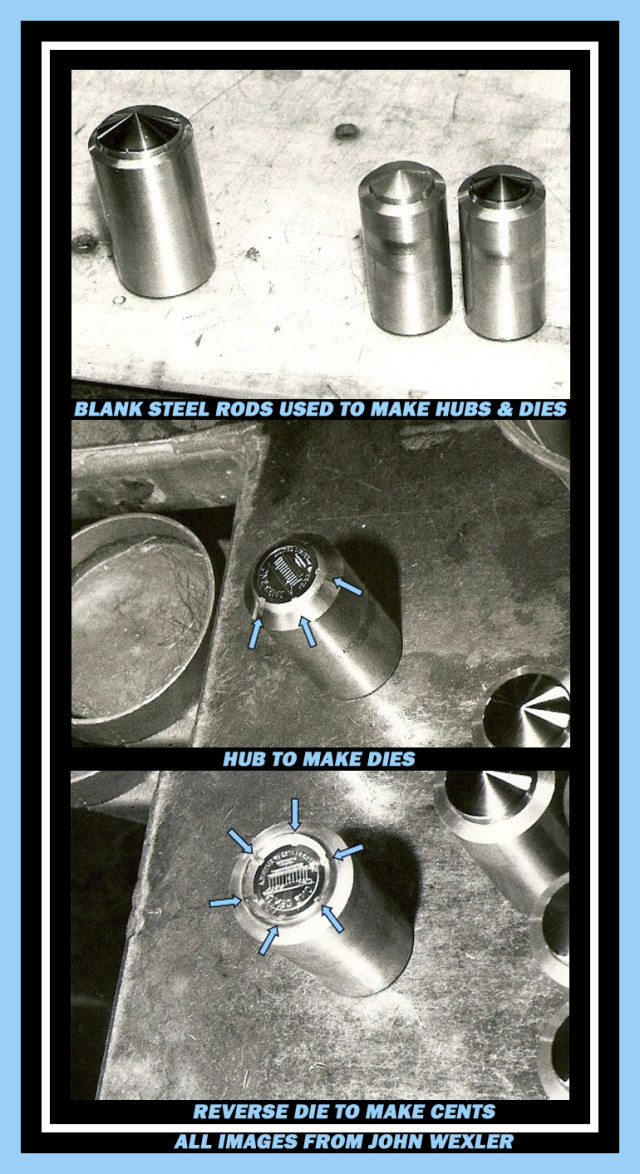 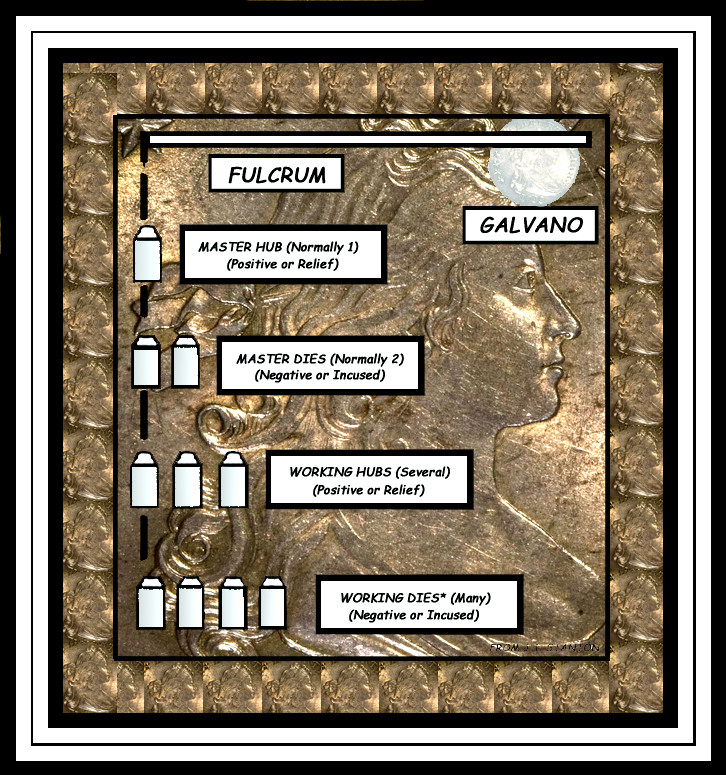 |
|
Pillar of the Community
United States
2651 Posts |
Coop-- ...ohhhh...now I get it!
|
|
Bedrock of the Community
United States
17884 Posts |
Coop, in that last picture, "reverse die used to make cents", that die is not finished yet. It now is turned on a lathe which cuts it down removing the mating notches and giving it a neck that fits inside the collar. It would be helpful to add a picture of a finished rev die. Even better would be pictures of both an anvil and a hammer die so you can see the differences between them.
Edited by Conder101
07/20/2011 4:47 pm
|
| |
Replies: 18 / Views: 2,958 |







 Posted 07/18/2011 5:35 pm





