Good question on an older coin Shadow. I don't know either but did a little research and came up with these comments. I don't know if any or all apply to an older minted coin or if the minting of non-modern proof coins were struck similar as today's modern proofs, but they seem to have some merit.
Perhaps comparing yours to a known proof might help.
"Strike - Proofs tend to be somewhat sharper than business strikes. In fact, most proofs are fully struck. There are a number of exceptions however. The most common exceptions in the
Morgan dollar series are the proof issues of 1891, 1892 and especially 1893. These dates are often found weakly struck in the centers.
Edges - Most proofs will have either square edges, or wire edges in the case of some matte and Roman finish proofs. Business strikes usually do not have square or wire edges.
Die Variety - Proofs were usually struck from one or two pairs of dies, and these dies were often used solely for proofs. Therefore, any coin struck from proof dies is at least somewhat more likely to be a proof. Die variety, while not conclusive, can be an important factor in determining proof status.
Lint Marks - Proof dies and planchets were usually polished with soft cloths. Occasionally, pieces of lint would adhere to the die or planchet prior to the striking process. Therefore, lint marks are fairly common on proof coins, yet rare on business strikes.
Lint marks are discernible from scratches because they are more even and uniform in intensity. They tend to be more curved than scratches. Furthermore, unlike scratches, they aren't surrounded by displaced metal.
If you aren't sure if a coin is proof, and it has one or more lint marks, the chances are good that it is a proof."
Jim










 Posted 10/03/2011 09:15 am


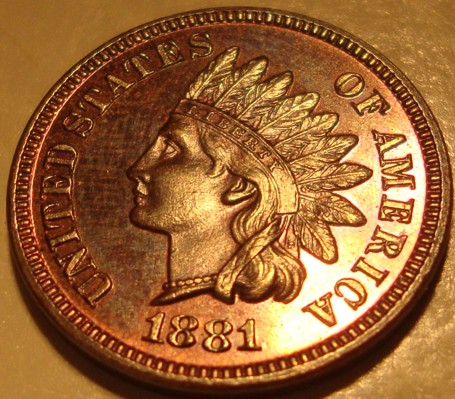
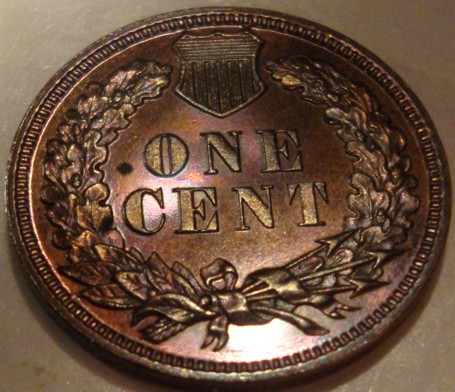
 Thats a beauty.


