|
This page may contain links that result in small commissions to keep this free site up and running.

Welcome Guest! Registering and/or logging in will remove the anchor (bottom) ads and the security checks. It's Free!
To participate in the forum you must log in or register.| Author |
 Replies: 54 / Views: 2,537 Replies: 54 / Views: 2,537 |
|
|
|
|
Pillar of the Community
Canada
6244 Posts |
For me it is Interesting how the back and forth is developing. You dispute my theory? Your opinion and I respect. the last two posts give you a really good way to follow. But for this and is my example. I had to invest 3800 $ in a new photo system. I sill have the forensic software so I can see better. I gave you the three major classes of your subject, but in each class you know has other subclasses. Numi is one of the masters in three dimensional. Nick is perfect right. Me I develop a way to rotate the three dimensional to see. Damage I can not show here due to the ways photos work.
I will look forward for yours analyzes. To complete NUMI: O'connor has many years of studying coins, him ask and then know about relative knowledge of different communities in this hobby in order to be explicit in his book..
Edited by silviosi
06/11/2023 5:53 pm
|
|
Pillar of the Community
 United States
6944 Posts |
I have been doing a lot of reading on Machine Doubling. My summary, some conclusions, and then questions. I think we all agree that this is not a real doubled die example. (Actually, I don't think anyone ever proposed that, but I am being 100% clear). The question here is: what specific kind of Machine Doubling happened to this coin? We have correctly proportioned devices accompanied by a thin duplicate shelf in a single uniform direction. This does not appear to be Die Deterioration Doubling. DDD examples on Error-ref.com look soft, rounded, and mushy. Our specimen is sharp, flat, shelf-like. The overall obverse coin strike looks pretty clear. Error-ref.com lists three sub-types of Machine Doubling during striking. Rim-restricted doubling is not relevant here. Slide doubling, which smears the design as the die drags across the newly struck coin, also doesn't seem to be a candidate. The ER description of Push Doubling matches a lot of Coop's examples in the #1-30 range. But that's the complete Machine Doubling entry at Error-ref.com. ER also lists flat field doubling for twice struck proofs (not relevant here), and ejection doubling, which produces effects like Sacagawea's extra eyes (also not relevant here). I note that visually the effect here is very similar to flat field doubling on proof coins, but that's obviously excluded from the possibilities. The problem I have with a push doubling conclusion is that the devices here do not seem to be cut into a shelf by a subtractive process. Everything is basically the correct size and outline, with a thin duplicate shelf underneath. Numidian has showed that quite well with his overlays. Approaching #100 in the Coop slide deck, we encounter "die movement doubling". It's a term I had not heard before on any site like ERef. The device appears correctly struck, but a shelf edge has been "pushed". That looks pretty darn close to my nickel. However, the term "die movement doubling" produces no results on Google. Obviously it's a phenomenon separate from the subtractive Push Doubling process. Is there a formal term for DMD? What is the cause? It doesn't seem like DMD can have the same cause as PD because PD relies on cutting some of the device metal into a shelf, which thins the devices. Nor does DMD seem that it can be caused by Slide Doubling because that process smears the metal. So what is Die Movement Doubling, what specifically causes that, and is that what happened on this nickel? 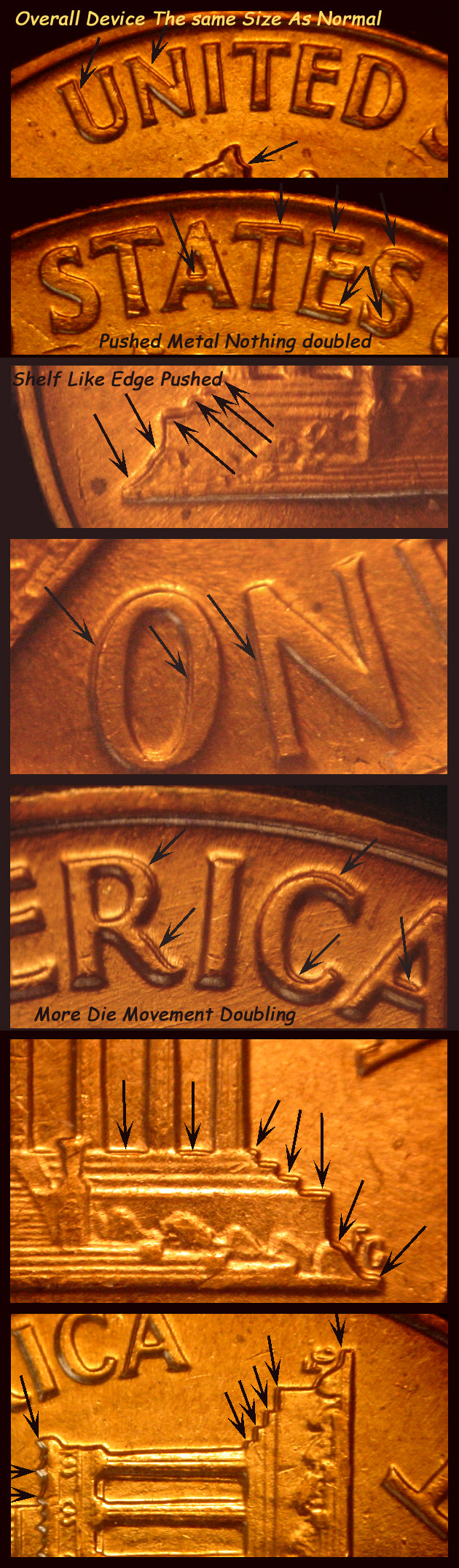 |
|
Pillar of the Community
United States
6944 Posts |
There is also something called "abrasion doubling" on Wexler's site. Heavy polishing of a die after a clash produces an effect similar to Die Deterioration, but in specific areas and apparently without the overall deterioration markers of DDD. Edit, forgot link: http://doubleddie.com/144864.htmlEdited by Brandmeister
06/12/2023 5:02 pm
|
|
Pillar of the Community
United States
6944 Posts |
In re-examining the nickel vs. the reference coin, I am now noticing that the strike seems shallower and less distinct than the second coin. I had initially assumed that was circulation wear, but maybe that is a sign of some Die Deterioration or polishing? |
|
Pillar of the Community
Canada
6244 Posts |
@ Brandmeister: Very nice work to understand, but what I do not understand why so much energy for uncollectable coins? The last link from Wex show an subcategory of DDD. Why you do not focus more on DD's? Seem to me you are able to come with something is the interest in collecting. Any form of MD is just a normal (me I say junk coins) face value. I agrees that if is MD coin at MS 66 or MS 67 is collectable till you find one clear. |
|
Pillar of the Community
United States
6944 Posts |
Quote:
Very nice work to understand, but what I do not understand why so much energy for uncollectable coins? It's a fair question. I am an engineer. The science of things matters to me. When I do a root-cause analysis, I get to a satisfactory explanation or I keep digging. I have very much enjoyed this discussion so far, even if the coin is worthless. I think people here give an answer of Machine Doubling (really meaning push doubling) far too easily. If the cause does not correctly explain the effect, then the scientific method requires further investigation. The term Machine Doubling itself seems to encompass a large number of common and uncommon scenarios that are not identical in formation or result. If we cannot point to a specific type of error from a specific cause, then that is guessing, not knowing with confidence. Also, the doubling question seems to arrive often from newcomers to this site. True die doubling is probably 1% of those cases. The various forms of MD/DDD and other manufacturing flaws are 99% of those cases. So all we have to do is guess Machine Doubling every single time, and we are likely to be correct with a 99% record. If we are looking for a valuable and rare 1%, then that is not a very useful strategy. I could throw out every tiny transparent mineral in my prospecting pan, but that guarantees I will never find a diamond. I would, however, be correct 99.99% of the time. Does that represent a mastery of diamond prospecting, or merely describe a basic grasp of probability? It seems quite possible to be 99.99% correct and achieve a result of $0. It is also worth asking the question in reverse. If I am sure that a coin has true die doubling, then I must first rule out worthless forms of doubling. Some of the legitimate forms of doubling like distended hub doubling seem to look very much like MD/DDD. How can I be trusted to identify a diamond if I cannot immediately dismiss quartz, glass, and other lookalike minerals? This seems especially important for doubled die coins, because the odds of finding one are tiny. A collector seems much more likely to purchase such a coin. You don't buy a Rolex if you can't identify a Rolex. I guess you can buy a Rolex from a certified dealer, but then you're just "buying the slab, not the coin". If I had found a different type of interesting error in a roll of nickels, I would be doing a deep dive on that subject instead of this one. =) |
|
Valued Member
Canada
219 Posts |
I am surprised Silvio by your comment  , a man of science like yourself should see the value of knowledge. It is not always about a quick buck! Quote:
Die Movement Doubling It is the first time I have heard about this terminology. From the description and pictures shown it is nothing more than Machine Doubling. Why come up with this new terminology?  Maybe Coop can explain what he saw that was different. Quote:
I think we all agree that this is not a real doubled die example. Sorry but I am not one of those. My research have led me to conclude that it is either caused by a Die Deterioration or a doubled die. I am limited on the amount of US nickels I can get so right now I can not rule out Die Deterioration as I have not found two coins produced the same year, having the same exact doubling, and with different deterioration states. Doing a quick search on this forum, you will find many posts of nickels have very similar type of doubling as this one. Edited by numidan
06/13/2023 09:37 am
|
|
Pillar of the Community
United States
3207 Posts |
All good points, Brandmeister. I went through the same thought processes back when I was roll searching nickels, which is the denomination I've searched most. I think you've reached a sort of wall in that few have pressed onward to the details you seek. A bit of knowledge that you may not have encountered yet is that coinage dies are slightly convex. Consequently, when a coin is struck and the dies begin to separate, different parts of the new coin are released from die contact at slightly different times. That helps explain why we so often see Machine Doubling on only part of a coin. I designed and built metal stamping machinery, and can say that.determining the cause of a product defect can be challenging. To root out the cause of each form of doubling might require a coin press with which one can run experiments. The mint's machinists likely know many of the details you seek, but eventually even they probably hit a knowledge wall. |
|
Pillar of the Community
United States
6944 Posts |
Nick, you make a valid point. I am accustomed to doing root cause analysis for low level software and high level digital microprocessor design (which is essentially just specialized code converted into a physical set of chip manufacturing tools by computer). In all those cases, I have the final product, the original code base, the manufacturing tools, the original requirements and design, and everything in between. Obviously I must reach the answer to all customer-found problems. The final test case must be isolated into something repeatable, possibly over hundreds of runs, before we make any changes to fix it. Or at least you should. I've seen a lot of people hack at a code base over the years until their bug stopped appearing. That's a great way to play Whack-A-Mole with bugs until your field guys break out the pitchforks and torches and invade your cubicle. For a coin, all we have is the final product, often in a worn or partly deteriorated state. In order to get to a true root case, you're right, I'd basically need a mint. Then I'd need a mint expert's knowledge to troubleshoot the problem. I did read somewhere about convex dies. The degree of curve is not something I know. Is that why Machine Doubling is seen more around the rims? I had kind of assumed that it's identified more around the perimeter because that's just where the lettering happens to be, and those devices tend to stand the highest from the field at a sharp angle (vs a bust, for example). |
|
Pillar of the Community
United States
6944 Posts |
Quote:Quote:
I think we all agree that this is not a real doubled die example. Sorry but I am not one of those. My research have led me to conclude that it is either caused by a Die Deterioration or a doubled die. Okay, my bad. I thought we were deciding among DDD, die abrasion, or some kind of " Machine Doubling". The problem I have with push doubling is that it does not explain 1. why the devices are full size, and 2. where the extra metal came from to form the shelf. You laid that out pretty well with your illustrations. I, too, am quite curious to hear Coop's explanation for Die Movement Doubling. I think the reason for the term is clear—it doesn't seem to follow the rules for push doubling, and thus quite likely has a different cause. |
|
Pillar of the Community
Canada
6244 Posts |
Quote:
Quote Numi
I am surprised Silvio by your comment , a man of science like yourself should see the value of knowledge. It is not always about a quick buck! Sorry I do not look for quick buck. Do I need this quick buck? Answer is No. The point for me here it is ,and I appreciate very much Brand, was when I wrote that him put to much effort for something which in the end will be "Blowing in the wind" do to the fact that will reach not many peoples. The rest will simply say is MD because theirs horizon in very close. I know this as a person who has now 383 Academia papers and studies. Brand, In the same direction if you want a very interesting subject it is Hub Doubling and because the Die from any reason slip, move , etc. majority will say MD. Yes has something from MD but the base? About your Mechanical Doubling (ejection). This in fact apply better to vertical presses as was Graebener (this it is the correct name AE in fact it is an A two points up), and was see on the Reverse. Edited by silviosi
06/13/2023 4:04 pm
|
|
Pillar of the Community
United States
3207 Posts |
We see Machine Doubling near the outer edges most often because if the coin rotates relative to the die, the coin's outer edge moves the largest physical distance. Die Movement Doubling sounds like a loose die is rotating or shifting rather than the newly struck coin. Besides the ones we've discussed, there are other factors that will influence Machine Doubling. For example, if the dies are not exactly parallel to each other, either due to improper installation or wear, when the dies separate after striking the coin, they will lift off first on one edge, and last at the edge 180 degrees away. If the coin rotates during that period, anomalies will happen near one edge and not the other. I imagine the design itself can also influence where anomalies are most likely to occur. If you are seriously into such details, you could probably study and write a paper or book that would be welcomed by the hobby. I would be interested in your findings, but I don't know how many others would. This is esoteric stuff. |
|
Pillar of the Community
United States
6944 Posts |
I appreciate Silvio's question about why not focus effort on hub doubling. Many people find hub doubled coins to be valuable. Coins diagnosed as machine doubled are seen as worthless. But why is that? I would wager that a great many of those people perceive hub doubles as valuable because a few experts suggested that was so. If the experts suddenly changed their mind, then the value would plummet. For me, the virtue of "true" doubling vs. "mechanical" doubling is not so clear. Both are man-made mistakes in the coin manufacturing process, but at different stages. I have not found a convincing argument for why hub doubling is so valuable, except that it is 1. repeatable across multiple coins, 2. it is perceived as rare. Compare hub doubling to other minting errors. Broad strikes and multi-strikes are dramatic mistakes. Die clashes are visually unusual. Die cracks, Cuds, chips capture a story about the mechanical minting process. But I don't know that die doubling is any more compelling than, for example, a repunched mint mark. Somebody had a shaky hand on the first swing of the hammer. Or somebody struck a die a second time a tiny fraction of a radian out of alignment. Is a microscopic split serif considerably more valuable than the nickel that started this conversation? I don't know. Honestly, with an ounce of perspective, the whole hub doubling obsession seems 80% as silly as a value premium for toning. You stored your coin in a contaminated environment and now the surface metal has chemical discoloration. But good news, the discoloration is a pretty concentric rainbow so +1 to MS grade for Hufflepuff. Huzzah! It's a hobby where some dude paid $40000 for a Roosevelt dime struck on a nail. I guess it's good that nobody cleaned the nail or PCGS might have graded it Details. Therefore, I'm not quite willing to uncritically accept what is commonly accepted as valuable or not. |
|
Pillar of the Community
United States
3207 Posts |
Agree there is a subjective element to what makes a coin valuable, but there is also rarity. A true doubled die is created by a specific die pair until the Mint pulls that die from service, and for most coins that makes a doubled die example a small percentage of the total mintage.. By comparison, Machine Doubling is common. There may be certain modern years and mints for which it is uncommon, but AFAIK no one bothers to survey that. Even though I don't find most Machine Doubling attractive, I set aside the extreme examples due to their curiosity. I'd bet a complete a set of machine doubled Kennedy halves would garner a respectable premium on ebay, even with a clear description they are not doubled dies. The bottom line remains collect what interests you, regardless of value to others. |
|
Pillar of the Community
Canada
6244 Posts |
@ Brandmeister:
I mention the Hub Doubling because the origins of those Doubling go back to the master Die and offend are confound with MD. the DD's resume to the Working Hub. Personally I do not care about the value and I care more of the variety. Will be nice if you and Numi will come with an exponential on this cloudy topic.
|
|
|
Replies: 54 / Views: 2,537 |
|
To participate in the forum you must log in or register.
Disclaimer: While a tremendous amount of effort goes into ensuring the accuracy of the information contained in this site, Coin Community assumes no liability for errors. Copyright 2005 - 2026 Coin Community Family- all rights reserved worldwide. Use of any images or content on this website without prior written permission of Coin Community or the original lender is strictly prohibited.
Contact Us | Advertise Here | Privacy Policy / Terms of Use
|
| Coin Community Forum |
© 2005 - 2026 Coin Community Forums |
| It took 0.47 seconds to rattle this change. |
 |
|
| |
| |




 First Page
 Previous Page


 Posted 06/12/2023 3:04 pm


