First Page
 Previous Page


 Posted 06/13/2016 5:08 pm


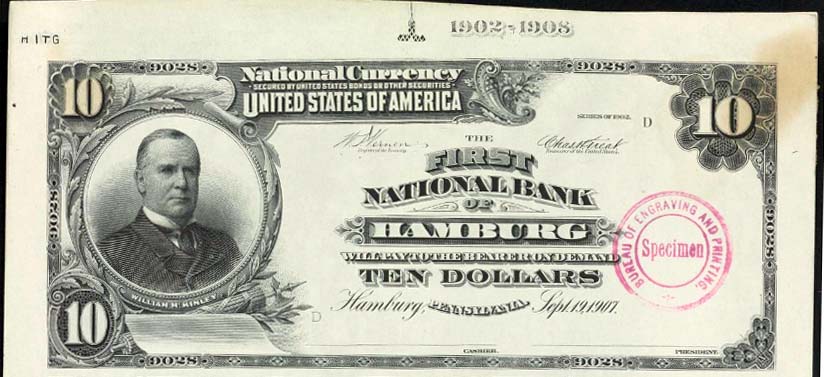
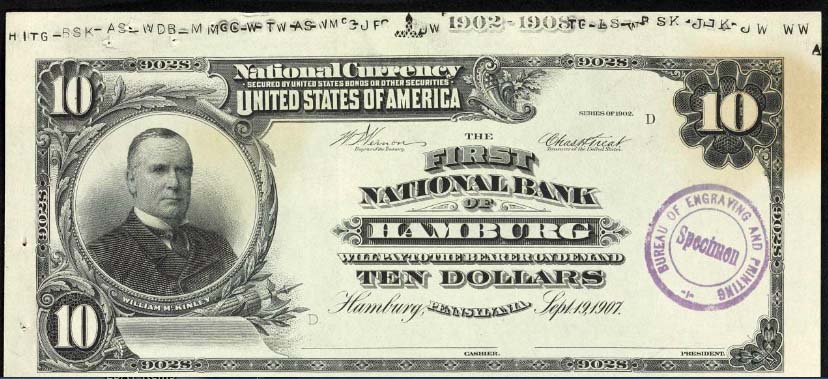
I learned a few things while going through these boxes. For a long time I wondered why some proof sheets had a long string of letters at the top, while others didn't. What I found out was that each time the plate was put on the press, the plate printer hammered his initials at the top. If the plate had a long life it acquired a lengthy string of initials.
Here is the top subject of the D-E-F-B plate (10-10-10-20) from the First National Bank of Hamburg, PA. On the top subject (plate D) of the first run you see the initials HITG at the top left. On the next proof of the same plate D, there is now an alphabet soup of initials following the first set, indicating more than a dozen print runs.
The BEP was very thrifty and used their plates as long as possible but, after many print runs, areas of the plate began to wear down. Often the first spot to show wear was the portrait. To amend this, a transfer roll of just the portrait was very precisely re-rolled over the worn portrait to refurbish the engraving. This was called "re-entering the heads" but other worn components could also be re-entered.
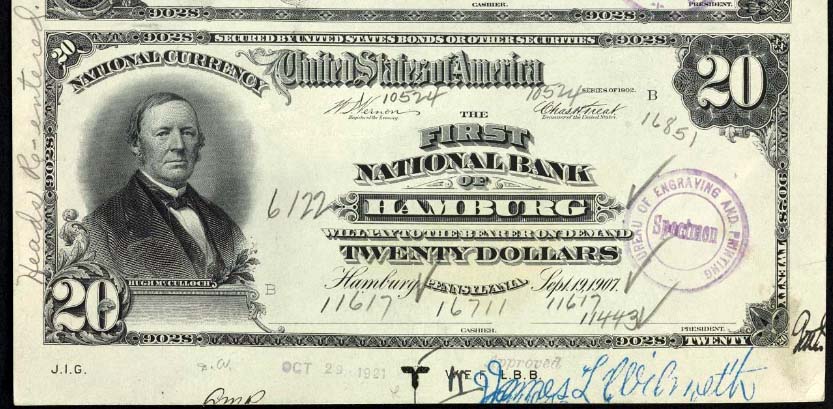
What I've found is that the proof sheets with long strings of initials at the top are nearly always marked "Re-entered" -- usually "Heads Re-Entered" penciled along the side or bottom. The bottom $20 of the later proof sheet shows this marking on the left.
It also shows some other interesting notations: roll numbers. Each cylinder die used to transfer a piece of the design had a number -- signatures, bank name, state, charter number, etc. The transfer press operator (siderographer) marked this proof with the numbers of the rolls needed to build the next plate, which would be the G-H-I-C plate.
Here is the top subject of the D-E-F-B plate (10-10-10-20) from the First National Bank of Hamburg, PA. On the top subject (plate D) of the first run you see the initials HITG at the top left. On the next proof of the same plate D, there is now an alphabet soup of initials following the first set, indicating more than a dozen print runs.
The BEP was very thrifty and used their plates as long as possible but, after many print runs, areas of the plate began to wear down. Often the first spot to show wear was the portrait. To amend this, a transfer roll of just the portrait was very precisely re-rolled over the worn portrait to refurbish the engraving. This was called "re-entering the heads" but other worn components could also be re-entered.
What I've found is that the proof sheets with long strings of initials at the top are nearly always marked "Re-entered" -- usually "Heads Re-Entered" penciled along the side or bottom. The bottom $20 of the later proof sheet shows this marking on the left.
It also shows some other interesting notations: roll numbers. Each cylinder die used to transfer a piece of the design had a number -- signatures, bank name, state, charter number, etc. The transfer press operator (siderographer) marked this proof with the numbers of the rolls needed to build the next plate, which would be the G-H-I-C plate.
Edited by GregAlex
06/13/2016 5:12 pm
06/13/2016 5:12 pm