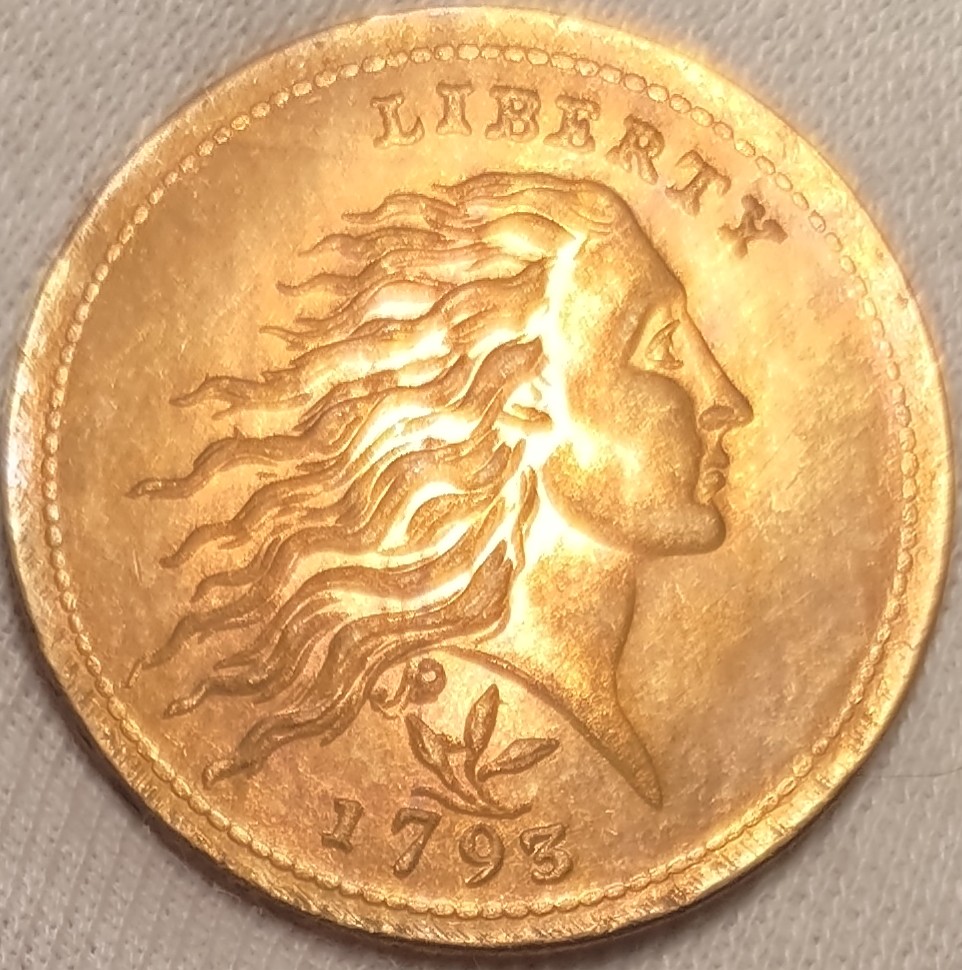
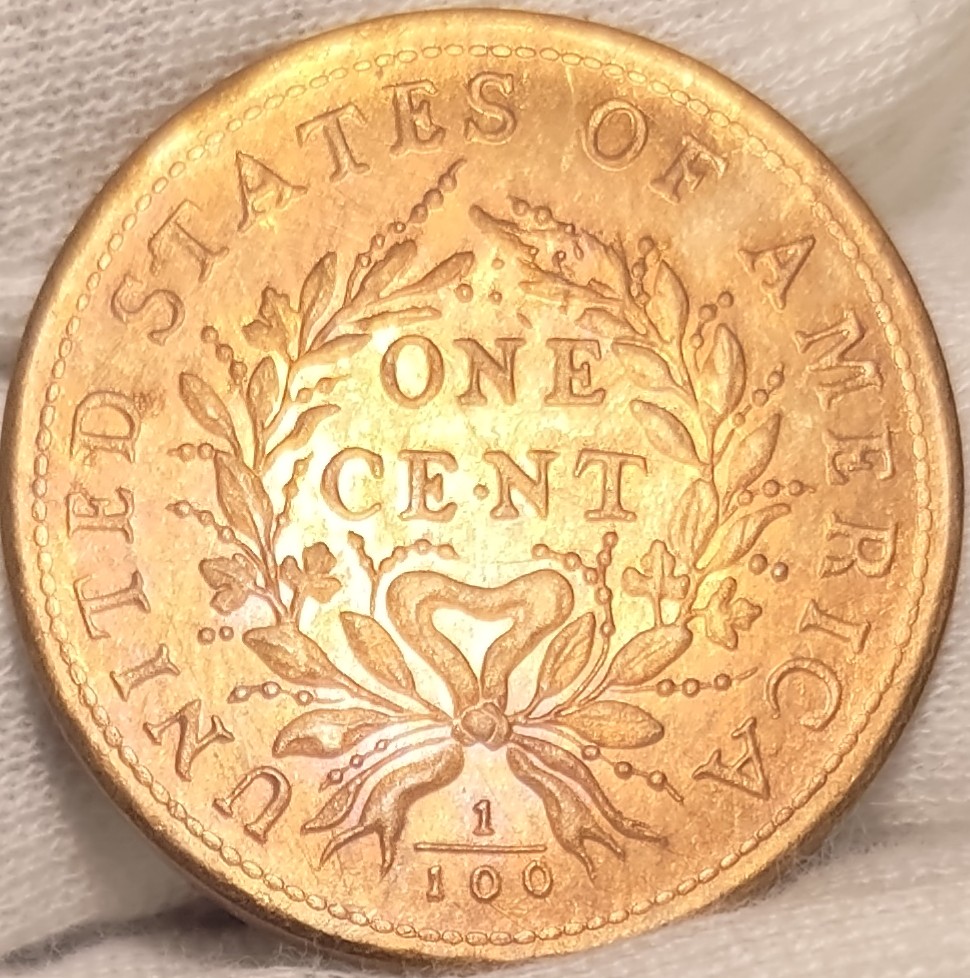
So here it is, the crumbled rim, a die crack on the reverse, raised edge, ejection marks, this coin weighs 9.44 grams, not that this matters but that's exactly 2 pennyweights lite=3.10 grams@1.55 grams per pennyweight.
What do you all think?, is it possible?
Same has been posted(different site) minus/research/feedback, into errors 1793,, the Oops, part of the Breen encyclopedia.
PS: This coin was purchased as a replica from a coin dealer in Israel.
Dimensions
28.48mm to 28.55mm, not a perfect circle, 1.77mm center, 1.68mm edge.
(Well, I kinda think the Mint wasn't weighing copper as strict as other precious metals in 1793, I mean when reading the coinage act of 1792, SEC.#19 for it states gold and silver, no mention of copper or weight requirements for copper coins struck.)
The following is reprinted with permission from Walter Breen's Encyclopedia of Early United States Cents 1793-1814, by Walter Breen, edited by Mark R. Borckardt
The new wreath design was Director David Rittenhouse's answer to the newspaper criticisms of the Chain Cent.
The actual diesinker is uncertain. It was not Voigt as the style is too different from the Chains. Neither
Joseph Wright nor
Robert Scot had yet been hired. This leaves only two likely candidates: Birch2 and
Adam Eckfeldt. In favor of Eckfeldt is the close kinship between these reverses and those of the
Half Cents of 1793, which Eckfeldt claimed as his own work.3 In favor of Birch is the kinship between the seven cent reverses and that of the Birch and Voigt cents of 1792. Most likely, both men worked on these dies, with Eckfeldt afterwards basining, polishing, and hardening them.4
Coinage began April 4, using blanks produced during the last few days of March from the remainder of the scrap copper bought March 1 through 6; these ran out April 19, halting coinage. Other copper purchases followed:5>
On inception of the design, April 4, the coiner struck a few prooflike specimens (presentation pieces) on brilliantly polished blanks.6 The first obverse die began, almost at once, to chip and crumble at the rims. Later dies buckled quickly, a problem originating in incomplete hardening, for which Eckfeldt found no solution until 1795.
The interruption on April 19, according to Julian, came about because the Mint's primitive rolling mills had broken down, as often occurred from 1793-1815.9 The supply of blanks was exhausted on that same day and the rolling mills were not again serviceable until the middle of June, after which the Mint resumed its search for acceptable copper.
In every date from 1793-1814, die descriptions have called attention to die blunders, and Remarks and Condition Census sections have alluded to occasional mint error coins; bizarre productions overlapping the waste-basket category of factory rejects, freaks, mint errors, striking varieties, or whatever one chooses to call them. I have herein deferred intensive attention to such coins until all the regular types and varieties were described.
The classification scheme in my
Half Cent book is followed here with necessary modifications. Some types of mint errors occur in
Half Cents but not cents, others con-versely. (To extend this system to other pre-1837 U.S. denominations will require other variables not dealt with herein, some having to do with stars and edge reeding, others with errors that could have occurred on cents but are not known on them.) However, you need not be familiar with my
Half Cent book to understand the classification herein; and the classification numbers in the
Half Cent book are not identical to those herein.
The basic principle is that in each subroutine of every process a sample of copper goes through from ingot to strip to planchet, any malfunction produces a particular kind of anomaly. Similarly, this is the case with every process in die-making from the die blank to the working die in the press, and with the striking process where the finished die meets a finished planchet to produce a coin. From this follows a variation of Alan Herbert's standard "P-D-S" (planchets, dies, striking) classification system. In technical descriptions below, I paraphrase and sometimes quote the corresponding materials in my
Half Cent book. (
Half Cent Encyclopedia, pp. 467-84.)
Many specific examples of the various errors, described below, are listed in the footnotes with additional details listed in the main text for the appropriate variety.
Planchet Blunders
Making Strip
1. Foreign matter remaining in the strip produced discolored streaks, usually dark or brassy colored, and of different texture from neighboring normal areas. Some types of trapped material contributed to chipping, pitting, laminating, or splitting along the boundaries between the atypical alloy and normal copper. (Examples include 1793 variety 6 (the Atwater Coin), several examples of 1793 varieties 21 and 22, along with 1794 variety 1a.) This type of erroris sometimes known as "improper alloy mix" although, in the case of the early cents, the coinage metal was properly pure copper without alloy.
2. Gas bubbles occluded in the melt would normally burst during rolling into strip, producing laminations or planchet cracks. Blanks containing such bubbles too small to have burst will not ring; the Mint's term for these was" dumb blanks." However, even normal 1793 Chain and Wreath cents will often not ring properly; the thicker a coin is in proportion to its diameter, the less it will ring, even in the absence of internal bubbles or splits.
3. Improper annealing, from which some regions remained stress-hardened, contributed to brittleness and cracking. It is not always ascertainable which of these several factors were responsible for any given planchet crack or planchet defect. Lamination detects are common on cents dated from 1793-1797, less common on later dates. 1793 variety 16c is notorious for them.
#65532;
Laminations often peel away from the field. They may peel away edgewise, splitting the coin creating a "clamshell" split with the appearance of an open clam. Flakes eventually fall off forming dropped laminations. Alternatively, a thicker piece with design elements remaining may fall out producing a dropped fragment. (For reasons of space, we list only a few of the most famous cents with lamination defects, slivers, or fragments that have fallen out. 1793 variety 19, from the Naftzger collection, illustrated in Early American Cents and Penny Whimsy (Sheldon 16, obverse 14VD) as a die break. 1794 variety 1a include Ruby: 340, Adams: 3, Adams: 4, and others. Some of these qualify as dropped fragments. Additional examples include 1794 variety 45, Adams :48; 1798 variety 34, Ruby: 514; 1798 variety 38, Downing: 1825; 1800 variety 8, Ruby: 539; and 1803 variety 19, in the John D. Wright collection, with almost half of the obverse lost in laminations.)
4. Rollers set too close together made strip, and therefore blanks, too thin. Tentatively listed as mint errors only if about 10% or more underweight, without incomplete planchet or lamination, and without evidence of overstriking on tokens or other coins. Lesser weight deviations are more common (several are recorded at 1794).(An example of 1794 variety 57 in the collection of the ANS weighs 190.95 grains (12.37 grams). "Wrong stock" would apply only if the cents were on blanks cut from
Half Cent strip, therefore of
Half Cent thickness. Three possible standard weights: a 1793 variety 16 or any 1793 Liberty Cap on the earliest
Half Cent stock (made mid-May for 1793
Half Cents at 22.2 mm) would weigh about 172.64 grains (11.19 grams), 1793 Liberty Cap through 1795 on late 1793-95
Half Cent stock (made for
Half Cents at 23.8 mm) would weigh 150.11 grains (9.73 grams), and 1795 Plain Edge through about 1800 would weigh 121.26 grains (7.86 grams).)
Authentication is recommended. Prolonged acid baths outside of the Mint also lower weight, though at the cost of blurring details and ruining the coin.
5. Rollers set too far apart made strip, and therefore blanks, too thick. Tentatively listed as a mint error only if more than 5% overweight; specimens under 5% excess are more common (several are known dated 1794) and are not of interest to error collectors. Authentication is recommended: cast and electrotype copies are usually grossly overweight also. Look at the edge first. (Major examples include: 1794 variety 52,222 grains (14.39 grams, 6.7% overweight). Unseen. 1795 variety 8, 187 grains (12.12 grams, 11.3% overweight), Kagin's 1/30/1986 : 4139.)
1793 Wreath Variety 7, untraced, ex Carl Wurtzbach. Variety 12, one seen, Chris Victor-McCawley. Variety 13, unlocated. Variety 16, several seen. 1793 Liberty Cap Variety 20, ANS collection with 29 millimeters diameter. A second was reported by Dr. William H. Sheldon. Variety 22, G.
17. Die scratches, die file marks are common; the most frequent locales are fraction bar and stem ends. Examples: Left from fraction bar, 180:2. variety 1.
22. Die breakage: Includes chips, single cracks, multiple cracks, split dies, bisecting cracks, rim crumbling, and major rim breaks. Accidents, one and all, not errors, though often collected by mint error specialists. An early complete listing is included in Die States for the individual varieties. Also see the keys to the various dates, which normally list the more bizarre or extreme die breaks.
Choice of Blanks
This category is listed here rather than under the Planchets class above, because the problem is not in the host coins (undertypes) themselves but in the coiner's decision to use these to make cents. The three following could exist on early cents.
1. Struck on
Half Cent blank. Identifiable by weight: 104 grains (6.74 grams) for 1793-95;84 grains (5.44 grams) for 1795 to about 1811. These should not be confused with possible coins struck on
Half Cent stock, above; the latter would be of
Half Cent thickness but large cent diameter. Later dates exist; I have seen an 1851 and have heard of others.
The only early date reported so far is an example of 1807 variety 1 on a
Half Cent blank, heavy at 94.1 grains: the blank, rejected as too heavy, was flung into a bin or hopper which later carried cent blanks. Not wrong stock because ever since 1800 all
Half Cents were made on blanks from Boulton & Watt. (Robert W. Miller, Sr. Seen May 10, 1990 at the EAC convention.)
Ejection: Single Planchet
Any failure of the feeding mechanism to eject the newly struck coin completely from the coining chamber will produce a mint error. Except for double profiles, these are major errors, some grotesque, all prized.
https://www.PCGS.com/coinfacts/coin...ge-rd/507170Thanks all












 Posted 07/18/2021 6:49 pm