| Author |
 Replies: 14 / Views: 1,709 Replies: 14 / Views: 1,709 |
|
|
Valued Member
United States
58 Posts |
I apologize if this has been asked in past. I am really interested in becoming a hardcore coin collector, but I am struggling with what I should be looking for. I have only been at it for roughly six months--picking up individual coins on the Internet here and there. It was not until two weeks ago where I came across an article pertaining to roll hunting. In the last 10 days I have completed a Philadelphia penny set from '58-'11, with some miscellaneous wheat, steel, and Indian pennies. I have also found Denver minted pennies from '61-'11. I am currently working on Kennedy halves, Jefferson nickels, and Roosevelt dimes. Should I even be worried about this? My first purchase was two gold-plated Buffalo proofs. When I received them only to find that "copy" was stamped on them, I was disappointed, but should I have been? To this day, I am still kind of sore about it. In laying all of this out before you all, I feel quite ignorant. As stated before, I am very interested in collecting. Oldest coin I have is 1881-O Morgan dollar. |
|
|
|
Pillar of the Community
United States
3345 Posts |
Well first off,  to hardcore coin collecting. I was just like you until I found this site. Second, get a RedBook. Gives you everything you need to know. |
|
Pillar of the Community
United States
1903 Posts |
Here is the best advice you will ever get...I promise....no joke..... learn first, buy later. And when it comes to collecting, pick ONE specific thing to learn/collect at a time. Know everything there is to know about that coin. Errors, die varieties, etc.... that way you are far less likely to get ripped of, and way more likely to spot a great deal. When I say one thing I mean something like "Lincoln Memorial Cents before 1982" or something like that. The "shotgun" approach to collecting anything will always getyou burned and dissapointed. So again I say, learn FIRST, then buy Roll hunting is a great way to learn, you will find some amazing stuff just roll hunting, and best of all you have only spent face value. You can't lose that way. Did I read your post right you have only searched cent rolls for a little over a week and already found a 1943 steel AND some Indian Head cents? Wow you are super lucky Edited by unholyroller
12/01/2011 8:11 pm
|
|
Valued Member
 United States
58 Posts |
|
|
Pillar of the Community
United States
1302 Posts |
Welcome. My advice is to get some coin books and read them. Yes, the biggest part of the hobby is not necessarily owning coins- but knowing everything you can know about them. Believe me, it will save you a ton of money in the long run and you'll avoid mistakes like the gold plated buffalo "proofs".
The US Mint makes proof sets each year and mints coins for circulation. It's not necessary to collect everything that gets put out. Buy what you like... and get even more enjoyment out of it by knowing all you can about that coin.
|
|
Valued Member
United States
58 Posts |
So how can one tell the difference between a proof coin and a minted coin?
|
|
Pillar of the Community
United States
7294 Posts |
Fred 2425, Proof coins have a frosted device and a reflective field often showing a mirrored effect. The surface of proof coins is delicate and improper handling of them will show as scuffs or finger prints. Here is an example of a proof coin.  A regular minted coin will not have the mirrored look and the entire surface will have the same color This is an uncirculated or MS coin.  I hope that this will clarify the difference for you. A couple of pointers: Never buy any coin off the TV. As said before educate yourself with a Red Book to know what is out there and then you can make a judgement of what it is you would like to purchase. |
|
Valued Member
United States
208 Posts |
Beautiful RFKs muddler! Obviously the proof is great, but the UNC is really impressive too!
|
|
Pillar of the Community
United States
1796 Posts |
Another thing to ask yourself is are you wanting to become a 'hardcore coin collector' primarily for the investment? Or are you in it primarily for the thrill (with your roll hunting)? Or both? (Both happens in varying degrees all the time.) Each side of the hobby has very different strategies which can both work with or against each other; however, it sounds like you're already well on your way there!
As you've probably already realized, roll hunting is a very different animal than purchasing coins from dealers or an auction house (and that fraud, or at least 'careful legal misdirection' is rampant). Investment purchases also involve a fair amount of speculation and patience as your assets mature.
My experience, for example, is that my late grandfather was more of an investment-oriented collector who taught me everything he knew. We'd go over the proof sets and uncirculated sets each year, the Silver Eagles and commemoratives, etc. However, I've always gotten my thrills from roll and change searching, which is (between that and coin trivia) the majority of my involvement in the hobby today. :-)
Unhollyroller is bang on when it comes to purchases: Learn first, buy later. Become a book expert, and then work on your "practicals," getting your hands dirty. :-)
That said, proofs aren't "better than" MS coins and vice versa. It's all a matter of context and how the values (both what you value it at as well as what the market values it at) fluctuate. Proofs do tend to be priced higher as they are "limited editions" with a set number of strikes (special strikes at that, as muddler has illustrated) which is a number much lower than you find for "common" coinage. Some proofs are also struck in precious metals, which are then subject to the crazy, currently zig-zag-up-and-down metals market.
So if I can give any good advice it's this:
1) Find your passion, first. Which set or type of coins are you most interested in? Do you like proofs more or less than uncirculated or MS coins?
2) Pursue that passion by hitting the books (or websites, or forums; hey you're here!)
3) Make your first purchases from a dealer. However, during the process express your interest to them, flatter them a bit and then listen to all the tips and factoids they'll share. You'll learn a lot that way.
4) Don't succumb to "buy it now" fever. Silver and gold fever is also right out as it's foolish to put your money into something so volatile right now. (Finding silver coins in bank roll searching, however, is always a profit provided you've bought the roll at face value. :-) )
5) Ask yourself, "Am I having fun?" if the answer is "No" go back to step 1 and start over.
Good luck!
(PS: Also, I prefer the Blue Book over the Red; Red's for retail 'ask' prices, Blue's for dealer 'bid' prices, and imho the better judge of what you can normally "get" for your coins if you must sell them.)
|
|
Pillar of the Community
United States
4897 Posts |
 That is very good advice! |
|
Valued Member
United States
58 Posts |
Steve - Thanks a lot. I really appreciate you taking the time out to bestow some knowledge upon me.
|
|
Pillar of the Community
United States
2283 Posts |
It's strictly a matter of taste and personal preference but there's some tendency for more advanced collectors to prefer Uncs. Proofs are far better made in most cases and can be exceedingly beautiful quite often. Some collectors actually prefer coins that have some nice honest wear so they tend to collect older coins. Uncs were intended to circulate in most cases so are more desirable to many on this basis. Proofs can be quite common even when the mintage is low because proofs are far more likely to survive than uncs. Proofs tend to have less demand than uncs but the demand for proofs tends to be more specific so prices can still be high.
If you're collecting later coins then whichever you decide I'd strongly recommend you seek nicer examples. This isn't as important with proofs since most proofs are pretty nice but it will probably be critical fir uncs. The uncs can be pretty poorly made and collectors in the future are probably going to demand attractive coins. Besides it doesn't cost much more to find nice attractive coins now and it makes it a bigger challenge and more fun.
Suit yourself. You can have fun with almost any coins so have at it. As someone else said though, there's no need to be in a hurry. Figure out what you like and then try to attack it systematically while learning as much as you can. This is so much easier now days with the internet since we all have ready access to lots of information and expertise.
Time don't fly, it bounds and leaps.
|
|
Bedrock of the Community
United States
10065 Posts |
There is another aspect of coin collecting I do not see spoken of much and it is how I started out back in the late 60s. I used to get the 3-ring binder sheets like these: 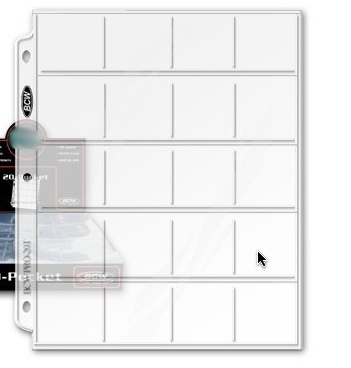 And then I would collect one of each coin from each year/mint. There were enough rows of pockets to put halves in the top, quarters right below, etc. down to the pennies (nowadays with the dollar coins being made you might want to research and see if they make sheets with 6 rows of pockets). This way my specialty was collecting a year set from each mint, but it also meant I was able to get complete, individual, sets of each coin denomination also. When I started out, I would put two or three (or more!) of each coin in a pocket if they would fit and just put Scotch Magic Tape (will not yellow, age, crack) tape across the top of each pouch (yikes!). But now wish I had used 2X2 holders which fit perfectly in these pockets. BTW - How much squash could a Sasquatch squash if a Sasquatch would squash squash? Download and read: Grading the graders Costly TPG ineptitude and No FG Kennedy halveshttps://ln5.sync.com/dl/7ca91bdd0/w...i3b-rbj9fir2 |
|
Pillar of the Community
United States
6001 Posts |
If you're collecting on a budget (as are most people), I would agree that it's best to do a lot of research before purchasing coins so you don't waste your money. Having said that, though, there is definitely something to be said for learning from experience since there is only so much you can get from books. As long as you're not throwing away tons of money on high end coins that may or may not be authentic, there's really nothing wrong with "wasting" a few bucks here and there on coins that you may end up replacing later down the line.
As for Proof vs. Uncirculated (both can be in mint state), I'm a huge fan of proof coins. If I could fill an entire type set with just proof coins, I would (that would get awfully expensive in a hurry, however). I just really, really love the way they look. It's a combination of the captivating mirror finish and the fact that they are usually better struck with more details and sharper rims than uncirculated coins.
Oh -- and welcome to the forums!
|
|
Valued Member
United States
187 Posts |
Quote:
PS: Also, I prefer the Blue Book over the Red; Red's for retail 'ask' prices, Blue's for dealer 'bid' prices, and imho the better judge of what you can normally "get" for your coins if you must sell them.) I agree,I always go by Blue Book prices for my purchases....I lose a lot of auctions,but I feel better knowing I paid an amount that I can easily recoup if I have to sell in the future. |
| |
Replies: 14 / Views: 1,709 |
|










 Posted 12/01/2011 8:07 pm


