| Author |
 Replies: 18 / Views: 6,270 Replies: 18 / Views: 6,270 |
|
Valued Member
United States
131 Posts |
I'm a novice so try not to laugh. I've got some of the new State Quarters and I'm wondering if this is an error. I've got some with the mint mark doubled in a similar way. 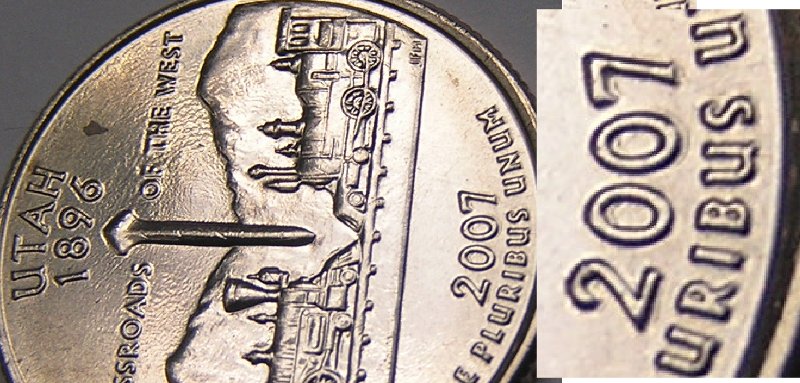 |
|
|
|
Pillar of the Community
United States
2651 Posts |
If you are refering to the date it is not a Doubled Die. If it was a Doubled Die the doubled portion would be the same thickness as the original. Hope that helps.
|
|
Rest in Peace
United States
7075 Posts |
|
|
Moderator
 United States
56855 Posts |
|
|
Valued Member
 United States
131 Posts |
The dimpling on your link seems to be similar. I wish I could get my camera to take a decent picture of mine because the picture doesn't even begin to do it justice.
On mine, the dimpling is on both the outside and the inside of the letters/numbers. In the picture the dimpling inside the number barely shows up but on the coin it's very obvious.
Also, I noticed on the images from the link that the dimples seem to affect all the letters. I have some where the only thing dimpled is the mint mark. And again, both the outside and inside of the letter is dimpled.
So I have to ask what is hubbing?
|
|
Bedrock of the Community
United States
62064 Posts |
A hub which is a positive makes the die which is a negative. The die then strikes the coins which are positive.
|
|
Valued Member
United States
131 Posts |
I've never really read up on doubling before. Tell me if I got this right. Machine Doubling is when the die strikes the coin more than once and the impression is not exactly dead on where the previous strike is. Hub doubling is when the hub is pressed onto the die, more than once, and the impressions are slightly off. Are these the only types of doubling? Back to my coin: A die is the opposite of the coin, that means the hub relief is like that of the coin. My coin isn't doubled because the impression shows a raised area (the letter for instance) and a dished out "shadow" next to it that is effectively lowered instead of raised. It's not doubled but it is something different. That difference comes from the hub and might be impressed on multiple die before being corrected. I don't know how many hubs or dies are used in a run of coins so I can't guess how big of portion of the coin population will have the effect. |
|
Bedrock of the Community
United States
62064 Posts |
I've never really read up on doubling before. Tell me if I got this right. Machine Doubling is when the die strikes the coin more than once and the impression is not exactly dead on where the previous strike is. On Machine Doubling the coin is struck only once on business strike coins. Because there is a die movement during the strike, the images get distorted/damaged during the strike. Hub doubling is when the hub is pressed onto the die, more than once, and the impressions are slightly off. Dies are hubbed. In times past this process was repeated 2 or more times depending on the denomination. If while creating the die, the die was not the same die or had wear/warped on it since the previous hubbing the images might have changed and not you see a doubling on the die. Another cause would be if the hub was not aligned correctly duing the different hubbings. So on doubled dies there can two or tripled die or quadruple dies because of miss alignments.Are these the only types of doubling? There can be master die doubling. The master die was doubled and transfers the doubled image to the hub. The hub transfers the doubling to the die. These are not valuable as many dies from all three mint can have this exact thing. The 1972 master die doubling is a classic example. It is a doubled die, but because a large percentage of the coins having it makes it a common example. This has happened on other years as well. 1932, 1961 are a couple examples I can think of.Edited by coop
04/21/2012 4:47 pm
|
|
Valued Member
474 Posts |
I'll vote this is Machine Doubling and not a 'trailing die.' Good explanation coop!
|
|
Valued Member
United States
131 Posts |
So awesome of you folks to help like this. I may get it figured out finally.
|
|
Bedrock of the Community
United States
62064 Posts |
Remember, it was a question/questions asked that help to get deeper on the matter. The dumbest question is the one not asked and you assume something. I've experienced that when I was a new collector.
|
|
Rest in Peace
United States
7075 Posts |
coop Thanks for your explanations and patience. So ... here's my question: I have gone back and forth looking at this photo and another one on this site that was determined to be Die Deterioration. They 'doubling' looks very much the same to me. What exactly is the difference in their appearance? I would appreciate, as always, any help or pointers that you can share. But I am beginning to think that my eyes are just too far gone to see the difference.
|
|
Bedrock of the Community
United States
12437 Posts |
Quote:
Are these the only types of doubling?
Coop mentioned master die doubling but there are some other types of doubling that will only affect certain portions of the coin. Repunched mintmarks(RPM) are MMs that have been applied to the die twice instead of a single punch, resulting in doubling of the mintmark. Overmintmarks(OMM) are similar to an RPM except it involves punching a die with two different mintmarks, typically D and S. Some RPMs are quite rare and dramatic while others are quite common but almost all OMMs are rare and desirable. RPMs and OMMs are extinct on all coins minted since 1990 due to the mintmark now being part of the hub design instead of a separate application to the working dies. Repunched dates can be found on 19th century series coins dating to the time when dates were applied with a multi-digit logotype punch. Longacre Doubling can also be found on some of the 19th century issues. LD is attributed to James Longacre, former Chief Engraver and designer of the Indian Head cent among other 19th century designs. LD is a form of doubling not not actually a die variety, it was an intentional part of the hub design most likely added to aid with die wear issues. There is also Die Deterioration Doubling, caused by extreme wear to the die. The edges of the die design wear away, causing a rough doubling appearance most prominent on the peripheral devices wear the die wear is greatest. |
|
Bedrock of the Community
United States
62064 Posts |
Die deterioration/wear starts on the outside of the devices near the rim. You look at the outside edges of these devices you will see the device start to age. In the MDS die sate they tend to round. In the LDS die state they become sharp edged. In VLDS they start to show excessive wear toward the rim. Keep in mint this affects the outside edges of devices. Note the examples below: 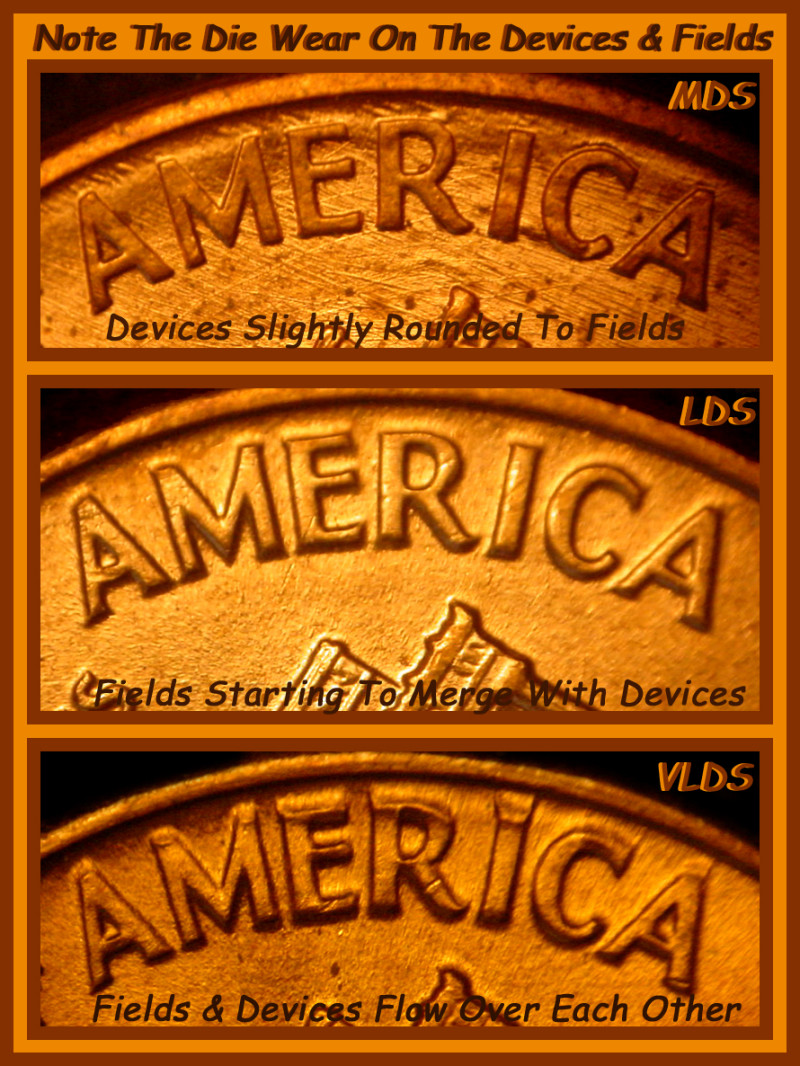 Keep in mind some of these coins are from the older die making process. The single squeeze process then to affect the outside edge of the out devices, but in these cases only the area next to the rim is enlarged but they are only die wear and not hubbed that way. The example above is one example. You see this on Zincoln's because the wear outlines the out edges of the devices near the rim area. 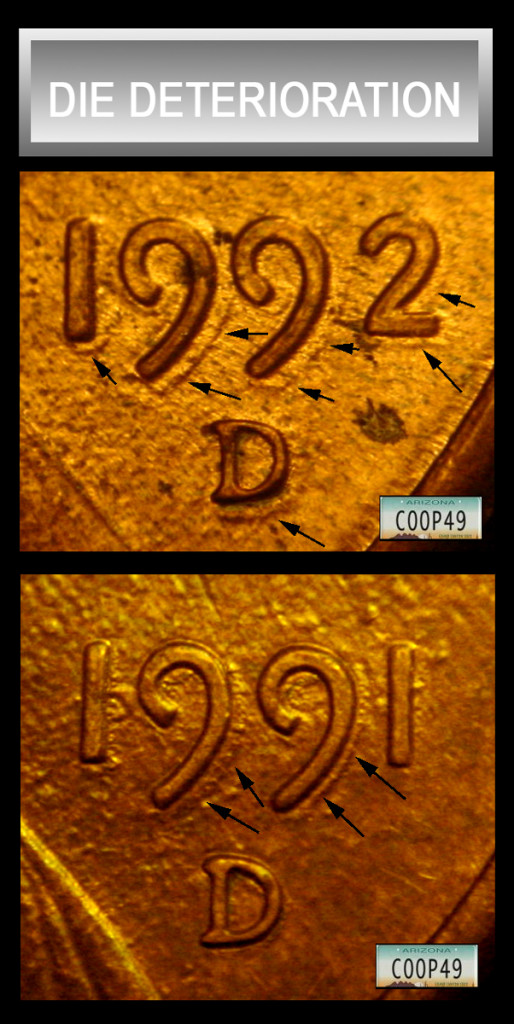 But this is not caused by a doubled, not by Machine Doubling but by die wear. Take another look at the coin above and you ce see it on the edges that face the rim in that whole area. Edited by coop
04/24/2012 02:03 am
|
|
Rest in Peace
United States
7075 Posts |
coop
Thank you for the detailed explanation. This is all still new to me. I just got my first loupe about 6 month ago and I am just fascinated by all the errors, varieties, and now, die states.
I saved your pictures so I can easily refer to them again. They are excellent photos and I think they will come in handy.
Thanks!!
|
|
Bedrock of the Community
United States
62064 Posts |
That is why I post them. For educational purposes. Thanks for asking the question.
|
| |
Replies: 18 / Views: 6,270 |







 Posted 04/20/2012 4:59 pm





