| Author |
 Replies: 13 / Views: 1,842 Replies: 13 / Views: 1,842 |
|
|
Pillar of the Community
United States
1227 Posts |
Okay, so this is a question I might have to explain a bit. I have some idea what a proof is, e.g. they're coins made in a different way with "quality over quantity" valued, sold in sets. But how do you spot one if it wanders into circulation?
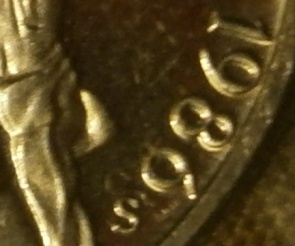
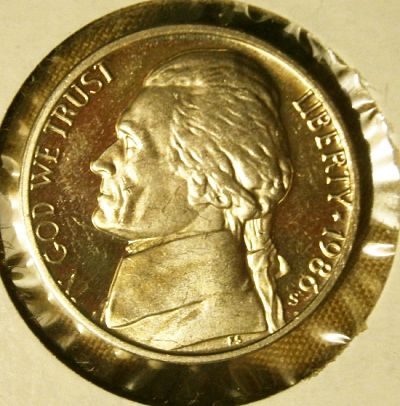
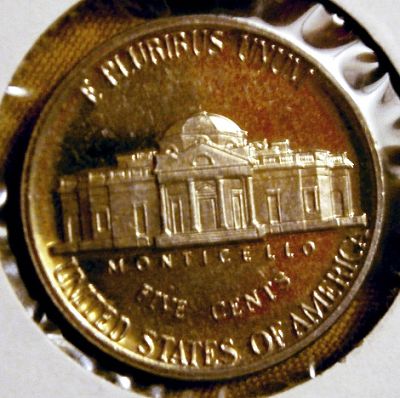
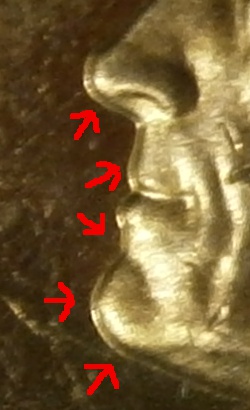
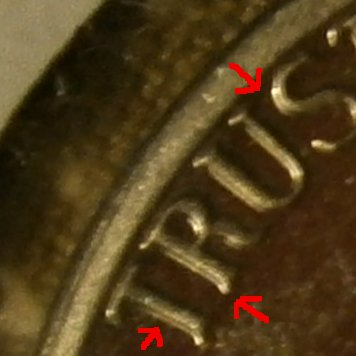
I ask because I picked up a 1986-S nickel at work that--aside from being in shockingly good condition for a nickel, especially an old one--doesn't look like . . . well, any other nickel new or old that I've ever run across. Jefferson has a frosted look, like etched/sculpted glass, while the field behind him looks like it was just about hand-polished by a very dedicated maid. The frost/polish effect isn't as pronounced on the reverse, but it's still there.
Proof? Not proof? We-need-more-pictures-to-provide-proof-that-it's-a-proof (lame joke, I know, sorry)? Maybe proof but I'm on the right track? Not a proof and I'm on a completely wrong track? Help!
Thanks, guys--this one has me lost.
|
|
|
|
Pillar of the Community
United States
4897 Posts |
Quote:
A proof coin is made with
a specially polished and treated die!
By treating the die in a special way, the coins it produces have a different appearance. Modern technology allows the high points on the coin design to be acid treated (on the die). The background (field) design of the coin die is polished, resulting in a mirror-like look on the coin it strikes. This gives the finished coin a frosted look (frosting) on the raise parts of the design, with a mirror like finish on the background. This contrasting finish is often called "cameo". On some older coins a cameo appearance is quite rare. The attribute "CAM", when added to a coin's description, means cameo appearance. "DCAM" means deep cameo, and indicates the cameo appearance is strong and easy to observe.
Proof coins are struck twice, or more!
Not only are proofs made using specially treated dies, each coin is struck two or more times by the coin die. By striking it more than once the metal is forced into all the crevices of the die, thereby giving a very fine detail to the image on the coin. This fine detail does not appear on some non-proof coins.
http://lynncoins.com/proofcoin_article.htm Modern proofs are fairly easy to pick out. Once you know how they are made. All proofs since 1968 will have a San Fran. MM. 19th century proofs?....a tad more difficult.... Edited by amida17
05/15/2012 11:37 pm
|
|
Pillar of the Community
United States
4132 Posts |
1986-S is always going to be a proof (San Francisco hasn't minted circulation strikes since the 70s with the exception of some SBA dollars). |
|
Pillar of the Community
 United States
1227 Posts |
 Whoa! Okay, then, that answers the question about this particular coin, for sure. I didn't look at names (sorry) so--whoever shared that commentary on cameos and how die stamps are done on proofs, thanks!! So in practice I'd be looking for that cameo appearance on any coins that came through my hands? |
|
Bedrock of the Community
 United States
12936 Posts |
Quote:
So in practice I'd be looking for that cameo appearance on any coins that came through my hands? That's a good indicator for sure. You're not likely to see (m)any proofs in circulation though. 'Course it depends on how many coins pass through your hands. If you are a teller or retail clerk or know one, your chances increase dramatically (obviously). I don't spend a lot of paper money so I don't get a lot of change. Just got my first 2012 coin in change this week, as a matter of fact. :) Great find with that 86S Jefferson!  Good luck and have fun! |
|
Pillar of the Community
United States
2295 Posts |
Great find on the proof nickel. Look for the mirror like finish. And proof coins minted before 1965 were done at Philadelphia, so you won't see a mintmark on them. Not a bad link. They missed that proof coins are struck with more pressure too. Also, some proofs were minted at West Point, like for Commems and American Eagles, but I doubt you'll find any in circulation, even though I saw one post of an ASE gotten at a bank for a dollar, in another thread. All circulating coins with an S mintmark from 1975 and on are proofs. Edited by wquinn
05/16/2012 08:58 am
|
|
Moderator
 United States
198363 Posts |
I always like seeing when a proof is found in circulation. I always feel like the finder has rescued it from a life it was not meant to have. Nice find!  |
|
Bedrock of the Community
United States
12437 Posts |
Quote:
All circulating coins with an S mintmark from 1975 and on are proofs Except for the 1979-S and 1980-S SBA $1 business strikes which were released for circulation, the 1981-S SBA $1 business strike were only available in Mint Sets but one of them could theoretically end up in circulation as well. |
|
Pillar of the Community
United States
8544 Posts |
I love a reverse proof too.
Oregon coin geek.....*** GO BEAVS ! ! ! ***
|
|
Valued Member
United States
72 Posts |
So what is a proof-like coin?I know that there are Denver Mint Eisenhower dollars struck on copper-nickel proof planchetts sent there by the San Francisco Mint due to poor quality or Overstock. They are described as being very shinny in both the fields and the applications of both sides. Would these be proof like? - Jim
|
|
Moderator
United States
198363 Posts |
|
|
Pillar of the Community
United States
1227 Posts |
CelticKnot, I'm a clerk at a gas station. Hence my near-constant stories about the cool stuff I find--there are six employees at my store, and four of us are collectors (one of us has been doing it for 30 years!). Word has gotten out to a lot of our regulars, so quite often when they find stuff they can't identify or spend elsewhere (the number of local clerks who apparently do not know what an Ike or SBA is, man . . . ), they'll bring it in on our shifts to spend. Then there's the change I handle as a matter of course, which is how I found this proof, along with a couple of dozen pre-WWII LWCs (my personal pet), my first Indianhead, a whole lot of foreign change, etc. Fringe benefits: I don't even have to pay for most of the rolls I hunt, I just fill our changers at work! This is kinda cool! I thought it looked weird for a nickel (albeit very pretty), but who knew? |
|
Pillar of the Community
Australia
1006 Posts |
Good question ninamason:) A proof coin is a coins which has been struck on a specially prepared die which is then treated in a number of ways (sand blasting) for a special effect. Now how to identify a proof coin in circulation. One way is to know which dates were released for circulation because proof coins are also struck in years were there were none actually struck for circulation. Secondly look at the relief of the coin (the difference between the high and low points) if this is more than a regular coin you probably have a high relief coin. Thirdly look at how the coin looks(primarily look for a Matte finish or a High shine finish).
|
|
Pillar of the Community
United States
1227 Posts |
|
| |
Replies: 13 / Views: 1,842 |
|




 Posted 05/15/2012 11:38 pm