| Author |
 Replies: 12 / Views: 2,108 Replies: 12 / Views: 2,108 |
|
|
Pillar of the Community
United States
1227 Posts |
I don't have pictures to explain what I'm talking about, but I bet you've all seen it before and maybe some of you know what it is: You know how on a brand-new, just-from-the-Mint coin, you get the cartwheel? I've been finding coins in my drawer, usually pennies (although I've found a few dimes like this too), that have a great luster and minimal toning (most recent: a 1959 that could pass for a 2008 if not for the date) but appear to have a RING in the light, instead of a cartwheel--you turn them from side to side and there's a perfect crescent of light that will appear on whatever part of the coin is turned to the light. I find it hard to believe these might be proofs--only one had an S mintmark, and I really don't believe I found 24 proofs out of a cash drawer in a single week. This is NOT the scuffmark you sometimes get on brand-new coins--in appearance it's exactly like a cartwheel, except for the shape, and is common enough that when I first began looking for a cartwheel on coins, this is the shape I thought I was looking for. Before someone goes "that's just PMD," the curious part is this: many of these coins appear undamaged. Sure, there's a teeny scratch here or a bitty nick there on some of them, but many of them appear almost new, or at least to be in smashingly good condition for the age. I also find it difficult to believe that anyone would clean this many old coins only partially, to the point that they're still toned to the "mellow copper" (instead of dark or bright copper) colour, or that that's even possible. So CCF: what the heck? |
|
|
|
Pillar of the Community
United States
3546 Posts |
Hi,
I could give a much better educated opinion on this if two or three photos showing this ring effect at different angles to a light source were available.
mdpmedia
|
|
Pillar of the Community
United States
1027 Posts |
The effect is common on Walking Liberty half dollars as seen in this image ... 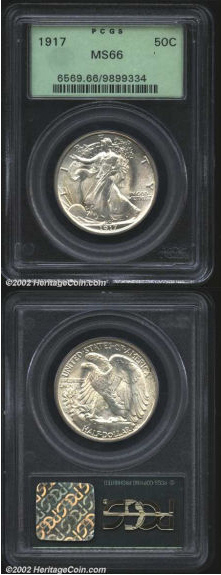 and is also seen on cents as well. It is perfectly normal and is not the result of damage. It is seen most often on high quality circulation strike coins. |
|
Pillar of the Community
 United States
1227 Posts |
Clair, I'm not sure it's quite the same--yours appears head-on, while what I'm seeing on these coins appears when they are turned in the light the same way you would when looking for a cartwheel. That is a gorgeous coin, though!
|
|
Pillar of the Community
Russian Federation
5186 Posts |
I've often seen a "ringed" luster on Saint-Petersburg mint steel 1 and 2 roubles (as in, it's there more often than not). This could be just normal "cartwheel" effect though, or something third entirely (well, if you have some steel SP mint coins in your collection - these were made in 2009 and 2010 - you could look to see what it actually is). Admittedly if it's supposed to be as common as the OP says this is probably exactly what he meant.
I have exactly two more coins (other than the above-mentioned pieces) with such a luster in my collection; one is an earlier SP mint piece (don't remember the date or denomination) and another is a bicentennial half dollar (from the USA).
|
|
Pillar of the Community
United States
950 Posts |
I know what you mean. Its almost like the metal molecules are lined up in different directions. Like a bad paint job on a car... it shines differently from different angles. I agree, its not PMD.. I have a bunch of wheats that are all shiny new and they sometimes have that round hazy reflectiveness. I think the picture of the walker is the same thing, you just cant move it in the light to see it change like you are describing. |
|
Pillar of the Community
United States
1227 Posts |
Baysinger, I don't know about bad car paint jobs, but that is EXACTLY what I'm talking about!! "Round hazy reflectiveness" = great description.
Given that I've only seen it on old (read: all-copper) pennies and new (read: clad, and curiously mostly from the mid-70s through the late 80s) dimes, I'm wondering if it has something to do with the way copper reflects with a light tarnish. Like I said in my original post, the idea that all of these were cleaned, in such a way that they then proceeded to tone gently and naturally again, without showing any visible signs of damage, is incredible (in the original, in-credible sense) to me.
|
|
Pillar of the Community
United States
950 Posts |
Just crossed my mind.. I wonder if this has something to do with how the metal has to stretch when pressed by the dies? I'm not sure how that works really.. I have only seen this on solid coins, not clad. Since the metals have a different hardness maybe that prevents it from happening on clad coins.
Come to think of it.. I haven't seen this on anything with nickel in it.. maybe nickel is the reason why it doesn't show up on other coins.
|
|
Valued Member
United States
88 Posts |
I believe what you're seeing is a microwear pattern on the working die that leaves shallow radial grooves on the die in the direction that the metal flows when struck. I see this constantly on coins that I am making. Depending on how far the metal is stretching it will usually begin to appear within the first thousand strikes. Copper does it least of all, cupronickel next, then silver, and the worst are the exotic metals like niobium and titanium... they are horrible for radially streaking dies.
If radial streaking is not too bad they are considered "normal" for business strikes. I understand that the US mint will run dies out to somewhere between 50,000 and 100,000 strikes before retiring them. Die cracking is rare nowadays since they started using the air hardening tool steels, so I would guess that it's the radial streaking going past some aesthetic limit that eventually kicks a die off the press.
|
|
Bedrock of the Community
United States
20027 Posts |
Sounds like what I call halo toning. Typically, you can see halo of luster round the central device (portrait). Seems to occur more often in the later die states because of the way the metal flows into the die.
|
|
Bedrock of the Community
United States
20027 Posts |
Quote:
I see this constantly on coins that I am making. What are you making?  Lincoln Cent Lover!VERDI-CARE™ INVENTOR https://verdi.care/
|
|
Moderator
 United States
194400 Posts |
|
|
Pillar of the Community
United States
1227 Posts |
BadThad, your "halo toning" also sounds very much like what I'm talking about. When you say "later die states" then, do you mean these would be coins from shortly before die cracks and replacement start happening?
|
| |
Replies: 12 / Views: 2,108 |
|










 Posted 07/27/2012 01:09 am


