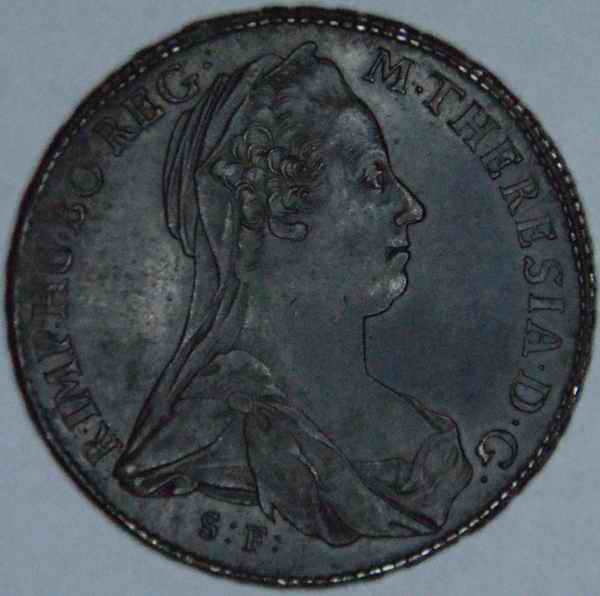
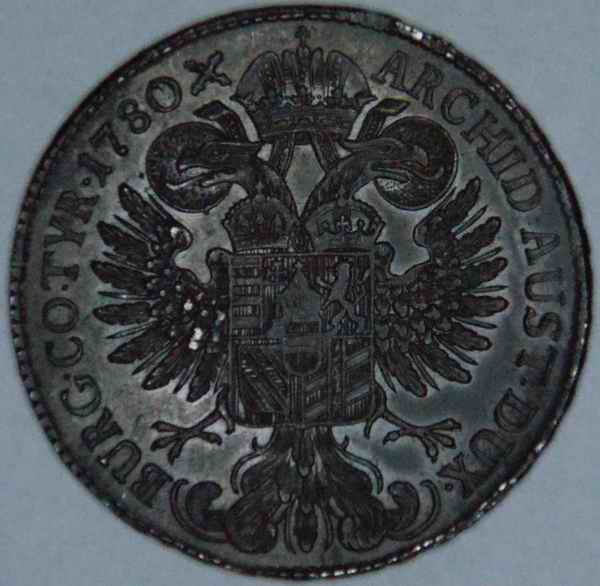
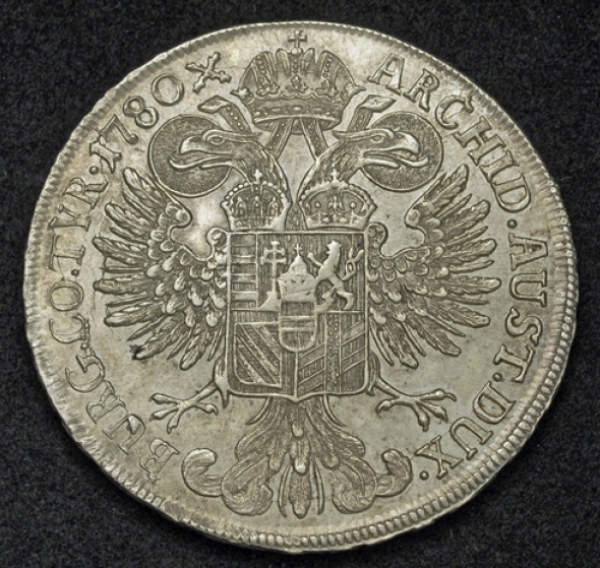
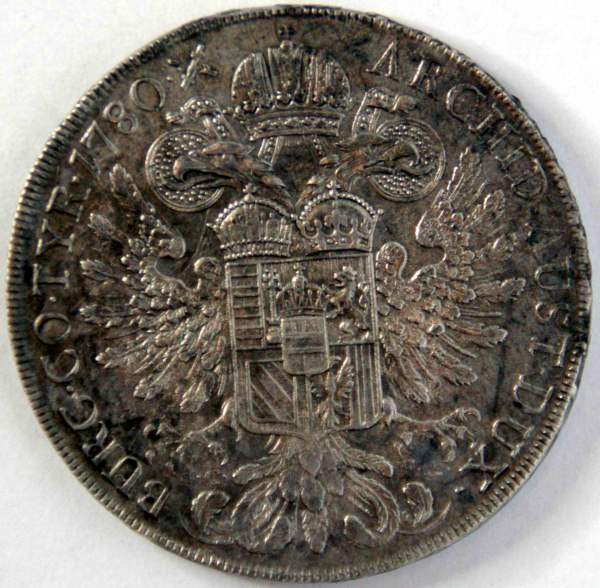
The maria Theresa thaler is a dangerous subject to make any comment on. The current accepted body of knowledge is riddled with errors: I was reviewing an old and locked thread that discussed this coin and cringed and some of the repetitions of errors: so as to highlight some of the issues this post takes some of the comments out of the older thread and highlights was is more correct with current knowledge:
Quote:
I guess it kinda 'rare' only 389 million!
Krause used to list the population as 800 million; most likely this was based on Behrens August 1969 World Coins article. It is currently accepted that the actual number is much closer to 400 million. What astounds me is so many people seem to think that is a huge amount. That 400 million is measured by most as being from 1751 (Incorrect date see later comment) to the current time and equates to a mintage of 1.5 million per year. That average is also deceptive.....the mode mintage number per year is much closer to 300,000 struck per year. It was only when the MTT was needed for wars/Military expeditions that the mintage numbers soared....eg Napiers expedition to Ethiopia, Italys invasion of Ethiopia as well as Egyptian and European actions in other parts of the Middle East/East Africa region. The Maria Theresa thaler is actually rarer than the Morgan dollar(total mintage 657 million). The
Morgan dollar has over 97 varieties....and the MTT (excluding counterstamps) has about the same perhaps more varieties. What seems to fool many people, some of whom should know a lot better, is the fact that the MTT is always produced with the same date. Even the ill fated
US Trade dollar had a higher yearly mintage than the MTT.
A lot of references use the start year for MTT as 1751.......this is an error that was started by HG Stride ( a
Royal Mint official who should have known better). The first MTT was struck in 1741.
Quote:
There were in fact only three varieties made in her lifetime according to Walter Hafner who wrote the definitive book on MTT's
This statement is poorly worded what would have been better is: in 1780 only three mints produced thalers bearing the bust of Maria Theresa: Vienna, Guenzburg( Burgau, a very misused name, is a region not a city/town) and Prague. Only one Prague mint variety is known with two known examples in existence. Vienna produced at least two varieties in 1780 (one plain brooch a second much rarer pearled brooch. Currently the total number of known original Vienna mint MTT stands around15-20 coins with the majority being the first variety.
Guenzburg: In 1976 when the first full description of the variety was published there were no known examples in existence. This year (2012) a sale in Europe brought the first one to light ( cost me Euro 1550.00) and quickly 2 more came to the market ( both lower grades and each sold for around Euro 1200)
Then there is this post
Quote:
Very cool to see one of these. My guesses as to how the features differ from a typical restrike:
1. In the word "AUST" the second letter is an actual "U" rather than a "V," which was typical on later restrikes.
2. The Shape of the "X" (which is actually a symbol of ownership of the Austrian Netherlands than an actual X) is different than later restrikes, and I believe that the serifs somehow indicate the exact mint.
Major error in the above:
2: the saltire "X" after the date was a mark of fineness added in 1750 when the thaler was debased from 9 to the Vienna mark to 10 to the Vienna mark. In the Veroderung (royal decree) signed by Maria Theresa the X is referred to as a St Andrews or Burgundian cross. It was later used in the Austrian Netherlands but not as a symbol of ownership. In 1753 the Bavarian monetary convention was signed and the thaler standard was adjusted slightly as it was set to 10 to the Cologne mark. The saltire was retained in that convention and is seen a variety of thalers....not just Maria Theresa's issues. As for the serifs sort of...but it is not reliable.
Quote:
There are five reverse mint marks:
A.H. G.S. for Karlsburg
EvS I.K. and P.S. I.K. for Prague
S.K. B.D./B for Kremnitz
T.S. I.F. for Gunzburg 1792-1796
Under the bust are:
F.S. for Venice 1815 only
SF, S.F., S:F: etc for Gunzburg and other locations after 1790
First off Mint mark is the wrong term. Mint marks were used but in the case of MTT mint signatures were predominantly used. The mint signatures were created from the Initials of the Mint master and mint warden(2IC) the only post 1780 restrike with a mint mark is the Kremnitz issue the mint mark is on the obverse and is the "B" listed above. The 1780 Kremnitz restrike was only struck in 1784. That year the mintage for all thalers from Kremnitz was just on 1,000,000. The majority of that mintage had a Madonna and child reverse accordingly the double headed eagle restrike from Kremnitz is extremely rare. In the last five years I have only seen three for sale: 1 on
ebay and the remainder in floor auctions. IMHO it is a very cheap coin for its rarity.
Now in regards to the FS variety: I won't go into to the long story but there is another attribution that is more likely to be true:
The F.S (Faby Stehr) coin was struck in the third quarter of 1793 at Guenzburg. The mint signature followed standard procedure for all Habsburg mints at that time but was actually in violation of the order covering the MTT restrikes. Vienna ordered the dies and existent coins destroyed. Currently 7-10 examples are known to exist making the Krause valuation a pathetic joke!
Missing from the above list is a possible issue from Lucca. This is the ST/SF variety Hafner 35. Hafner based his work on that of An academic Leypold ( who in turn had based his work on examining the Hafner collection. Hafner 35 was original desinated as being from Milan but in 1986 (2 years after Hafner's publication Leypold published another paper updating his research and in that paper he noted that the St/SF variety was most likely from Florence (1814-1828)










 Posted 10/29/2012 06:15 am