| Author |
 Replies: 25 / Views: 2,620 Replies: 25 / Views: 2,620 |
|
Valued Member
United States
169 Posts |
I know this illness can afflict many copper coins... I just got this S. Africa Penny and I wanted to know if its verdigris or some other natural process... 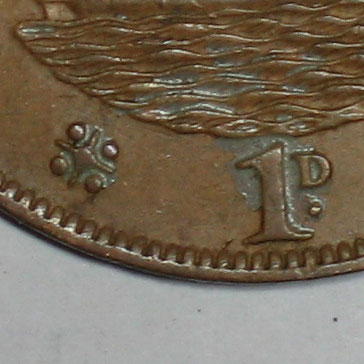 |
|
|
|
Pillar of the Community
United States
7123 Posts |
Looks like green death to me ,, Verdigris to me .
so far I have found nothing that is really effective on getting rid of it that does not alter the coin .
Metalman
|
|
Valued Member
Australia
161 Posts |
You sure it isn't something on the coin? It doesn't look anything like any vergigris I've seen unless it's just the pic.
|
|
Pillar of the Community
Australia
3838 Posts |
Usually I would try to scrap most of them out with a toothpick very gently. If they do some off, yes, they are perhaps verdigris. Nasty stuff it is.
|
|
Valued Member
Australia
161 Posts |
My main concern about this and the reason I don't think its verdigris besides it looking odd is vergigris doesn't usually go around high points on a coin it goes around, over and throught it. Oh and verdigris doesn't have a glossy finish.
|
|
Pillar of the Community
Belgium
2078 Posts |
I would put it first in a pure solvent
acetone in the pitch dark of a moonless night in the darkest part of my cellar with a wooden box over it wearing night goggles and gloves and breating equipment . Then rinse it in triple distilated water
Or alternatively in pure 99% plus ethanol
This ethanol can then be used to pickle cherries or prunes or whatever or deluted by 50 % with water and can be drunk
Beware 99 % ethanol will burn out your throat all the way to your stomach and kill you fast instead of slowly
|
|
Pillar of the Community
Belgium
2078 Posts |
PS It might be simple plasticizer migrated from PVC and acetone would dissolve that  I have had cases like that and for some or other reason ; probably condensation ; the attack is on the lower point of the coin |
|
Moderator
 Australia
16960 Posts |
I would agree with SS - I'm not sure what it is, but it doesn't look like the dangerous, spreading form of verdigris. With that "glossy finish", It looks for all the world like a patch of bronze patination like you get on ancient coppers - and that coin shouldn't be seeing signs of that for a few centuries yet.
Green Death, Bronze Disease or Verdigris is usually pale blue-green in colour, and crumbly. Try scraping at your deposit with a toothpick or similar tool. If it doesn't come off easily, then it probably isn't a major cause for concern. I'd recommend putting it in a flip or 2x2 and monitor it for a year or so; if it doesn't spread or changed appearance, it's probably just a relatively stable patch of oxidation.
Don't say "infinitely" when you mean "very"; otherwise, you'll have no word left when you want to talk about something really infinite. - C. S. Lewis
|
|
Valued Member
United States
382 Posts |
You could always out it in a glass bottle of GAS stick a rag in it and light it ! ! !! ! !! Just kidding. I have used Olive Oil in the past for my Coppers, it does not really get rid of the greenie meanies but it does give the coin a beautiful surface when done. "They" say the coin should be left in the oil for weeks. I have done this and no success. Tony  |
|
Valued Member
Australia
161 Posts |
It works fine on surface verdigris but not so good once it starts eating into the coin.
Like anything, test on worthless coins.
|
|
Pillar of the Community
United States
1173 Posts |
Ageka wrote: "I would put it first in a pure solvent acetone in the pitch dark of a moonless night in the darkest part of my cellar with a wooden box over it wearing night goggles and gloves and breating equipment . Then rinse it in triple distilated water Or alternatively in pure 99% plus ethanol This ethanol can then be used to pickle cherries or prunes or whatever or deluted by 50 % with water and can be drunk Beware 99 % ethanol will burn out your throat all the way to your stomach and kill you fast instead of slowly"  Maybe one should sit back and drink the ethanol while the coin is in the acetone! |
|
Pillar of the Community
Belgium
2078 Posts |
Hunter You guessed my MO  |
|
Pillar of the Community
United States
7123 Posts |
Sap and SS may be right ,, I did not notice the shine last night when I looked at the pic,,
If whatever it is has been on the coin for a substantial period of time ,, removing it will leave a different color where it was ,, if it is not actively damaging the coin ,it maybe best to leave it alone.
I would however segregate that coin from my other copper and Bronze coins just to be on the afe side of things.
Metalman
|
|
Valued Member
 United States
169 Posts |
I poked at it a bit with a toothpick... some of the stuff fell off. There doesn't seem to be any strong discoloration right underneath the patch. Might try acetone if I end up getting a bottle.
|
|
Pillar of the Community
United States
2703 Posts |
Does not look like bronze disease. I have battled the green death, and this does not look like it.
Based on my experience, here is what I would do:
1) I would probably leave it alone and monitor it as sap advised. This is probably the best advice.
2) If I just couldn't stop thinking about it and had to try something, I would start off as mild as possible. I would take a small fine, soft artists brush, dip it in distilled water and dab the spot carefully to see if the grey stuff will dissolve. Dab lightly with the brush at glancing angle rather than directly at the coin's surface to avoid any possibility of leaving marks. Then blot carefully with a soft paper napkin, pressing it against the spot. Work under a microscope if you have one. If the stuff starts to come off and and the coin looks better, then slowly repeat the process until you have the stuff removed. Go slowly, give the spots time to dissolve and make sure you are not making it look worse. If distilled water did nothing, I would try 70% isopropyl (rubbing) alcohol in the same procedure. If still nothing happens, the spots are pretty stable, I would leave it alone, it really does not detract that much.
I don't think olive oil will do the trick, but you could try that in the same procedure as well. Use the lightest oil at the store, which is usually the cheapest (do NOT use the heavy and expensive extra virgin types, they will not work as well).
Hope this helps!
|
|
Pillar of the Community
United States
2703 Posts |
Maybe the grey stuff is glue or cement or some other liquid (a beverage)? I am guessing the coin was placed on an unclean table or desk and it picked up some liquid from something spilled on the table's surface which then dried down.
|
| |
Replies: 25 / Views: 2,620 |







 Posted 04/15/2007 04:04 am





