| Author |
 Replies: 12 / Views: 2,421 Replies: 12 / Views: 2,421 |
|
|
Pillar of the Community
2087 Posts |
I am asking if this is a modern fake. The coin just doesn't look right according to the period it was minted. However my experience with this type of coin is very recent. It is known today as a Luigino in the past it was known in the Ottoman realm as Timmin (or Temmin). Timmin purportedly means "8" or "an eighth" in 17th century Arabic-Ottoman. This example is supposedly from Fosdinovo but I couldn't find it listed in Krause ( I may have looked in the wrong place) The story behind the Luigino series is interesting. In the 1650s the French got into conflict with the Netherlands, a side effect of this conflict was that French Levantine traders lost access to the Lion Thaler. A trader in 1657 used some of these coins for purchases in Smyna and the locals there valued the coin at 8 to the dollar(hence the name Timmin). The actual European issue value was 12 to the dollar. The coins were very attractive in the Ottoman empire, some suggest this was because they were one of the first milled coins seen in that region. There was considerable demand and French traders realized they could make a 100% profit using the coins. So they started using them in great numbers. The initial official exchange rate followed the Smyna experience and was officially set, by the Ottomans Authorities, at 8 to the dollar( note: around this time all Dollar/Thaler coins were valued at the same rate by the Ottomans, hence the Lion thaler had been the preferred coin for Levantine trade due to its low silver content). British and other traders soon found themselves at a distinct disadvantage to the French. They appealed to the Ottoman authorities who adjusted the exchange rate to the correct level. French traders wanting to maintain their competitive advantage adapted quickly: they found European mints who were happy to produce these coins using a debased silver standard. My reading suggests that from about 1660-1669 the silver content of these coins steadily decreased every year until the coins were effectively valueless in bullion terms. It was in 1667 ( the year of this possible example) that the Ottomans started to properly deal with the problem. The Ottomans had a preference for the Dombes variety of this coin and this became the standard form. Rightly One could say all mid to late 1660's Luigino are fakes or tokens. But this one really looks like a modern copy to me. I can't use weight or diameter to judge the authenticity. I would really appreciate the comments from others in regards to whether I have a true 1667 strike or a modern fake. 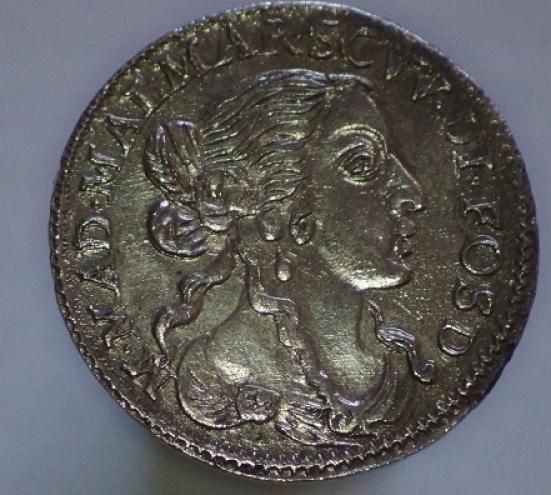 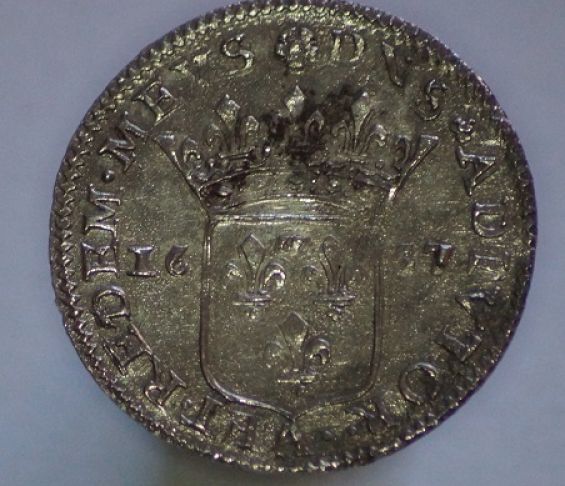 Edited by austrokiwi
02/08/2013 06:19 am
|
|
|
|
Pillar of the Community
United States
5362 Posts |
Excellent back-story on this coin. It is very similar to the Carolus 8R coin. There are a few issues from the early history of world trade that present a similar history. Funny how numismatists keep forgetting these stories. It is a rediscovery of history that was once well known but is now forgotten. These coins could be classified in a way similar to the 8R. In particular what you say: Quote:
Rightly One could say all mid to late 1660's Luigino are fakes or tokens. Now the issue becomes how do you tell which is which without XRF and how common are these alternative circulating versions? Are they a distinct and collectible class? I have to agree with you that this coin looks particularly modern, but high grade early European coins often do. I would be willing to bet that the originals were made on a roller press (standard for that era). The roller press used rather thin strips of metal that tended to bend as the design was imparted. The finished coins were punched from the strip. The process was the reverse of the 8R. So clues about edging involve the parallel grooves on the edge of a high grade coin. If punched they would be perpendicular and show no angular variation to the faces. If clipped the angle would vary and be irregular. Adjustments were made to the edge so some filing is likely depending on the standard tolerance. I would look for a slight bend and at the edge very closely. Modern forgers rarely get those traces right. Make sure the die surfaces are fairly smooth and uniform. The image formation on a roller press depends on the surfaces being parallel at all times and equidistant from one another. On a roller press the details are applied as the strip rolls through the press and the dies rotate. The impression is applied across the face at one time. Major flow lines tend to be directional and parallel to the rolling direction while the balance of the flow lines are minimal. Also look for traces of distortion along the axis especially of the letters and small features where a 360 degree perspective is visible at one time. Modern forgers usually use flat presses because die replication from a rolled coin is difficult to duplicate. I do not know any who do that, but it is possible I would suppose. Then I would compare engraving styles with other coins of the same denomination. If after all of this it still looks real you might want to get an XRF test to see if any modern rare earth metals are found in the surface silver. This is not a quick process when you start exploring new territory (or territory that has been forgotten) BUT you could be the person to retell this story and perhaps in the process create a new class of collectibles. It becomes your duty to become the teller-of-the-tale. |
|
Pillar of the Community
 2087 Posts |
These photos might help you see what I do. The top coin in both photos is a 1664 Dombes(France) strike. The bottom left is a 1666 Tassarolo (Italy) strike, and the bottom right is the suspicious Fosdinovo (Italy) 1667 strike. The Fosdinovo coin is cruder in design on a slightly larger blank that just may reflect lazy production in 1667 but it just looks way to modern to me. The coins probably were produced by roller mill but as they are aprox 20 mm in diameter and only 1mm thick the signs of this production method are, for me, very hard to spot. Looking at these photos, as poor as they are, I am even more suspicious of that bottom right coin. 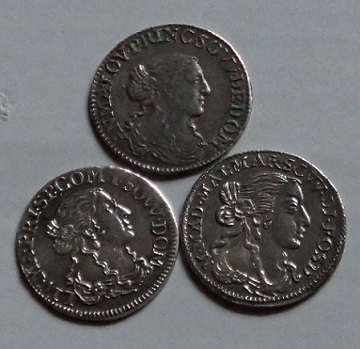 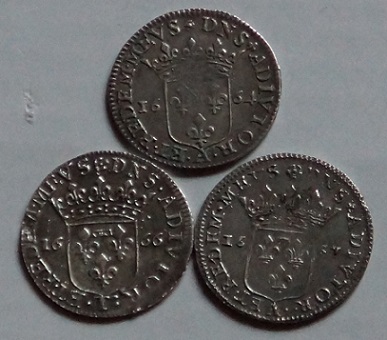 |
|
Pillar of the Community
United States
5362 Posts |
I located the following coin in MS 63 encapsulated by NGC sold for $207 on Jan 11, 2011 at Heritage. 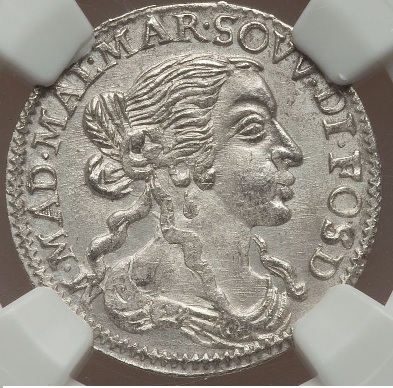 Looks pretty similar to yours. That is not to say either of the two is actually "genuine" they both may fall into the counterfeit category which I suspect they may. How long did these stay in circulation? Edited by swamperbob
02/09/2013 6:04 pm
|
|
Pillar of the Community
2087 Posts |
Thanks Swamperbob I had never thought of using Heritage Archives for this coin. My example is a close match to the two examples that Heritage has in their archives ( similar grade as well). The crudity of the design is probably due to lazy die making work. In 1667 it was probably very likely the days of the Luigino were numbered and the debasement had reached "new lows" cheap manufacture would have been a priority at that time. The other less interesting fact is my example only cost €40.00 so I certainly didn't over pay for the coin.
|
|
Pillar of the Community
United States
5362 Posts |
Sounds like you got a good deal. I use Heritage and Stacks a lot when checking ebay auctions. Just last week a territorial gold coin appeared that had been broken out of a TPG holder. Heritage had sold it for $3220 as a "tooled coin". It appeared with no warning and was terminated as a fraud. The access via the Internet is wonderful for checking. |
|
Pillar of the Community
United States
1769 Posts |
Tough to say but as with most coins you go by a regal weight standard, appearance of metal, edge wear, obverse/reverse legends matching correctly, etc.. But since the 1660's you see a silver debasement occuring. During the last 3-4 years I have been SERIOUSLY examining/collecting world contemporary counterfeits pre-1800 such as the French ECU's. I have in my collection XRF confirmed: copper, brass, bronze & debased silver alloys. Sounds like another good study for your coinage. If you contact me in late March/April I may be able to XRF examine a few for you at little or no cost just for research - I am that booked up with other numismatic investigations ... this is what happens when you only charge for postage & handling <BG>. See some of my duplicate items which are XRF'd on E-Bay from time to time and google my name with the word "coin" as a reference (John Lorenzo, coin).
John Lorenzo
United States
Edited by colonialjohn
02/11/2013 1:50 pm
|
|
Pillar of the Community
United States
1962 Posts |
|
|
Pillar of the Community
United States
5362 Posts |
Interesting - shipwreck with three types of trade coins. I wonder if the Luigino coins were locally made or copies made elsewhere for trade purposes. Always a possibility when you get a mix of trade money.
|
|
Pillar of the Community
Hong Kong
1270 Posts |
Hi members, I would like to show you this Ragusa/Dubrovnik Republic 1794 2 Ducati. The portrait of this thaler size silver coin is always mis-interpretated as Maria Theresia but it is only a portrait imitating MTT for competitive trading purpose in Mediterranean region. I have checked the S.G. of this coin a few days ago and it was measured as 9.78 which corresponds to about 55.33% silver fineness in my system. For other data (%Ag) compared with the known book value, I suppose my system had underrated the measured Ag fineness by 5% so the fineness of the following coin at most equals to 60%Ag. It seems un-reasonable for a Trade dollar coin had that low Ag content in that era. How could it compete with a real MTT by such a low Ag fineness? As the World Coin Catalog does not state the Ag fineness of this coin, I hope someone who knows the actual silver fineness of this coin can tell me. Or, was there any cause that enabled this 2 ducati coin to debase? Of course, I hope this is another modern fake anyway. Any comments on this coin are welcome. Henry 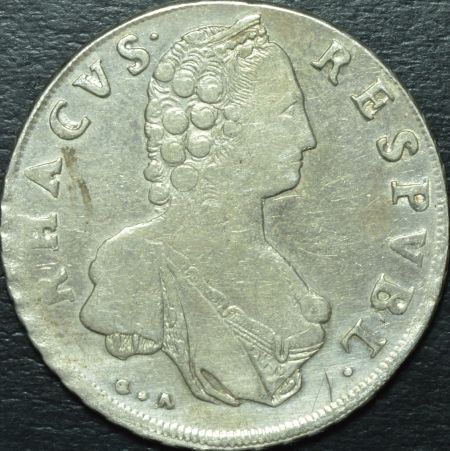 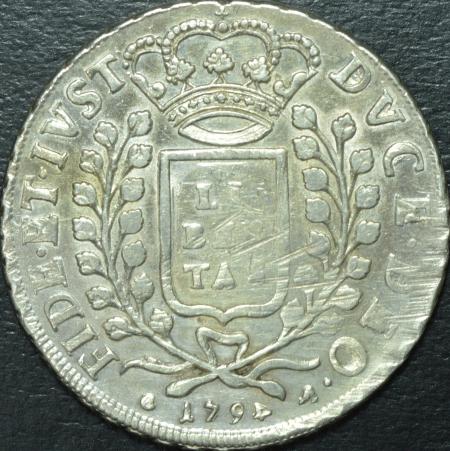 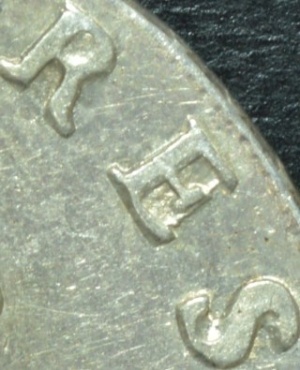    |
|
Pillar of the Community
2087 Posts |
Thanks for all the comments: my replies: Quote:
Sounds like another good study for your coinage. If you contact me in late March/April I may be able to XRF examine a few for you at little or no cost just for research - I am that booked up with other numismatic investigations The Luiguino aren't that important to me apart from the economic story they tell. However I will contact you late march for another coin. London die MTT. In Austria it is believed that Bombay/Calcutta Mint MTT have a specific set of identifiers. Problem is I have not been able to find one with those identifiers......in my research I discovered the researcher responsible for initially describing the Bomaby Calcutta types had based his description of a coin in The Royal Mint. Problem is that coin is/was a trial strike and as there were considerable concerns with it Royal Mint technicians went to India to sort the problem out. It may well be that coin ( now lost) was one off variety. What is known is Indian silver was poorly refined. I believe I have identified the true Bombay Calcutta identifiers but would need the have this tested by XRF. ( If My hypothesis is correct the coins with the specific identifiers I have identified will have aprox 0.04% gold in the alloy as well as tin and zinc) Quote:
Kiwi, I'd bet that your piece is from the shipwreck source that produced a quantity of these pieces. My three examples came from three different sources but I don't discount the shipwreck source idea. Quote:
Interesting - shipwreck with three types of trade coins. I wonder if the Luigino coins were locally made or copies made elsewhere for trade purposes. I know the following mints produced Luiguino modelled on the Dombes type: Arquata, Avignon, Monaco, Orange, Torriglia, Genoa, Loano, Serboga,Tassarolo, and Tuscany. I am sure this list isn't complete. It would make sense to have coins made as close as possible to the final destination so I would expect Sicily would be a good place to mint these coins. I checked Krause and there is no record there of these coins listed under Sicily. Thinking about it as I write. Sicily was under Naples and Naples does not seem to have produced these coins. Linking a shipwreck to Sicily may not not overly reliable. the coins could have been shipped from Genoa or Marseilles and sunk near Sicily on the way to Istanbul Smyrna or Allepo ( French traders were the ones who commissioned these debased coins) Edited by austrokiwi
02/14/2013 3:30 pm
|
|
Pillar of the Community
United States
1962 Posts |
"Naples" (as in Naples and all of the southern mainland) and Sicily each produced their own distinct coinage (under Spain) at that time... a luigino denomination was not produced by either of them.
Sedwick doesn't mention anything that links the shipwreck or the origin of the coins TO Sicily... they were simply found in a shipwreck NEAR Sicily (apparently clandestine, no other info). Could be from anywhere...
|
|
Pillar of the Community
United States
5362 Posts |
I think proximity may be overstated. A coin especially one made to take advantage of a trading premium on a specific variety is going to be made by people who have no access to originals or who produce no native trade coin that is accepted at equal rates. Also implied are a suitable sources of silver and adequate minting capabilities.
I know by the late 1700s silver shipments in bulk added only 2-3 cents per dollar to shipments from London to China. So a trade premium of 4% would have been attractive to the English forgers at that time. They also tended to debase their silver in line with the target's capability of testing. The used Sheffield plate technology (after 1770) to hide their deception.
I like your thoughts on silver testing to ID poorly refined Indian silver. Worth exploring anyway.
|
| |
Replies: 12 / Views: 2,421 |
|







 Posted 02/09/2013 04:06 am


