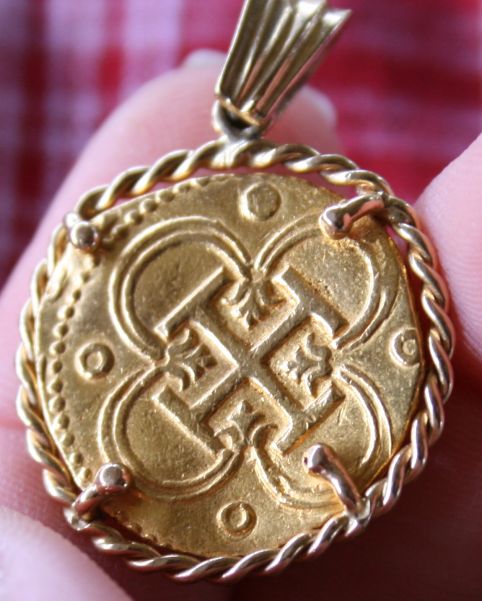
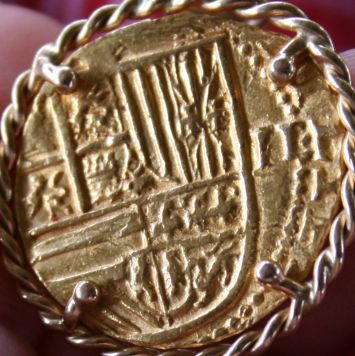
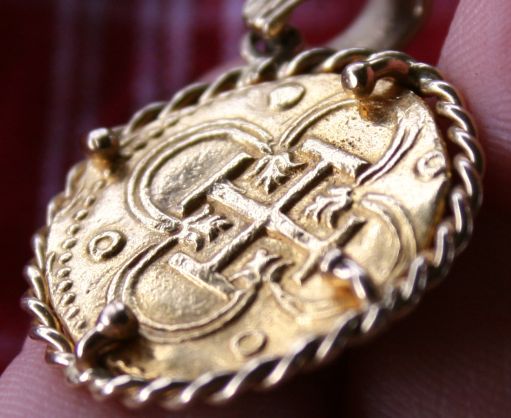
Firstly, the Philip II Seville 2 escudos attribution is correct. Furthermore, the design as seen is correct. This is either a genuine coin, or copied perfectly accurately FROM a genuine coin. Note that a Seville Philip II 2E (esp. clipped down like this seems to be - see below) is not particularly rare or expensive as far as gold cobs go.
I would ask the weight, and try to guesstimate what that bezel might weigh to try to ascertain whether that "could be" in the range for a legit 2E plus bezel (or too low, indicating a likely copy as casts are typically light)... However, note that you noticed that part of the words (i.e., the legend) looks cut off. That wouldn't be unusual at all - on LATER cob coinage (getting into the 1600s, where the planchet were often made chunky and too small for the design). However, most EARLIER pieces like this tend to be broader that this, not chopping off as much legend. Therefore, IF this is an original coin, it was almost certainly clipped down somewhat at some point... so estimating weight is difficult (though I might guess an original clipped like this would be around 5.5-5.6g without the bezel).
Now, what alganbagerap said about (genuine) coins used in jewelry and what happens to them is absolutely correct. Additionally, when dealing specifically with Spanish reales/escudos of this era (cobs or otherwise)... in addition to a lot of GENUINE pieces ending up in jewelry over the years, there are a LOT of jewelry REPLICAS out there. People LOVE the whole pirate-era, doubloons, pieces of 8, etc., etc. kitsch. So, after seeing so many silver and gold replicas of reales/escudos (produced and sold by outfits such as "Atocha Treasure Co.", and the Fishers themselves)... if you're not familiar with what you're looking at, you should almost assume guilty before innocent.
Now, I'm more familiar in assessing silver, whose surfaces I've simply seen more of in person and in photos (genuine material and replicas, of which I keep a database). I also find that they generally put more effort into crafting higher quality, more convincing casts for the gold "coins" as opposed to the silver... which only makes sense, as they are bigger ticket items.
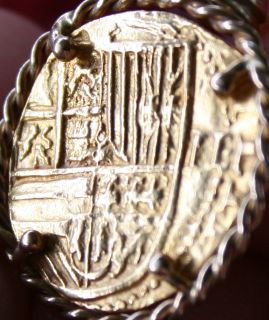
Also, going back to the point about jewelry pieces taking a beating through wear and tear (and/or intentional polishing)... gold is softer than silver, and will catch more dings, scratches, etc... which further complicates assessing a genuine vs. replica for a gold cob in jewelry. As such, it's usually a lot easier (for me, at least) to know if a silver Spanish "coin" in jewelry is genuine or replica.
So that's a general quick and dirty of what goes into analyzing a piece like this... As far as this one in particular - I don't see anything that screams cast, but I wouldn't say "genuine" conclusively. The fact that it's clipped down so much is a point on the side of genuine (such clipping reduces any numismatic value, making it a more logical candidate to "waste" on jewelry).









 Posted 11/13/2013 8:41 pm




 After a hundred years or so of this type of treatment, it's hard to tell if it's a well made copy or a badly treated original.


