| Author |
 Replies: 9 / Views: 5,265 Replies: 9 / Views: 5,265 |
|
|
Pillar of the Community
 United States
3098 Posts |
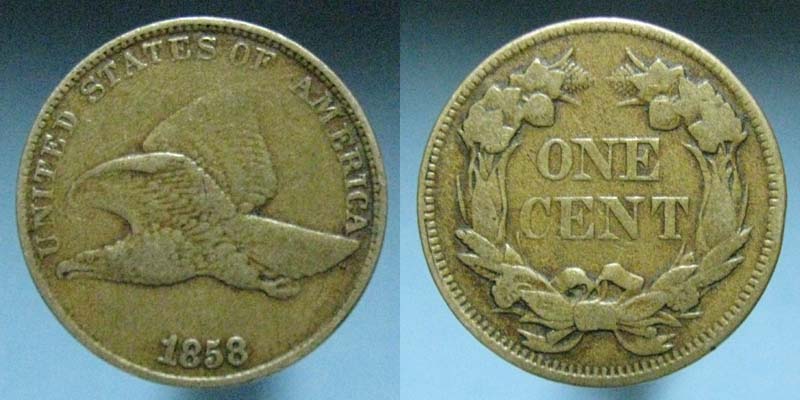 I have this 1858 LL Flying Eagle cent that I think might be an 1858/7 overdate. It appears to have the tell-tale broken wing. The coin is worn enough and has enough marks on it where there is no remaining evidence of the two die chips above the date that are part of the diagnostics for the overdate. Can this type be identified by the broken wing alone, or do you need the die chips in order to be certain? 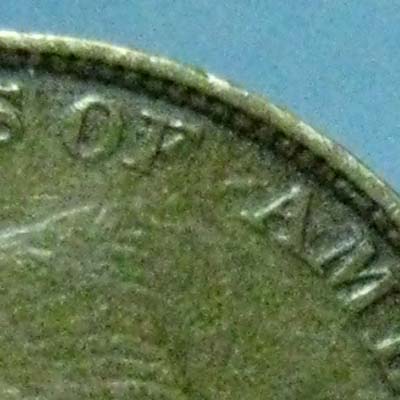 *** Moved by Staff to a more appropriate forum. *** *** Moved by Staff to a more appropriate forum. *** Paul Bulgerin
|
|
|
|
Bedrock of the Community
United States
10045 Posts |
Here are a couple pics showing the markers above the first "8" in 1858 and the (faint) remains of the 8/7--which is pretty tough to see on later die states. (click to enlarge details) This "ear" above the corner of the 8 is the only direct evidence of the original 7 on the die.  Edited by DVCollector
01/05/2014 11:18 pm
|
|
Pillar of the Community
 United States
3098 Posts |
There is a faint mark in the right spot and at the right angle for the die chip to the upper right of the second 8, but I couldn't say for sure if it is a worn die chip or just a mark. There is no remnant of the die chip in the field above the first 8.
Paul Bulgerin
|
|
Bedrock of the Community
United States
10045 Posts |
I seem to recall the broken wing tip was on a hub, so several dies have it--not only the overdate.
The overdate is a tricky one to detect--and I'm not sure which markers are on every overdate coin.
The actual 8/7 is not visible on all of them.
Edited by DVCollector
01/06/2014 12:00 am
|
|
Pillar of the Community
United States
716 Posts |
I think it is almost impossible to tell if your coin is an 1858/7 overdate (Snow-1). As DV stated the broken wing tip alone is not diagnostic because it is found on a number of other dies. Your coin does have the high leaf reverse variety which is found on the overdate but again it is not diagnostic. So due to the worn condition or late die state of your coin, making that determination either way may be impossible.
There is also a similar overdate variety (S7) which is extremely rare. It is characterized by an extra '7' to the right of the '8'( similar to S-1) and a extra '1' to the left of the date. There is also strong doubling in UNITED esp. on the UNI and the eye of the eagle.
All the information I posted comes from Snow's attribution guide. Hope this helps.
|
|
Pillar of the Community
United States
8533 Posts |
How they can make out a seven is beyond me...  Oregon coin geek.....*** GO BEAVS ! ! ! ***
|
|
Pillar of the Community
United States
3098 Posts |
Thanks for the help. I'll list it as an 1858/7 "With my fingers crossed for luck that it is" written on the coin holder.
Paul Bulgerin
|
|
Bedrock of the Community
United States
10045 Posts |
--possibly with sommething like "decide for yourself" because many IHC buyers will be looking to see the diagnostics.  Quote:How they can make out a seven is beyond me... Seriously. It must have taken a close analysis of several EDS examples. I specialize in overdates, and all of mine are much clearer--I can never find this one without the markers, such as the die dent above the "8"--and I have yet to find one anywhere, unattributed. Edited by DVCollector
01/06/2014 4:55 pm
|
|
Pillar of the Community
United States
716 Posts |
I looked at a couple of mint state 1858/57 overdates that Rick Snow had for sale on his website. Even with the closeup photos and arrows pointing to the markers I had a difficult time seeing them. Maybe they are more evident with the coin in hand.
|
|
Pillar of the Community
United States
688 Posts |
I know for me personally, I wouldn't buy this coin as an 1858/7 unless it was slabbed and certified by a TPG. As others have stated, the broken wing tip isn't enough to make it the overdate and the other diagnostics are hard to make out. If I was looking at purchasing it I wouldn't pay anymore than I would for a normal 1858 FE in that condition. |
| |
Replies: 9 / Views: 5,265 |
|










 Posted 01/05/2014 11:40 pm


