| Author |
 Replies: 14 / Views: 7,444 Replies: 14 / Views: 7,444 |
|
|
New Member
United States
3 Posts |
Hi, I just bought this Spanish 8 R Cob for my grandson as a gift and was going to have it mounted in a bezel for him. But it's under weight by almost half. (Weighs 15.4 grams). As far as I can tell all the markings are correct and it is a 1733 Klippe, assayer "F". Appears sea salvage. This coin does appear to have a ridge, like a cast ridge, but only on one side. Just wondering if that could be from being cut in two long ago. Any help is greatly appreciated. Thanks in advance. 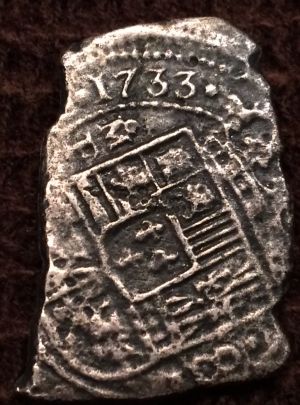 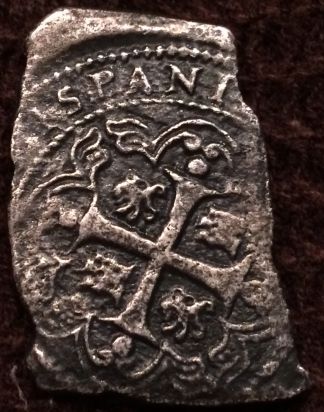 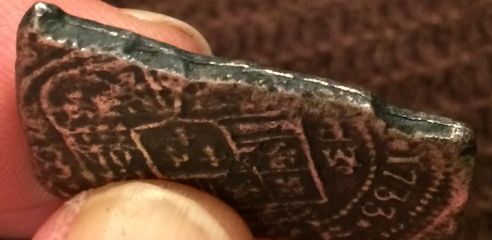 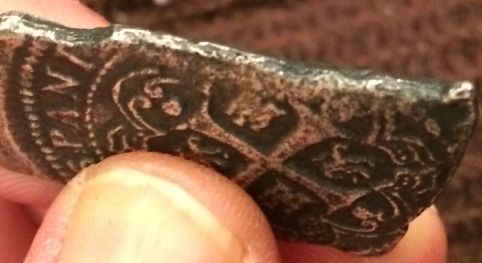 Edited by jamest
01/10/2014 12:56 am
|
|
|
|
Pillar of the Community
France
1591 Posts |
Looks like a cast copy of a sea salvaged 8 reales Klippe indeed.
What you have on the cut is not possible on a genuine coin, and those were ultra-sharp, even really damaged sea-salvaged coins of this type are sharper.
|
|
New Member
 United States
3 Posts |
|
|
Pillar of the Community
United States
3363 Posts |
"Two minutes ago I would have sold my chances for a tired dime." Fred Astaire
|
|
Pillar of the Community
France
1591 Posts |
PS : as a pendant, it can still be nice ! I would actually prefer to damage a copy than a genuine coin ;)
Particularly for this type - they are quite scarce and expensive (you can get a nice "regular" cob for much less, which would look cool as a pendent)
|
|
Pillar of the Community
2087 Posts |
An aside: you call it a "Klippe" I thought klippe were completely different eg: http://www.mcsearch.info/search.htm...&c=&a=&l=#16To expand a Klippe is produced by means of a roller mill strips of metal were rolled through an apparatus much like an old fashioned washing machine mangle. This producing a series of coin on the strip. to produce the actual coin it was cut out of the strip. it became fashionable for the contemporary collectors to collect the un-rounded cut outs. As seen in the link. |
|
New Member
United States
3 Posts |
Yeah, as a pendent it would be very nice because of its full date and very good details. I defiantly wanted it to be authentic.
Also it's called a "klippe" because its a transition coin (struck 1732-1733) 1733 was the last year of hand struck cobs at the Mexico City mint.
|
|
Pillar of the Community
France
1591 Posts |
astrowiki : look for Klippe 1733 on MCSearch, you'll see that coin ;)
It's the name of hand-cut coins indeed. From what I understood, they were cut to the proper weight, and then printed between two mechanical dies. To me klippe = klipped, which means hand cut.
It's indeed the transition between the cobs (hand hammered between two dies), and modern coins which were cut to the proper shape and weight, and then pressed (the edge being applied before or after - depending on the period)
What you describe could is what was done for previous copper coins from Spain, they were rolled like that and then cut (not all, some were hammered). Segovia was also minting silver coins that way (I can post pics of those if you want).
|
|
Pillar of the Community
United States
1768 Posts |
Its a cast. I have yet to XRF analyze a real one. I just have to spend the $1000-1250 for a struck real one. <BG>.
John Lorenzo
United States
|
|
Pillar of the Community
United States
1801 Posts |
John
I have several real ones (I sure hope they are real), when do you want to do the XRF? I could ship them to you right before USMexNA in October and you could bring them back to me at the event. Since the main discussion topic this year is fakes, that would work out nice.
|
|
Pillar of the Community
France
1591 Posts |
|
|
Pillar of the Community
United States
1768 Posts |
Actually I was just at the New York International and met Max & Cory from Mexican Coin Company. This years MNA Conference is indeed on fakes - I think they tried to get Bob Gurney (swamperbob) to go but not sure on his answer - he was just at Florida FUN - its also a long flight for me from NJ to Arizona but I am considering it. I will take you guys up on your offers but not right now ... maybe one at a time in a few months - got some other stuff going on now and someone else has to do the XRF analysis for me at my new company so its only a few samples per month. Personally - I am assuming there will be no surprises on these issues with Ag,Pt & Au levels.
One thing is for sure on another topic Krause is all "messed up" with the War of Independence listings. Max does a great talk on certain KM issues in the recent MNA #2 Conference Talk which is available on CD - see the MNA journal or call MCC. I also talked to Mike Dunnigan at the NYITL - he kind of straighten me out on the 1811 Chihuahua cast pieces from my recent 9/2013 paper in the MNA journal - my idea that the plain edge 1811's may have CIRCULATED first and then with regal edges is UNLIKELY as an anti-counterfeiting measure for these issues. There are about 5-6 known 1810 Chihuahua - these are actually known as a group of authentic mint stamp pre-1811 issues (i.e., such as 1806,1808,1810,1809, etc.) with the Chihuahua T & Pillar of Hercules casts as with the 1811-183 issues and ALL OF THESE have circle and sqaure edges. He had one of the 5-6 known at NYITL for $10,000. The edge was present but CRUDE. The point being there was a notion a year earlier in 1810 at Chihuahua to supply regal type edges to these cast Chihuahua's. So ... the plain edge seen in my study for the 1811 Chihuahua cast he thinks are just minting flukes or pieces that just ACCIDENTALLY got passed the edge applying process during their production at Chihuahua in 1811. Seems likely ...
Edited by colonialjohn
01/11/2014 11:15 pm
|
|
Pillar of the Community
France
1591 Posts |
colonialjohn : I love that hunt for information regarding those chihuahua cast issues :)
One of the raw edge coin was mine, and didn't have proper metal content. You listed it as a sheffield plate, but for a crude issue, it's very strange. Couldn't it just be really badly mixed silver ?
In any case, that coin keeps puzzling me - I don't see the point of faking such coins, particularly with an advanced technique like that which was much more complicated than simple casting. And remember, the two stamps are there, and are perfect and perfectly clear.
I've seen those MNA DVDs on sale at USMex, I wish there were something else than DVDs ... I understand it's easier to get some money that way, but I would pay as much for a nice PDF presentation with the same content (presentation + pictures). I've actually seen at least two or three interesting topics (counterstamps, cobs for felipe II and III, and Sedwick's presentation)
|
|
Pillar of the Community
United States
1768 Posts |
It simply could be debased alloy ... the WOI issues are still in their infancy.
JPL
|
|
Pillar of the Community
United States
1962 Posts |
Should be noted that the piece in the original post is a known replica (I have seen it in "historical replica"-type sets... and I actually have one that I picked up loose) so really, it is more properly intended as a replica rather than numismatic forgery, if you're inclined to mark such distinctions... While a fairly faithful Klippe replica in terms of just detail, this honestly shouldn't fool anyone into thinking it's genuine... even if seeing just obv and rev photos and not a shot showing the clear edge seam. It "appears sea salvage" b/c it was clearly cast from a sea salvage piece, likely from either the Rooswijk wreck or the 1733 Fleet. Quote:
Looks like a cast copy of a sea salvaged 8 reales Klippe... even really damaged sea-salvaged coins of this type are sharper. Very true, Mathieu... and even in general for cobs or milled pieces, if you're familiar with the look of legit wreck material, the physical distinctions between "seaworn", "cast", and as in this case "cast from a seaworn piece" become clearer. Edited by realeswatcher
01/13/2014 2:44 pm
|
| |
Replies: 14 / Views: 7,444 |
|






 Posted 01/10/2014 10:25 am





