Coin Community Family of Web Sites Join Thousands of Coin, Bullion, & Money Collectors
Join Thousands of Coin, Bullion, & Money Collectors Specializing in Modern Numismatics 300,000 items to help build your collection! Shop for APMEX Bullion on eBay!Vancouvers #1 Coin and Paper Money Dealer Coin, Banknote and Medal Collectors's Online Mall Royal Canadian Mint products, Canadian, Polish, American, and world coins and banknotes.


Username:
Password:
Save Password
Forgot your Password?


This page may contain links that result in small commissions to keep this free site up and running.

Welcome Guest! Registering and/or logging in will remove the anchor (bottom) ads. It's Free!

How Do You Tell Sea Salvaged Gold From Not?

To participate in the forum you must log in or register.
Author Previous TopicReplies: 19 / Views: 7,397Next Topic
Page: of 2
Pillar of the Community

United States
684 Posts
 Posted 01/22/2014  12:20 am Show Profile   Bookmark this topic Add Westwood Arms to your friends list Get a Link to this Message Number of Subscribers
Lack of toning? Dull surface? Pitting? Dings? Probably should have asked the question before I bought it.

TPGs will go MS for known wrecks but AU details for sea salvage, just wondering what the difference is. Attribution?
Pillar of the Community
Thailand
1509 Posts
 Posted 01/22/2014  12:41 am  Show Profile   Bookmark this reply Add thai-vic to your friends list Get a Link to this Reply
As far as I'm aware gold does not acquire toning nor does it tarnish but it's softness does make it prone to dings but then I'm no expert. I await an expert's opinion.
Pillar of the Community
serial's Avatar
Australia
539 Posts
 Posted 01/22/2014  01:13 am  Show Profile   Bookmark this reply Add serial to your friends list Get a Link to this Reply
one of the biggest give away is actually the effect that sea sand has blasting against the coin. it etches it in ways that experts are meant to be able to spot. also coral can attach itself to the gold in rare cases and this can be used to attribute time under water
Moderator
Learn More...
Sap's Avatar
Australia
16806 Posts
 Posted 01/22/2014  02:10 am  Show Profile   Bookmark this reply Add Sap to your friends list Get a Link to this Reply
A lump of gold will dissolve in seawater, but very, very slowly. The alluvial gold nuggets that washed down the now-sunken rivers of Beringia during the last ice age are still there and still mostly intact after thousands of years, which is why we now have Discovery Channel documentaries about dredging them up. A gold coin soaking in seawater for a few centuries or even a few millennia isn't going to show obvious corrosion from the salt water alone.

What will damage gold coins underwater is environmental friction - near the surface, wave and tide action will cause friction with the sand. Coral, barnacles and other sea-life can also attach themselves to a piece of gold, carving out a little dint for themselves in the soft metal; further damage can result from attempting to remove such concretions.

But if the coins are sealed up pretty well in a barrel or something similar, so that salt water can get in but not sand or sea-life, the coins should be pretty much undamaged. I believe the SS Central America wreck coins are in this category.
Don't say "infinitely" when you mean "very"; otherwise, you'll have no word left when you want to talk about something really infinite. - C. S. Lewis
Bedrock of the Community
DVCollector's Avatar
United States
10045 Posts
 Posted 01/22/2014  02:27 am  Show Profile   Bookmark this reply Add DVCollector to your friends list Get a Link to this Reply
Since most gold coins comprise an alloy with silver or copper--seawater will have some reaction with the surface, creating a small degree of porosity. I don't remember where I read this--so correct me if I'm wrong here.
Edited by DVCollector
01/22/2014 02:47 am
Valued Member
Canada
129 Posts
 Posted 01/22/2014  07:32 am  Show Profile   Bookmark this reply Add uchihadesendent to your friends list Get a Link to this Reply
I agree with the post above when salt water is in contact with gold it will make little bubbles in the gold due to being in contact with it
Pillar of the Community
denco7's Avatar
United States
2543 Posts
 Posted 01/22/2014  08:42 am  Show Profile   Bookmark this reply Add denco7 to your friends list Get a Link to this Reply

Quote:
How do you tell sea salvaged gold from not?


Not like there is a lot of "unattributed" gold coins laying around in shallow water for the nonprofessional to find. If you take a gold coin and sell it, you get melt, if you take the same coin, say that if is from this long lost wreck and has been under the sea for 200 years, your going to get a hefty premium. So I don't think anyone is going to try and sneak recovered coins in a sale.
Pillar of the Community
Bm0ney's Avatar
Canada
1005 Posts
 Posted 01/22/2014  09:58 am  Show Profile   Bookmark this reply Add Bm0ney to your friends list Get a Link to this Reply
Sap, I've read "ship of gold"
Great novel about SS. Central America
Pillar of the Community
Pertinax's Avatar
United Kingdom
2133 Posts
 Posted 01/22/2014  2:51 pm  Show Profile   Bookmark this reply Add Pertinax to your friends list Get a Link to this Reply
How do you tell if coins you see on sale described as "salvaged from a wreck" or similar descriptions, are truly that ?

I've occasionally seen very worn gold coins described that way but I also suspect I've seen modern cast forgeries of gold coins described as "salvaged from a wreck".

How does one tell the genuinely salvaged from very worn coins or cast forgeries ?
Pillar of the Community
United States
684 Posts
 Posted 01/22/2014  10:43 pm  Show Profile   Bookmark this reply Add Westwood Arms to your friends list Get a Link to this Reply
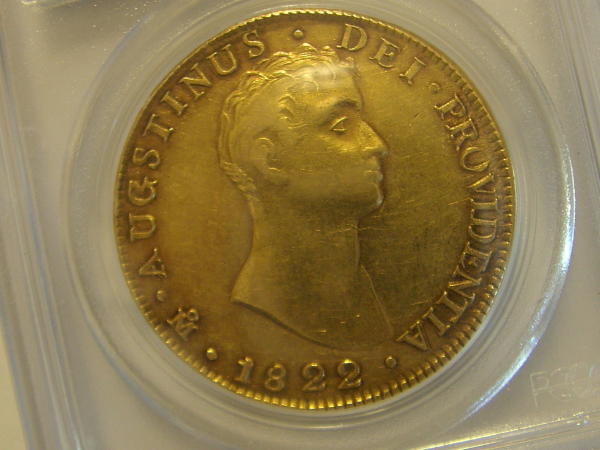
I do not have the coin in hand but will post a picture when we get it. It is lot 28978 in Heritage auction #3031. It has a few dings and the hi-res pics show a lot of small nicks. Discussed this at length with fellow collectors and figured the quality of the strike outweighed the sea salvaged stigma. Needed a Chas. III 8E for the type set.

If I could just attribute this.
Moderator
Learn More...
vermontensium's Avatar
United States
16677 Posts
 Posted 01/22/2014  10:47 pm  Show Profile   Check vermontensium's eBay Listings Check vermontensium's eCrater Listings Bookmark this reply Add vermontensium to your friends list Get a Link to this Reply
I have some nuggets salvaged from the S.S. Central America. The sea water gives them a "lackluster appearance" making them look dull as opposed to fresh out of a river or stream.
swcoin.ecrater.com
Pillar of the Community
United States
684 Posts
 Posted 01/22/2014  11:01 pm  Show Profile   Bookmark this reply Add Westwood Arms to your friends list Get a Link to this Reply
Does sea salvaged gold "color up" eventually? I stuck a white 1964 quarter in an old sulfur envelope a couple years ago as an experiment. I can't find it...AAARGH.
Pillar of the Community
United States
684 Posts
 Posted 01/22/2014  11:18 pm  Show Profile   Bookmark this reply Add Westwood Arms to your friends list Get a Link to this Reply
Here is a pic of toned gold coin. The peripheral orange toning is nice.


How-Do-You-Tell-Sea-Salvaged-Gold-From-Not?
Pillar of the Community
United States
1962 Posts
 Posted 01/23/2014  02:28 am  Show Profile   Bookmark this reply Add realeswatcher to your friends list Get a Link to this Reply
Not that I play with gold that much, but I do observe...

Westwood, that 1777 8E has the prototypical surface for salvaged gold - that slightly frosted or matte or dull surface (depending on your descriptive preference). If you've seen a lot of 1715 Fleet gold, that look should be familiar. As mentioned, it's more from the slow effect of friction from sand, etc. that ever-so-slightly etches the surface... moreso than any chemical corrosion/etching like you'd see on silver (which gold, even alloyed, is generally immune from). Salt-water really should at most cause a few isolated slight pits in spots that might be slightly higher in copper (those which present as a slightly reddish spot on a piece with normal skin).

A few other thoughts:

-- Yes, slightly dull look, but does have a nice strike for Mexico portrait gold (no weak shield).

-- Will it tone? As you know (and showed), old collection gold gets that orange hue to it, but it's slow to develop and subtle. I'm not familiar with the intricacies of how gold alloy tones, so I can't comment there. One factor here of course is the effect that whatever chemical/acid wash it was given has had upon the reactivity of the surface. My experience with salvaged pieces is that whatever neutralizing they do at the end of conservation seems to somewhat retard any future toning. I wouldn't hold my breath...

ColonialJohn, any thoughts on that?

Of course, being in the slab won't help. If you decide you like the piece and want to hold it for a while... AND also want to give it a chance to possibly tone up somewhat... it probably needs to be cracked out.

Quote:
"TPGs will go MS for known wrecks but AU details for sea salvage..."

Eh... I understand how you're saying that an attributed wreck may get the benefit of the doubt over generic salvage, and that can in fact happen. However, there's a lot of subjectivity in grading cos.' handling of wreck material which I think can sometimes explain that observation. Dealing with salvage material is not their main area of expertise, and I think a lot may depend on what a given grader may happen to know or recognize about certain types of material... and then also whether a company has done bulk encapsulation for a certain wreck. That may influence the in-house knowledge of that material.

I also think there's subjectivity in the details grade that gets assigned b/c sometimes, it's not always easy to see past "seawear" to judge pre-existing "circulation wear". All the 1783 8R from the El Cazador are in theory "uncirculated"... but some are seaworn to the point where calling a given piece UNC would seem silly.

Another case is the well-preserved 1733-34 ducatons from the Vliegenthart (a whole chest of neat, tightly packed rows). I've seen pieces that are without any doubt specimens from this salvage slabbed with or without attribution... sometimes AU details, sometimes UNC details... sometimes even AU or UNC "problem-free" grades. Yet, they're all from the same batch, all UNC when they went down. Now, referring to what I said above, if the grader happens to be familiar with this material such that when he sees a high-grade 1734 ducaton with some scattered surface corrosion, he knows it's an UNC piece from the Vliegenthart, he will be inclined to call it "UNC details" (though "Vliegenthart" might not necessarily be noted). If someone isn't familiar, however, that same coin might get called "AU details" as an honest guess. So, it doesn't necessarily have to be that known provenance is DIRECTLY garnering a coin bonus points... it might be more indirect.

In this case, NGC went "AU details". It's definitely strong for an AU... whether it deserves "UNC details" is debatable. ANACS will actually call something "AU58 details" - that might apply here.

-- Potential attribution: I don't think that would ever be possible here... I don't know of any wreck that produced these in known quantities, and a quick check of Sedwick's online archives doesn't show any similar 8E with wreck provenance. Don't forget, a lot of times the origin of such material is, for obvious reasons, kept quiet on purpose. Probably the best you could get is to ask "someone who would know if", off the record, there is any kind of salvage that produced material like this.

Pillar of the Community
GERMANICVS's Avatar
Germany
1849 Posts
 Posted 01/24/2014  11:00 am  Show Profile   Bookmark this reply Add GERMANICVS to your friends list Get a Link to this Reply
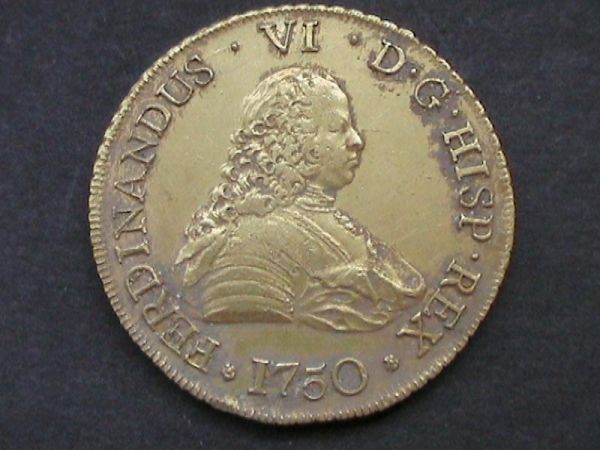
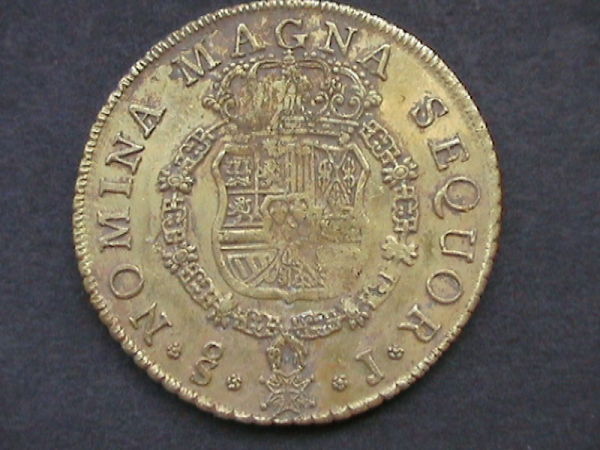
Here is an 8 escudos coin which was part of the treasure recovered from the Nuestra SeƱora de la Luz in the early 90's.

At purchase, if I recall, one had the option of having the coins cleaned by experts of the auctions house, or, delivered as they were recovered.
I chose to have my 'pelucona' as it was recovered from the ocean floor of the coast of Montevideo after 240 years. The ship sank around 1751.

The surfaces clearly show a matte appearance, and some marine deposits, in addition to some minor scuffs. This is approximately how one may expect a gold coin to look like after recovery from salt water.

The appearance is obviously not the same as a non-salvaged coin, but I find still quite appealing. I guess this has also something to do with the purity of the gold used to strike the coin. I am guessing that the higher the copper and other impurity content, the more salt water corrosion damage would be incurred (?).

How-Do-You-Tell-Sea-Salvaged-Gold-From-Not?

How-Do-You-Tell-Sea-Salvaged-Gold-From-Not?
Pillar of the Community
United States
1962 Posts
 Posted 01/24/2014  2:46 pm  Show Profile   Bookmark this reply Add realeswatcher to your friends list Get a Link to this Reply
Happen to see this today - stated wreck provenance, granted a problem-free grade. This is, I suppose, acceptable enough, yet the piece does have a slight bit of that matte look talked about:
http://www.ebay.com/itm/1724-Nether...171217552918

GERMANICVS, thanks for posting that 8E... I figured someone might mention or post a Luz coin - it's one of the more prominent wreck sources of Spanish milled gold. They are another example of pieces that you sometimes see with no assigned wreck pedigree (but its origin is fairly certain from the year/mint/"look") slabbed problem free... and occasionally achieving a problem-free grade even WITH the pedigree.


Quote:
The appearance is obviously not the same as a non-salvaged coin...

Yup... certainly it's much more intact than silver would be in that setting (see the cob 8R recovered from that wreck)... However, it does have that flat/matte finish (though maybe to a slightly lesser degree than the 1777 8E). Regarding those accretions - in hand, does it look that's "into" the surface of the coin at all, or is it just topical residue?
  Previous TopicReplies: 19 / Views: 7,397Next Topic
Page: of 2

To participate in the forum you must log in or register.


Disclaimer: While a tremendous amount of effort goes into ensuring the accuracy of the information contained in this site, Coin Community assumes no liability for errors. Copyright 2005 - 2026 Coin Community Family- all rights reserved worldwide. Use of any images or content on this website without prior written permission of Coin Community or the original lender is strictly prohibited.
Contact Us  |  Advertise Here  |  Privacy Policy / Terms of Use

Coin Community Forum © 2005 - 2026 Coin Community Forums
It took 0.47 seconds to rattle this change. Forums