Coin Community Family of Web Sites Join Thousands of Coin, Bullion, & Money Collectors
Royal Estate Auctions - $1 Coin AuctionsCoin, Banknote and Medal Collectors's Online Mall Royal Canadian Mint products, Canadian, Polish, American, and world coins and banknotes. 300,000 items to help build your collection! Vancouvers #1 Coin and Paper Money Dealer Join Thousands of Coin, Bullion, & Money Collectors Specializing in Modern Numismatics


Username:
Password:
Save Password
Forgot your Password?


This page may contain links that result in small commissions to keep this free site up and running.

Welcome Guest! Registering and/or logging in will remove the anchor (bottom) ads. It's Free!

Mexico 8 Reales

To participate in the forum you must log in or register.
Author Previous TopicReplies: 9 / Views: 1,891Next Topic  
Valued Member
Coinaholic73's Avatar
United Kingdom
298 Posts
 Posted 11/20/2014  10:04 pm Show Profile   Bookmark this topic Add Coinaholic73 to your friends list Get a Link to this Message Number of Subscribers
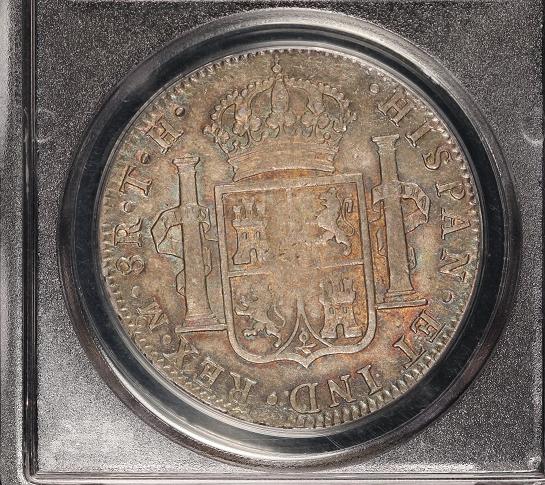
Want to add one of these to the collection but the frequency of fakes scares me a bit so I thought I might go 'graded' when I get one. I came accross this PCGS example

Mexico-8-Reales

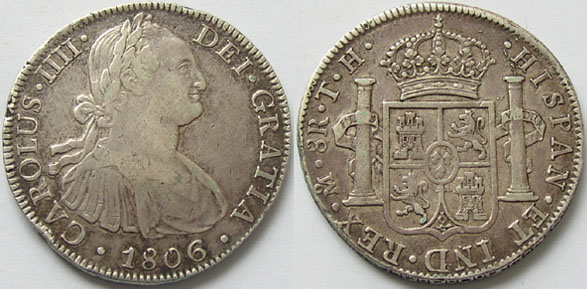
Then compare it to this coin which is local to me

Mexico-8-Reales

The local coin dealer has graded his as aVF, and yet PCGS has graded the top example as AU-55!! Am I missing something as even as a complete ignorant of this series I can see the centre of the shield has completely worn away and the jewel band of the crown has worn too?
Pillar of the Community
swamperbob's Avatar
United States
5362 Posts
 Posted 11/20/2014  10:44 pm  Show Profile   Bookmark this reply Add swamperbob to your friends list Get a Link to this Reply
You are confusing "wear" with lack of detail due to a weak strike.

The 8 Reales were struck on a manually operated open sided screw press so strike pressure was not uniform. A lower impact pressure can mean that a die will not infill at the dead center. The areas that you point out are deeply cut into the reverse and they are opposite the deepest portion of the obverse die. Full strikes are therefore less common than weak ones.

I would have significant concern that the coin owned by your local dealer might be a silver counterfeit. It is a type that I would suggest having XRF tested to see if any gold is present. The reason are the numerous rounded breaks on the reverse which resemble similar chips seen on known Class 2 counterfeits. The dealer coin also has some significant edge damage as well.
Pillar of the Community
Lucky Cuss's Avatar
United States
4883 Posts
 Posted 11/21/2014  09:19 am  Show Profile   Bookmark this reply Add Lucky Cuss to your friends list Get a Link to this Reply
Regarding the dealer's specimen, would the raised spots underneath the dot and "H" and between the right pillar and the shield also be cause for concern?
Colligo ergo sum
Pillar of the Community
United States
684 Posts
 Posted 11/21/2014  11:10 pm  Show Profile   Bookmark this reply Add Westwood Arms to your friends list Get a Link to this Reply
Yeah, there are some raised spots or bumps on otherwise smooth fields on the pillar side. I would not buy the local coin.
Pillar of the Community
swamperbob's Avatar
United States
5362 Posts
 Posted 11/22/2014  12:33 am  Show Profile   Bookmark this reply Add swamperbob to your friends list Get a Link to this Reply
Lucky Cuss Yes, the raised spots around the H are rather typical of those seen on transfer dies associated with late 19th century silver counterfeits. I refer to these as Class 2 Counterfeits and although they circulated as genuine in China they were not made at the date shown nor in the location claimed by the mint mark.

Tests with XRF that show the presence of over 1/2 percent gold in the alloy are essential to placing these coins in an earlier than 1870 category.
Pillar of the Community
jerseyben's Avatar
United States
1211 Posts
 Posted 11/22/2014  08:27 am  Show Profile   Bookmark this reply Add jerseyben to your friends list Get a Link to this Reply
Bob, is it true that many people currently accept these class 2 pieces as genuine specimens?

It begs the question: If people don't know it is a counterfeit and it is being treated as genuine, is it really a counterfeit?

If you care to share, I would love to hear your thoughts on this topic.

Note: I am not injecting my own opinion here, just trying to stir up conversation.
Pillar of the Community
colonialjohn's Avatar
United States
1757 Posts
 Posted 11/22/2014  09:33 am  Show Profile   Bookmark this reply Add colonialjohn to your friends list Get a Link to this Reply
Ben -

See Bob's response for Class 2 Types in the "recent" Rocky Road thread in this World Coins and Commemoratives forum (1776 & 1787 8 Reales Genuine or Not?).

There has been a recent paper with a link also supplied by Dos Mundos. This is just one of several documents SUPPORTING Type 2 GNL's in terms of CAROLUS premium's in the China Market.

As discussed its the most complex of the FACTS put forth in GNL or should I say ... SWALLOW.

John Lorenzo
Numismatist
United States
Edited by colonialjohn
11/22/2014 09:36 am
Pillar of the Community
jerseyben's Avatar
United States
1211 Posts
 Posted 11/22/2014  09:53 am  Show Profile   Bookmark this reply Add jerseyben to your friends list Get a Link to this Reply
John,

I agree with the facts presented regarding the Class 2 counterfeits. I have decided to stay away from Type 2's for my own collection.

My question is how does this affect the current market? I would argue that most dealers and collectors are previously unaware that they have these types in their inventory/collections. They have been treating them as genuine pieces for many years.

How will this information Type 2's "change the game"?

-Ben
Pillar of the Community
colonialjohn's Avatar
United States
1757 Posts
 Posted 11/22/2014  12:07 pm  Show Profile   Bookmark this reply Add colonialjohn to your friends list Get a Link to this Reply
In some ways it does nothing overall - they can be slabbed if an XRF is done by the dealer or owner ... end of story - Type 2's IMO will never be a collectible like for example a Type 1 in a Brass with chinese chopmarks ... I sold one recently on ebay for over $100 ... to some that is KOOL - including yours truly - I would buy any at the right price right now at $50 or more ... send me a photo and a price and I will back it up! <BG> ... Type 2's is another story ... it's up to the TPG's to act ... the Sheffields ... same way ... these are collectible Type 1's ... in some ways Ben ... we just play it out and see what happens. In some ways the GNL Book has thrown a lot on our plate ... it will take time to accept/disregard/configure/modify in terms of our coins and how we buy Spanish/American Colonials. Authors like Coronado have already shown contemporary counterfeits exist ... now we have a few others that are a bit more sophisticated (Sheffield & Off-Metal Type 1's, China Market Type 2's, Modern Forgeries Type 3's and the rest like 8 Real 1805 Lima Button Type 4's).

JPL
Pillar of the Community
swamperbob's Avatar
United States
5362 Posts
 Posted 11/22/2014  3:07 pm  Show Profile   Bookmark this reply Add swamperbob to your friends list Get a Link to this Reply
jerseyben You ask two questions;

Quote:
Bob, is it true that many people currently accept these class 2 pieces as genuine specimens?

It begs the question: If people don't know it is a counterfeit and it is being treated as genuine, is it really a counterfeit?


The easy answer to the first question is yes. The average dealer and the TPGs can not tell one type from the other. They also do not admit to being aware the Class 2 coins ever existed. They could if they chose to distinguish many of the Class 2 coins today but chose not to for financial reasons. They are not purists.

Now it is a fact that written records from the period PROVE these coins did exist. These same records also indicate that some were "perfect" copies. So the expectation from the 1880s has been that it is impossible or nearly impossible to tell them apart.

That attitude as been around since the early part of the last century. It was true then but not now.

When I was very young (early teen) I knew an old dealer a couple towns over who was a friend of my uncle's that had a small shop. He was a World Coin specialist and I was fascinated with World Coin Counterfeits. A few years later I sorted out Mexican coins for him that came in bags of 1000 coins from China. He KNEW there were silver forgeries made in Massachusetts mixed in with these coins. We discussed this on many occasions in the 1960s and he never disputed that fact at all. He was however a pragmatist and made his living selling coins for a profit. He said since there was no way to tell the two types apart that he simply sold all full weight silver 8Rs as real. This was based on their being real silver. Notice he never said they were genuine. When I tried to pin him down to say the word genuine he would only wink.

That has been the attitude since 1930 for most dealers who knew and for the most part this attitude has resulted in very few if any people remembering that these coins ever existed. The attitude was;
Quote:
Nothing could be done so why concern yourself.


The Massachusetts operation that my uncle and this dealer were well aware of was a small operation producing anywhere from 3,000 to 30,000 coins a month as needed by the company. That is not too many coins per year. It was also semi-secret and the general populace did not know. The workers generally were not coin people and they felt (based on statements I heard from one actual counterfeiter) that they never believed what they were doing was wrong.

How many other small local operations existed - no one knows. So since there has been no one central source of information for this production discovered (at least as of yet to be discovered) no one knows how many copies were made. We are at the same point today - all we can do is to make an educated guess as to how many of the 10,000,000 to 30,000,000 dollars per year (needed to balance the US trade deficit with China) were Class 2 Carlous dollars. I have never suggested that they all were Carolus knock-offs but that is one possibility. If 10% were knock-off Carolus coins that is still between 1 and 3,000,000 coins per year.

So while the overall impact is unknown, an estimate can be made based on search results. On an average day on ebay, of the Carolus Dollars posted I typically spot 4-10 that I suspect could be Class 2 based on the photos alone. At coin shows where I can examine these coins the number increases to nearly 20% of all coins I see. Of the 200 or so I have bought over the years, about 70 to 80% are in the end determined to be class 2 post-1870 knock-offs based on a lack of gold or pre-1870 knock-offs based on low SG. The rest could simply be earlier knock-offs of the correct assay or they could be genuine. The low SG coins are the ones with 80%-86% silver content based on accurate SG tests done with an analytical balance. These are the earliest Class 2 counterfeits (these earlier Class 2 coins often contain gold because they were made pre-1870).

So I expect that more than 10% but likely less than 20% of all Carolus dollars that exist are Class 2. Most of these come from China and some have small chop marks.

The second part of your inquiry is pertinent for a more general discussion:

Quote:
It begs the question: If people don't know it is a counterfeit and it is being treated as genuine, is it really a counterfeit?


I would ask should delusion pass for truth?

That is like saying if a TPG slabs a counterfeit does it become genuine? That was a sentiment attributed to Mark Hoffman the infamous Utah forger. He began his career in High School manufacturing 1914 D Lincoln cents. They were good enough to be authenticated at which point he felt his work was somehow justified and he was not doing any harm.

In 1950 the Denver mint made very few 5 cent pieces. An enterprising forger believed to be from Texas recognized these coins would carry a numismatic premium so he made MORE copies of the 1950 D 5 cent coin than the mint made. That was a WELL KNOWN story at one time (ca 1970) and actually held down the price of 1950 D Jeffersons because supply was adequate to meet demand.

Were you aware that over 1/2 of all 1950 D Jefferson nickels on the market were COUNTERFEITS?

Would you like to know which type your copy is?

The same thing pertains to Carolus Dollars.

Commercial dealers like my old friend who are only in it to make a profit WILL NOT CARE. People like me will care.

Every collector needs to make their own decision.

However - no coin made outside the mint by a counterfeiter can ever be the genuine thing. Believing otherwise is allowing self delusion to take over.

I am not delusional.

  Previous TopicReplies: 9 / Views: 1,891Next Topic  

To participate in the forum you must log in or register.


Disclaimer: While a tremendous amount of effort goes into ensuring the accuracy of the information contained in this site, Coin Community assumes no liability for errors. Copyright 2005 - 2026 Coin Community Family- all rights reserved worldwide. Use of any images or content on this website without prior written permission of Coin Community or the original lender is strictly prohibited.
Contact Us  |  Advertise Here  |  Privacy Policy / Terms of Use

Coin Community Forum © 2005 - 2026 Coin Community Forums
It took 0.34 seconds to rattle this change. Forums