| Author |
 Replies: 11 / Views: 13,080 Replies: 11 / Views: 13,080 |
|
|
Moderator
 Australia
16959 Posts |
I've recently acquired a hoard of mixed world coins, among which were a handful of Australian coins. All the Australian coins had "problems", environmental damage of some kind or another - so I assume that whoever assembled the collection was a metal detectorist and those coins were their local "finds". I kind of expect to find "green meanie" bronze pennies and halfpennies in such circumstances and there were many of those, but I was kind of taken aback when this one was included in the mix:  As some of you might be able to tell, it's an Australian silver florin. I should point out that, for those unfamiliar with the series, that between 1947 and 1965, Australian "silver" coins were made of a debased silver alloy, .500 fine - so this isn't pure silver corroding, it's the copper, as you can tell by the green colour. So I thought I'd use my chemistry skills to try to clean this one up, at least to the point where a bullion dealer would at least recognize it as silver; I doubted anyone would give me anything for it in that green corroded state. So, after a few days of soaking in a regularly changed 5% disodium EDTA solution, I was surprised at how well it was actually looking - I thought it would look more like a Moon map, all covered in craters. Instead, I found this:  The reverse has come up really, really nice - it was clearly in near-mint condition before it was buried, or whatever happened to it. The obverse, however, has suffered worse, and even in this pic, it's clear that in some places the freshly exposed raw silver surface is pitted where the corrosion has found a weak spot and gone deep. The remaining brown gunk was much more stubborn, requiring several more days soaking, combined with a soft plastic-bristled brush and an occasional scrape with the fingernails. Herein is its final state: 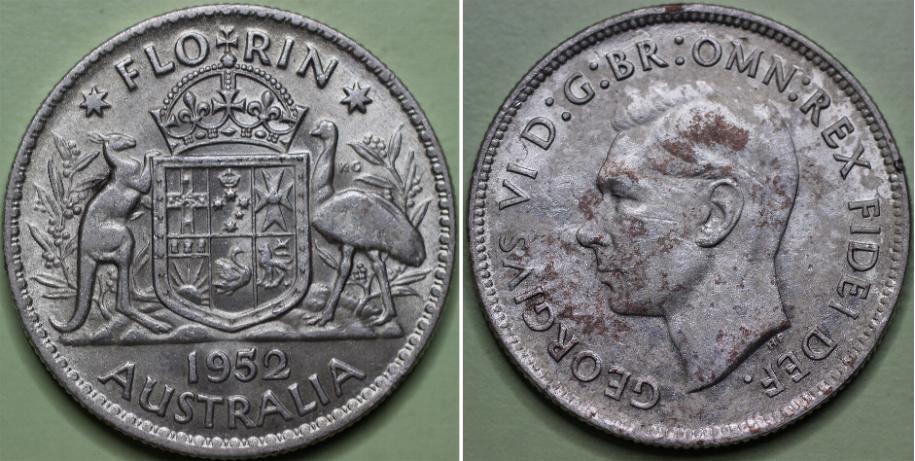 Is it perfect and "collectable"? Not really - it's still a "cleaned coin" and the obverse damage is too severe - though I must admit it's still nicer-looking than the heavily worn 1952 florin currently sitting in my collection. I'm even considering swapping it out. Don't say "infinitely" when you mean "very"; otherwise, you'll have no word left when you want to talk about something really infinite. - C. S. Lewis
|
|
|
|
Pillar of the Community
3772 Posts |
Congrate on the result
&
good to demonstrating that conserving/cleaning coins can be worthwhile.
|
|
Pillar of the Community
 United States
1949 Posts |
Wow, that is a fantastic conservation job!
|
|
Moderator
United States
194400 Posts |
I am shocked. That is a magnificent transformation.
|
|
Valued Member
United States
306 Posts |
That's incredible! Totally stunned! Great job!  |
|
Pillar of the Community
United States
1512 Posts |
I would swap it out, just for the sake of remembering the experience! Nicely done!
|
|
Pillar of the Community
United States
9806 Posts |
Nice job Sap! You don't often get silver to turn out better than it was beyond removal of light toning. Now if it were copper I imagine the results wouldn't have been near as nice looking, Gold on the other hand, would probably clean up perfectly. Wonderful conservation job, that reverse is still showing mint luster after all the years of being buried. You might try to get the obverse to tone somewhat, might cover the look of corrosion areas on the obverse, sunlight and a sulfur rich paper or velvet tray to sit in, might do the trick.
"Buy the Book Before You Buy the Coin" - Aaron R. Feldman - "And read it" - Me 2013! ANA Life Member #3288 in good standing since 1981, ANS, Early American Coppers Member (EAC), Colonial Coin Collectors Club member (C4), Conder Token Collector Club member (CTCC), Civil War Token Society (CWTS) member, Liberty Seated Collectors Club (LSCC) & Numismatic Bibliomania Society member (NBS), USMex, Member in good standing, 2¢ variety collector. See my want page: http://goccf.com/t/140440 |
|
Bedrock of the Community
Australia
21789 Posts |
The alloy for this coin is 50% silver, 50% copper.
It seems to me that during the corrosion process, that the copper was preferentially attacked, and that the remaining silver in the area of maximum corrosion was so weakened that it was easily removed by only slight mechanical force.
Excellent job of cleaning and preservation nevertheless.
Sap: Do you know any more of the conditions under which these coins were corroded?
|
|
Moderator
 Australia
16959 Posts |
Quote:
Sap: Do you know any more of the conditions under which these coins were corroded? No, I don't. The only provenance I was given for the hoard was that "someone from Rockhampton" (near the central Queensland coast) brought it in. But if it was a detector find, it could have been found anywhere and brought there. Don't say "infinitely" when you mean "very"; otherwise, you'll have no word left when you want to talk about something really infinite. - C. S. Lewis
|
|
Moderator
Australia
16959 Posts |
Quote:
Westcoin said:
Now if it were copper I imagine the results wouldn't have been near as nice looking... I did try to treat some of the bronze "green meanies" in the hoard, too. For most of those coins, instead of an ugly green mess, I now have an identifiable but still ugly brownish mess. Sorry, but I didn't think of doing before-and-after pics of those. Don't say "infinitely" when you mean "very"; otherwise, you'll have no word left when you want to talk about something really infinite. - C. S. Lewis
|
|
Pillar of the Community
Australia
1985 Posts |
Wow that's an amazing restoration job. I've got a couple of 0.500 Ag sixpences in a similar condition, but I guess the cost of buying disodium EDTA would make it not worth the while. I wonder if I could get my hands on some at work.  |
|
Pillar of the Community
4628 Posts |
That coin is amazing, from a dirty dog to a coin with in my opinion now - "nEF details"!
I find coins like that here, my guess is that it spent decades under ground in a moist volcanic soil. Coastal Queensland is like Auckland, a warm moist climate - which is death to silver coins, especially base silver ones. The soil could have had some broken up pebbles from volcanic rocks in it.
It may have even been to PNG or the Solomon Islands, as both used Australian coins before their own coinages in the 1970s - both have at least some volcanoes.
Failing that, a lake or the shallows of a sea. Its not worn enough to have spent decades in a flowing stream. It may have been pulled out of the mud of a river or lake bank.
Edited by Princetane
09/01/2022 8:13 pm
|
| |
Replies: 11 / Views: 13,080 |
|







 Posted 02/11/2015 10:19 am





