Coin Community Family of Web Sites Join Thousands of Coin, Bullion, & Money Collectors
Specializing in Modern Numismatics Royal Canadian Mint products, Canadian, Polish, American, and world coins and banknotes. Join Thousands of Coin, Bullion, & Money Collectors Coin, Banknote and Medal Collectors's Online Mall 300,000 items to help build your collection! Vancouvers #1 Coin and Paper Money Dealer Royal Estate Auctions - $1 Coin Auctions


Username:
Password:
Save Password
Forgot your Password?


This page may contain links that result in small commissions to keep this free site up and running.

Welcome Guest! Registering and/or logging in will remove the anchor (bottom) ads. It's Free!

Did You Know

To participate in the forum you must log in or register.
Author Previous TopicReplies: 23 / Views: 6,901Next Topic
Page: of 2
Pillar of the Community
aardspeed's Avatar
921 Posts
 Posted 04/09/2015  10:13 am Show Profile   Bookmark this topic Add aardspeed to your friends list Get a Link to this Message Number of Subscribers
Did you know that:

-All of Panama's currency is in coins, as they print no paper currency. (Though US bills are considered legal tender).

-In Denmark the Danish krone has had the 25 øre coin removed from circulation. From 1 October 2008, one could no longer pay with it in stores, and from the 1 October 2011, one could no longer exchange it. Neither in regular banks nor the national bank.

-Kettle drums were once used as currency on the island of Aler in Indonesia.

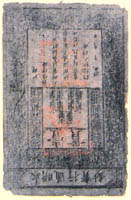
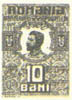
-The largest banknote in the world was issued in China during the Ming Dynasty (1368-1399). It was a 1 Juan with a size of 22.8 x 33 cm. The smallest banknote ever was issued in Romania in 1917. It was a 10 bani with a size of 2.28 x 3.8 cm.
BIGGEST
Did-You-Know

SMALLEST
Did-You-Know


-Laws regarding melting and export

On April 17, 2007, a Department of the Treasury regulation went into effect prohibiting the treatment, melting, or mass export of pennies and nickels. Exceptions were allowed for numismatists, jewelry makers, and normal tourism demands. The reason given was that the price of copper was rising to the point where these coins could be melted for their metal content. In 1969, a similar law regarding silver coinage was repealed. Because their silver content frequently exceeds collector value, silver coins are often sold by multiplying their "face value" times a benchmark price that floats relative to the spot silver price per ounce. Interestingly enough, it is not illegal to melt a foreign currency. According to U.S. law, a U.S. citizen is allowed to melt foreign coinage (i.e. Canadian Pennies) for personal or commercial use. The Canadian government, however, decrees that that is illegal, though it is unclear how far their jurisdiction might extend.

-Scientists have sniffed out the reason for the musty, "metallic" odor you smell after handling coins or touching metal objects. A new study finds that the smell of iron is, ironically, a type of human body odor, created by the breakdown of oils in skin after touching objects that contain the element. When touching objects made of iron, perspiration from skin causes the iron atoms to gain two electrons. The doubly negative iron atoms react with oil in skin, causing them to decompose, forming 1-octen-2-one


-According to the Japanese Currency Law, a maximum of 20 coins of the same denomination can be used as legal tender. Rejection of the acceptance under 20 pieces of the same denomination is prohibited. In case of over 20 pieces you can reject accepting the coins in daily transactions.


- cleopatra was no older than 18 when she became the queen of Egypt. Despite her glamorous image today, she is depicted on ancient coins with a long hooked nose and masculine features.


-Inventor John Shepherd-Barron is said to have been soaking in a tub when he got the idea of a device which would later be called the automatic teller machine, more commonly known today as the ubiquitous ATM.
The first ATM was built and put up in London in 1967 by the British bank Barclays. Also, with effect of new IRS (Internal Revenue Service) rule, specially designed ATMs were placed at churches that increased tithing and credit card donations. Today, there are more than 1.6 million ATMs in the world.


-Around $10 billion in loose change sits idle in American households. How much of it is in your home?

-It would take more than 197 billion stacked nickels to reach the moon.

-US coin designs cannot be changed more than once in 25 years without special legislation by Congress.

-Many ancient coins, especially from Asia, have holes in them. It is thought this was to enable them to be carried around on a string before pockets were added to clothing. However, some modern coins still have this feature.

-On U.S. coins, no mark under the date or a P means it was minted in Philadelphia, D is Denver and S means San Francisco. On very old coins, sometimes the mint mark was an O for New Orleans, but this mint was only operational from 1838 to 1861 and from 1879 to 1909 and only minted coin denominations that are no longer in use.

-In the U.S.A., The Bureau of Engraving and Printing produces 38 million notes a day with a face value of approximately $541 million. That doesn't mean there is $541 million more money circulating today than there was yesterday, though, because 95% of the notes printed each year are used to replace notes already in circulation.

...There are so many more interesting facts from around the world about money.
Take some time one day & check it out!
Moderator
Learn More...
jbuck's Avatar
United States
188770 Posts
 Posted 04/09/2015  10:57 am  Show Profile   Bookmark this reply Add jbuck to your friends list Get a Link to this Reply
More than one thing om this list that I did not know when I awoke this morning.
Bedrock of the Community
Conder101's Avatar
United States
17884 Posts
 Posted 04/09/2015  11:05 am  Show Profile   Bookmark this reply Add Conder101 to your friends list Get a Link to this Reply

Quote:
On very old coins, sometimes the mint mark was an O for New Orleans, but this mint was only operational from 1838 to 1861 and from 1879 to 1909 and only minted coin denominations that are no longer in use.

Dimes, quarters, halves and dollars are no longer in use? (OK maybe I'll give them the halves and dollars.)
Moderator
Learn More...
jbuck's Avatar
United States
188770 Posts
 Posted 04/09/2015  11:12 am  Show Profile   Bookmark this reply Add jbuck to your friends list Get a Link to this Reply
Poor choice of words there. Funny, when I read it earlier I knew what was intended.
Pillar of the Community
Australia
3831 Posts
 Posted 04/09/2015  12:02 pm  Show Profile   Bookmark this reply Add gxseries to your friends list Get a Link to this Reply
Believe Philippines has issued the world's largest banknote a few years ago. This was a limited edition banknote if I remember correctly. Obviously we aren't looking at sheets of banknote which makes the size too huge to compare.

My partial coin collection http://www.omnicoin.com/collection/gxseries
My numismatics articles and collection: http://www.gxseries.com/numis/numis_index.htm
Regularly updated at least once a month.
Bedrock of the Community
GR58's Avatar
United States
11951 Posts
 Posted 04/09/2015  12:19 pm  Show Profile   Bookmark this reply Add GR58 to your friends list Get a Link to this Reply
I liked reading this .... As stated ... Some good information.


Where did you get all the facts?
Pillar of the Community
nalaberong's Avatar
Canada
2805 Posts
 Posted 04/09/2015  1:30 pm  Show Profile   Bookmark this reply Add nalaberong to your friends list Get a Link to this Reply
The first Chinese square-holed coins apparently had the hole so that they could be put onto a square rod and scraped into shape (they were cast so they often had excess metal attached to them). Or so I've heard.

In Belarus, Vietnam, Laos, Nigeria, and most likely North Korea, no coins circulate and banknotes are used for all commerce.

The world's least valuable currency is the Iranian rial, trading at about 40,000 to one U.S. dollar. The 1,000,000 rial "Iran Cheque" is not a conventional banknote (it's destroyed when redeemed) but it is currently the world's highest-denomination piece of currency.

The first modern bimetallic coin was Italy's 500 lire, issued in 1984.
Pillar of the Community
SilverStackerKid's Avatar
United States
6478 Posts
 Posted 04/09/2015  1:50 pm  Show Profile   Bookmark this reply Add SilverStackerKid to your friends list Get a Link to this Reply
Wow. Well, you learn something new every day. Thank you for sharing!
Pillar of the Community
Dar's Avatar
United States
1476 Posts
 Posted 04/09/2015  5:29 pm  Show Profile   Bookmark this reply Add Dar to your friends list Get a Link to this Reply
Nice FYI's.

Very interesting. Thanks for posting them.
Rest in Peace
bpoc1's Avatar
United States
4078 Posts
 Posted 04/09/2015  7:30 pm  Show Profile   Bookmark this reply Add bpoc1 to your friends list Get a Link to this Reply
Interesting. Let me book mark to read later.
Pillar of the Community
Nickel Guy's Avatar
United States
604 Posts
 Posted 04/09/2015  7:38 pm  Show Profile   Bookmark this reply Add Nickel Guy to your friends list Get a Link to this Reply
They say if you haven't learned at least one new thing a day, then your day was wasted. Well, if that's true, I'm good for a couple of days now!
Pillar of the Community
Russian Federation
5174 Posts
 Posted 04/09/2015  9:38 pm  Show Profile   Bookmark this reply Add january1may to your friends list Get a Link to this Reply
Did you know that...

In Russia, the 1 kopek coin, discontinued since 2009, was briefly reissued in 2014, apparently to help currency exchange in newly acquired Crimea. As of that issue, its face value was less than 0.03 US cents; it is worth even less today.

Kyrgyzstan did not introduce any coins until 2008; for the previous 15 years (1993-2007), all of that country's currency was paper money.
Belarus still does not issue any circulating coins, but makes a lot of NCLT (most of it with ludicrously low face values).

Not really related to coins, but it is hard to imagine how Cleopatra VII (the one usually meant by "Cleopatra") managed to end up anywhere near beautiful considering her ancestry; by best known estimate, she only had four different great-grandparents (and two of them were children of the other two).

The denomination tracking system used in Numista allows for numeric denominations of up to 16 million. As of this post, there are eight coins listed on Numista with denominations too high for that system; five of them are German notgeld from 1923, while the other three are commemoratives from early 2000s Turkey.

Coins with the image of Theodosius II (Eastern Roman emperor 408-450) were first issued in 402 AD, when little Theo was less than two years old. On these coins, Theodosius is depicted in full military garb appropriate for a (junior) Emperor, and doesn't look particularly similar to a baby.

The New Orleans mint operated until 1909, but in its last few years, it issued almost entirely Barber coins. The only coins issued by the New Orleans mint after 1904 that were not designed by Barber were the 1909-O gold half eagle and the 1906-O gold eagle (both of them relatively uncommon dates, with mintages less than 100,000).

The US 10 cent coin issued between 1916 and 1945 featured a depiction of the main symbol of fascism (which, to be fair, had not yet become such by 1916). It did not, contrary to popular belief, feature an image of Mercury; however, the relevant design was reused in a cylindrical Niue coin which did label it as Mercury.

According to the Coinage Act of 1965, all US coins minted in 1793 or later are legal tender. This includes Half Cents and Trade dollars, which were not in fact legal tender previously. (They're still worth an awful lot more than face value, naturally.)

Victor David Brenner, the designer of the Wheat cent, was a Jewish immigrant from what is now Lithuania. The Lincoln side of his cent design is still used, with minimal differences, to this day - over a century later.

The Russian and Ukrainian 10 kopek coins have (approximately) the same diameter as the Soviet 10 kopek coins, which in turn have (again, approximately) the same diameter as the pre-1917 silver 10 kopek coins - back to at least the late 18th century.
Pillar of the Community
Chute72's Avatar
United States
1314 Posts
 Posted 04/10/2015  02:07 am  Show Profile   Bookmark this reply Add Chute72 to your friends list Get a Link to this Reply

Quote:
The first modern bimetallic coin was Italy's 500 lire, issued in 1984.

What is meant by bimetallic? Obviously alloyed coins have been available for centuries, and US has used clad coins since1965.
Moderator
Learn More...
Fuzzy317's Avatar
United States
14463 Posts
 Posted 04/10/2015  02:18 am  Show Profile   Bookmark this reply Add Fuzzy317 to your friends list Get a Link to this Reply
bimetallic is referring to a coin made by combining two sections of different metal. Like the current Euro dollars

here is an example from Greece
http://en.numista.com/catalogue/pieces2190.html

or one from Italy
http://en.numista.com/catalogue/pieces716.html
Pillar of the Community
aardspeed's Avatar
921 Posts
 Posted 04/10/2015  07:41 am  Show Profile   Bookmark this reply Add aardspeed to your friends list Get a Link to this Reply
I'm glad so many liked these blurbs about coins & hope to see more blurbs added by whomever wants to share them!


Quote:
from GR58:

I liked reading this .... As stated ... Some good information.

Where did you get all the facts?


-->I was just killing time doing some web searching & I came across these facts & really thought they were interesting to share. Hope more get added!!
Pillar of the Community
aardspeed's Avatar
921 Posts
 Posted 04/10/2015  08:30 am  Show Profile   Bookmark this reply Add aardspeed to your friends list Get a Link to this Reply
More "Did you knows":

-If you had 10 billion $1 notes and spent one every second of every day, it would require 317 years for you to go broke

-During the colonial days, people used coins from around the world. The quarter is called "two bits" because the Spanish-milled dollars were easily cut apart into equal "bits" of eight pieces; two bits equaled 2/8, or a quarter of a dollar. The first coin issued in the United States was a silver dollar.

-The first woman on a dollar coin was Susan B. Anthony, a leader in the women's rights movement. The second was Sacagewea, who was instrumental in helping Lewis & Clark explore the Louisiana Purchase.

-84% of women and 74% of men would pick a penny off of the ground. Would you?

-CoinHeads are everywhere. Like you, we have a certain thing for money, called respect. We pick up pennies, put away for rainy days, and teach our kids how to save. Coins have a special place in our life (be it a piggy bank, jar, or shoe box.) We know how coins can add up—we want to get the most out of them, and we get an almost indecent thrill from using them. You know what we're talking about. It's a CoinHead world, and we hope you're part of it.

-Since 1959, President Lincoln has been featured on both sides of the penny. His facial profile is featured on the front, and if you look closely, you'll see his statue in the Lincoln Memorial on the back of the coin.In the late 1800s, the Mint issued two-cent and three-cent coins.

-Codfish were depicted on many of the first coins of the US.

-Edmond Knowles of Flomaton, AL holds the current record for most pennies processed, totaling $13,084.59 (and counting).

-Coinstar Center® machines have counted more than 440 billion coins in more than 661 million transactions.

-Coinstar Center® machines have processed more than $24.5 billion in coins. How much of that has been yours?

-78% of Americans say they would make more of an effort to reuse their change if they knew it would help the environment. Coinstar helps in this effort by recycling coins through the Federal Reserve.

-The penny contains the least amount of copper of all U.S. coins.

-When was paper money first printed in the U.S.? The U.S. Department of the Treasury first issued paper U.S. currency in 1862 to make up for the shortage of coins and to finance the Civil War. There was a shortage of coins because people had started hoarding them; the uncertainty caused by the war had made the value of items fluctuate drastically. Because coins were made of gold and silver their value didn't change much, so people wanted to hang onto them rather than buy items that might lose their value.

-What denominations of bills were first printed? The first paper notes were printed in denominations of 1 cent, 5 cents, 25 cents, and 50 cents.

-How long does money last? That depends on the denomination of the note. A $1 bill lasts 18 months; $5 bill, two years; $10 bill, three years; $20 bill, four years; and $50 and $100 bills, nine years. Bills that get worn out from everyday use are taken out of circulation and replaced.

-How much does $1 million weigh? That would depend on the denomination of the bills you use. Since there are 490 notes in a pound, if you used $1 bills it would weigh 2,040.8 pounds, but if you used $100 bills it would weigh only 20.4 pounds.

-How many pennies were made in 1998? There were more than 10 billion pennies made in 1998. The actual number of coins produced, by denomination, was as follows: pennies, 10,257,400,000; nickels, 1,323,672,000; dimes, 2,335,300,000; quarters, 1,867,400,000; half-dollars, 30,710,000.

-What percentage of bills are $1 notes? Almost half, 48 percent, of the notes printed by the Bureau of Engraving and Printing are $1 notes.

-What are the dimensions of U.S. paper currency? Our present currency measures 2.61 inches wide by 6.14 inches long, and the thickness is 0.0043 inches. Larger sized notes in circulation before 1929 measured 3.125 inches by 7.4218 inches.

-What is money made of? Coins are usually made of copper and another element, such as zinc or nickel. Currency paper is composed of 25 percent linen and 75 percent cotton. Red and blue synthetic fibers of various lengths are distributed evenly throughout the paper. Before World War I these fibers were made of silk.

-Has a woman's portrait ever appeared on U.S. paper money? Martha Washington is the only woman whose portrait has appeared on a U.S. currency note. It appeared on the face of the $1 Silver Certificate of 1886 and 1891, and the back of the $1 Silver Certificate of 1896.

-What time is it on the Independence Hall clock on the back of the $100 bill? Though it would be difficult to tell without a magnifying glass, the hands of the clock in the steeple of Independence Hall are set at approximately 4:10.

-Has an African American ever appeared on U.S. currency? Paper money bears the signatures of four African American men who served as Registers of the Treasury (Blanche K. Bruce, Judson W. Lyons, William T. Vernon, and James C. Napier) and one African American woman who served as Treasurer of the United States (Azie Taylor Morton). No portraits of African Americans have appeared on paper money, but commemorative coins were issued in the 1940s bearing the images of George Washington Carver and Booker T. Washington, followed more recently by the release of a Jackie Robinson coin.
------------------------------------------------------------

SOME AMAZING CURRENCY I JUST HAD TO SHARE:


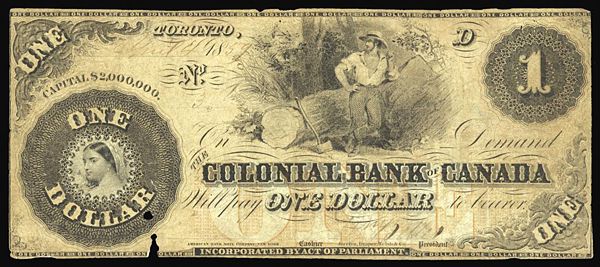
-Colonial Bank of Canada. 1 Dollar, 4.4.1859. P-S1666. (Charlton #130-10-02) Another scarce early dated Canadian note which shows a lovely woodcutter vignette along with a woman at the left in a porthole frame. A small notch in the lower left margin is mentioned along with a small hole just above that flaw as well. A few other scattered minor internal splits are evident. One of the most important features is that the note bears the serial number three. GOOD-VERY GOOD."

Did-You-Know

-----------------------------------------------------
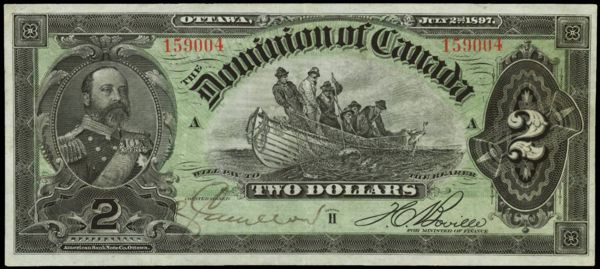
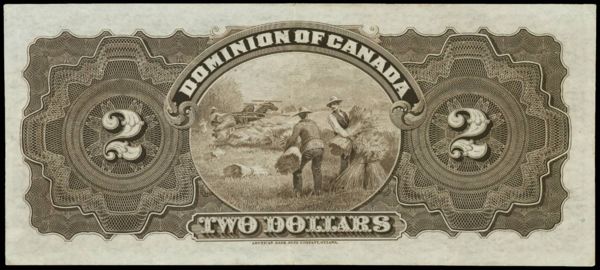
-Dominion of Canada. $2, 2.7.1897. P-24Cb. DC-14c) A striking note which will certainly be well received by the collecting community. It is the only piece for the catalog number which PMG has graded at the Extremely Fine grade level with only a scant few higher. Brilliant inks illuminate the fisherman vignette at center and clarify the portrait of Edward, the Prince of Wales at left. Seldom offered publically and even more so in this lofty circulated grade. PMG Extremely Fine 40.
Did-You-Know

Did-You-Know

------------------------------------------------------------

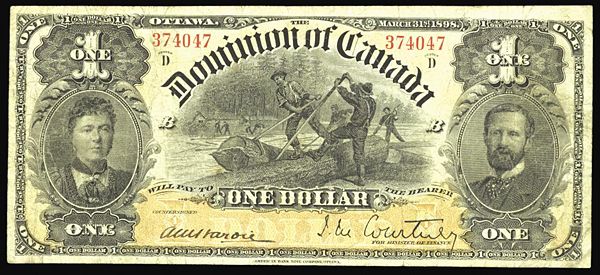
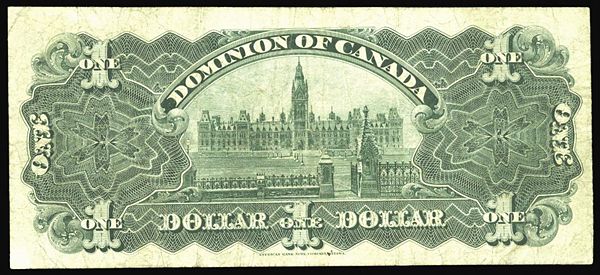
-(New York, January 2010), where it sold for $419.75. The catalog description noted, "CANADA. 1 Dollar, 31.3.1898. P-24. (DC-13a) This note shows the more scarce 1898 inwardly curved lettering of the word "ONE" at the left and right and will be a piece to excite collectors. The note shows the lumberjack vignette with stunning quality considering the technical grade. FINE
Did-You-Know

Did-You-Know
--------------------------------------------------------

-(Long Beach, September 2006), where it sold for $1955. The catalog description noted, "DC-17a $4 1902. This is the scarcest of the three types of fours issued in the 1900-1902 series. The central vignette is changed to reflect the Canadian works, but most of the other design elements remained unchanged from the 1900 series. Fine-Very Fine, the bottom margin trimmed slightly into the design. The paper surfaces appear a bit rubbed in spots.


Did-You-Know

Did-You-Know
---------------------------------------------------------

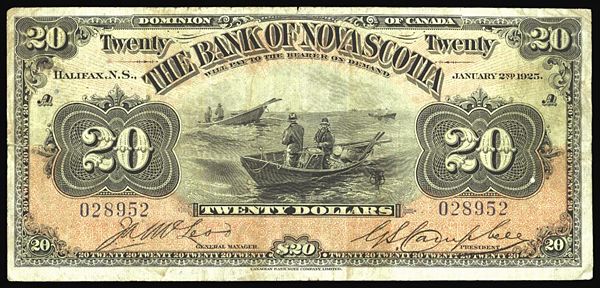
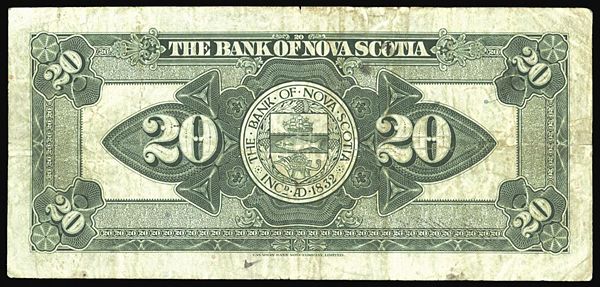
-(New York, January 2010), where it sold for $753.25. The catalog description noted, "CANADA. Bank of Nova Scotia. 20 Dollars, 2.1.1925. P-S629a. (Charlton #550-28-18) A tough-to-find higher denomination note from this bank which shows a lovely fishing vignette at the center and a pleasing rayed under print. A few margin tears are mentioned for accuracy. FINE.
Did-You-Know

Did-You-Know
-----------------------------------------------------------

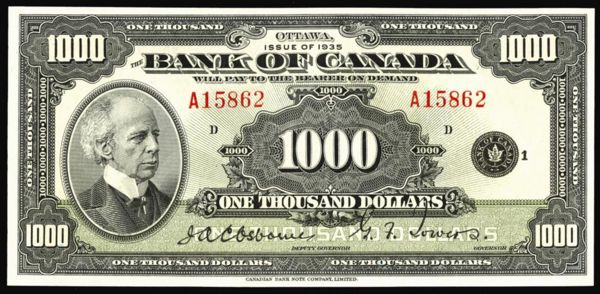
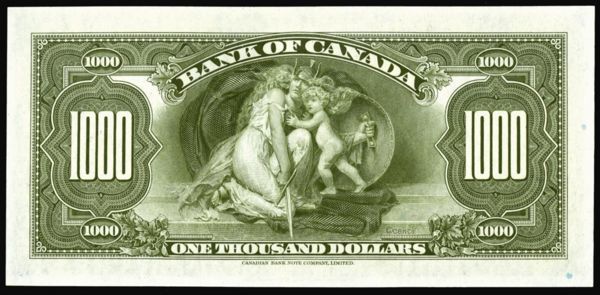
-(Los Angeles, August 2009), where it sold for $19,550. The catalog description noted, "CANADA. 1,000 Dollars, 1935. P-56. BC-19. The first of two Gem $1,000 Canadian notes we are offering today which will be a highlight for any advanced collection of Canadian banknotes. This English text variety, although not as rare when compared to the French text note variety, will surely attract considerable attention, as it presents itself flawlessly. PMG GEM UNCIRCULATED 65EPQ.
Did-You-Know

Did-You-Know
-----------------------------------------------------------

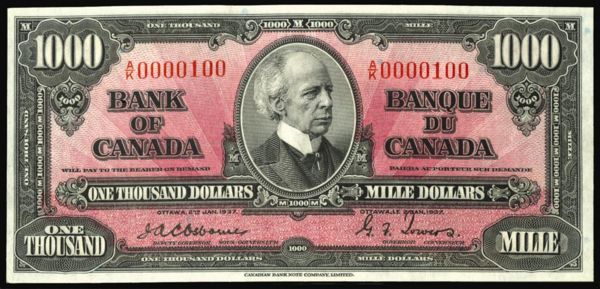
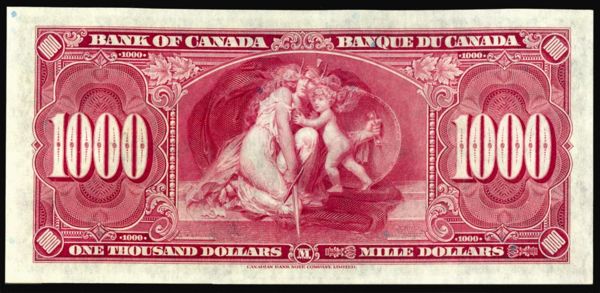
-(Los Angeles, August 2009), where it sold for $21,275. The catalog description noted, "CANADA. 1,000 Dollars, 2.1.1937. P-65. BC-28. Alongside the 1935 Issue $1,000, this tremdously scarce note is another highlight of the sale with a terrific low serial number of A/K0000100. This example shows nice original paper along with stunning color which illuminates the design. The reverse allegorical scene is breathtaking, showing a women with a sword and shield sheltering a young child. PCGS GEM NEW 65PPQ.

Did-You-Know

Did-You-Know
  Previous TopicReplies: 23 / Views: 6,901Next Topic
Page: of 2

To participate in the forum you must log in or register.


Disclaimer: While a tremendous amount of effort goes into ensuring the accuracy of the information contained in this site, Coin Community assumes no liability for errors. Copyright 2005 - 2026 Coin Community Family- all rights reserved worldwide. Use of any images or content on this website without prior written permission of Coin Community or the original lender is strictly prohibited.
Contact Us  |  Advertise Here  |  Privacy Policy / Terms of Use

Coin Community Forum © 2005 - 2026 Coin Community Forums
It took 0.64 seconds to rattle this change. Forums