| Author |
 Replies: 25 / Views: 3,650 Replies: 25 / Views: 3,650 |
|
Pillar of the Community
United States
3229 Posts |
Just picked up this 1799 Carlos IIII. It 26.74 grams and is 39.5 mm. it has obviously been chopped a couple of times cleaned at least once and then maybe re-toned for good measure. I just got swamperbobs book and am figuring out how to wrangle a specific gravity test together but have not done so yet (it may be a few weeks...work is crazy). I am having a hard time finding the overlaps on the edges...maybe picture #2 & #8? Do you think it is authentic. 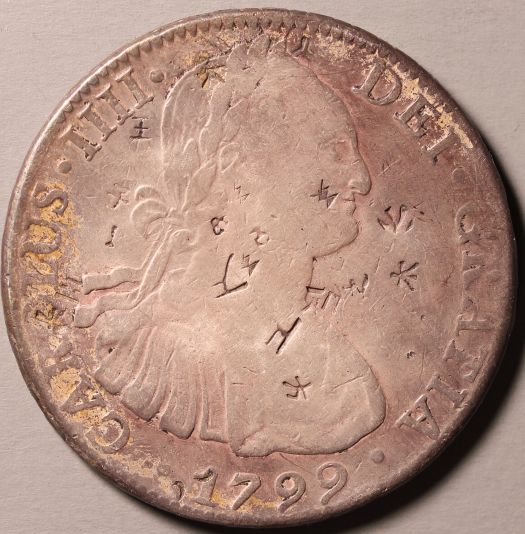 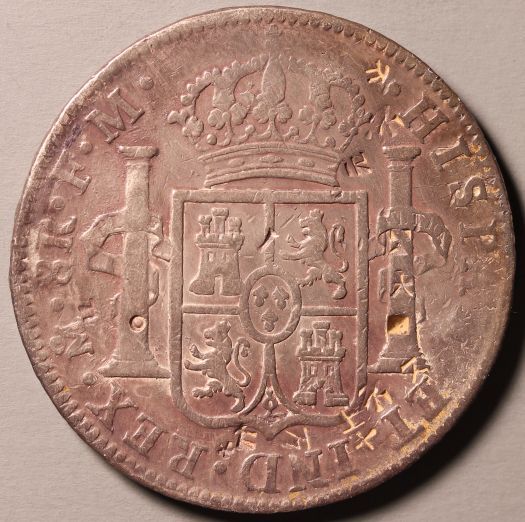 1  2  3  4  5 6  7  8  9  10  11  |
|
|
|
Pillar of the Community
United States
4883 Posts |
If it isn't genuine, then somebody went to an awful lot of trouble with all those chopmarks.
Colligo ergo sum
|
|
Pillar of the Community
Hong Kong
1270 Posts |
It looks good to me, good eye appeal, so is authentic to me. Henry
|
|
Pillar of the Community
United States
1156 Posts |
It was wise of you to buy Bob's book, TJsCoins. You probably noted that there were 12 examples of 1799 Mo fakes -- this was a popular year for counterfeits -- although I don't see an example that exactly matches yours.
I would be concerned about the discoloration in some areas such as the CAROLUS legend. Is that a non-regal alloy showing through? The circles and rectangles on the edge show a lot of variance in shape. Most importantly, photo #8 shows a 7 segment section of overlap but I don't see the corresponding 7 segment section on photo #2 -- assuming that it is the 180 degree view.
I would guess that it is not authentic.
|
|
Pillar of the Community
United States
1760 Posts |
I will let Bob make the conclusion: 1. Note the wavy (i.e., up and down) circle/squares edging when viwing 360* how it hits the edge at times. 2. Note the different sized circles in the circles for this edge. 3. Note the alignment difference: HIS is below PAN.
Its looking contemporary counterfeit. Good weight. Type 2?
My guess - counterfeit. A good one?
JPL
Edited by colonialjohn
05/16/2015 09:26 am
|
|
Pillar of the Community
 United States
3229 Posts |
I would be concerned about the discoloration in some areas such as the CAROLUS legend. Is that a non-regal alloy showing through? The discoloration is on the surface. 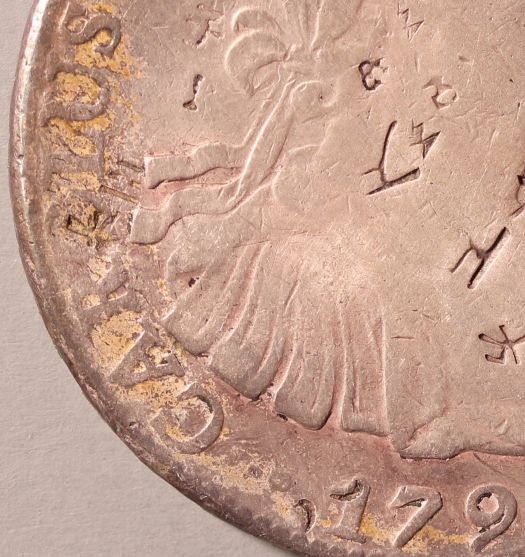 Quote:
photo #8 shows a 7 segment section of overlap but I don't see the corresponding 7 segment section on photo #2 -- assuming that it is the 180 degree view.
Photo #2 is at is 180 from #8. I think I can kinda see some overlap on photo #2 but the vergis is in the way. I tried acetone and verdicare with out sucsess to remove it. BTW, I suspected that this one might be a contemporary counterfeit at purchase. Thought it would be a good coin to put to the tests:) |
|
Pillar of the Community
United States
5362 Posts |
Nice coin - something is clearly wrong with the edge. The key is which class it will fall into as John noted. A Class 1 counterfeit will contain less than 700 fine silver and might have been made at any time between 1799 and 1935. A Class 2 silver counterfeit will contain more than 800 fine silver and they typically date between 1830 and 1930. Lucky Cuss You say... Quote:
If it isn't genuine, then somebody went to an awful lot of trouble with all those chopmarks. I have two comments about that statement. First the presence or lack of chopmarks is absolutely NO GUARANTY of authenticity. For instance in the 1843 Numismatic Chronicle edited by John Jonge Ackerman of the "Numismatic Society" (now Royal Numismatic Society) there is claim with reference to a counterfeit 8R as follows: Quote:
9. Is a Spanish dollar, with about a hundred " chops" upon it ; and which has evidently circulated extensively for some years among the Chinese, who never suspected that it was copper plated with silver. The date of 1843 was apparently a Sheffield Plate Class 1 type. This is because electroplating with silver was not used for forgery when the coin entered circulation. The thick plate Sheffield coins made in 1796-1820 time period are the most successful of the Class 1 coins because the silver was thick enough so that an early small chop did not cut through the layer. Secondly there are many Class 3 Numismatic forgeries that use chops added by the forgers themselves to take advantage of people who believe the first point to be true. Many of these are electroplated after the coin was made. Others are made of white metal. Back to which class the coin belongs in. Specific gravity is a great way to tell. SG 10.3 and it is Class 2 but 10.0 or lower will be Class 1. wonghinghi You say ... Quote:
It looks good to me, good eye appeal, so is authentic to me. Henry I guess we simply disagree on the definition of authentic or you are using that word to include coins that can be proven to have been made after 1880. Most Class 2 counterfeits passed in circulation for decades because they looked good. Many dealers like my old friend Al Dorego from Seekonk, Mass never differentiated between the Class 2 coins and genuine coins because "they were good silver." He lived in the same area that I did and he KNEW that silver reproductions were made for China. He didn't care because they sold as real. I still face that viewpoint all the time. Good silver = Good coin. That is no problem as long as we all understand that the date on an "authentic" coin may not be accurate. TJsCoins Since you bought the coin suspecting a counterfeit it is a great buy. SG can determine the difference between Classes 1 and 2. Appearance of the edge eliminates Genuine at least as I see it. |
|
Pillar of the Community
United States
4883 Posts |
Quote:
First the presence or lack of chopmarks is absolutely NO GUARANTY of authenticity. I agree, and I think I've made the same point myself here before. My comment was simply that if it's a forgery, it would seem to be a rather elaborate hoax relative to the return. I wonder, assuming it is indeed a counterfeit, if all the chops were made prior to its being placed into circulation, or if there was less scrutiny placed on it because of a few "original" chops as spurious as the coin itself, with many more authentic (albeit ill-advised) ones being added as it made its way through the channels of commerce. Colligo ergo sum
|
|
Pillar of the Community
Hong Kong
1270 Posts |
TJ, if you don't like this coin and want to part it, just notify me through my private email. I will buy it. Henry
|
|
Pillar of the Community
United States
5362 Posts |
Lucky Cuss I am of the opinion that the coin was not made in Mexico City and not in 1799. The coin did apparently see considerable circulation over a long period of time in China. That is the essential nature of the better Class 1 and all Class 2 counterfeits. They passed for many years some until today and everyone thought they were genuine.
|
|
Pillar of the Community
Hong Kong
1270 Posts |
Just a question to you about this coin, Bob. If this is a 2nd CC, when would it be produced? Maybe 1830-1930s about your theory? At this period of time, counterstamping coin was no longer popular. Why was this coin still being counterstamped? The most logical reason is this coin was an original so the reason for counterstamping is established.
|
|
Pillar of the Community
United States
3229 Posts |
Thank you all for your great replies! I was on the hunt for "good" contempory counterfeit and it looks like maybe I have found one:).
At Henry, I do yet have plans to sell but if I do I will give you first shot.
Bob, I will get a SG test when my free time allows. I am just getting aquatinted to your book (I am on page 37 only). Any suggestions on how to do a specific gravity test? I need to set up the set up and figure out the math.
|
|
Pillar of the Community
United States
5362 Posts |
TJsCoins The math is simple. Specific Gravity is the weight of the coin expressed in grams divided by the volume of the coin expressed in cubic centimeters.
The volume of the coin in cubic centimeters is equal to the buoyancy of the coin suspended in water. Any object suspended in water is acted upon by a force (buoyancy) that is equal to the volume of water the object displaces. Fresh water weighs exactly 1 gram per cubic centimeter. So the volume of the object equals the loss of weight.
The weight of the coin in air minus the weight of the coin suspended in water is the the volume of the coin. Divide the weight of the coin in air by the loss of weight (buoyancy) and you have the SG.
That is IT as far as the mathematics goes.
The scale however needs to be accurate. This is where you need to follow the rules of science and mathematics. The bare minimum accuracy needed to classify a forgery requires a density reading that is accurate to ONE DECIMAL POINT. To determine SG expressed to 0.1 you need a scale that accurately weighs to 1/100th of a gram. Most inexpensive digital scales (under $500.00 or so) are NOT accurate enough to produce any more than that. The cheaper ones are actually only good for +/- 0.5g. A shift of 0.1 in SG equates to about 6% in silver content. An SG of 10.0 is just about 720 fine so any SG below 10.0 is a Class 1 Counterfeit by definition.
10.2 is 840 fine and 10.1 is 780 fine. So a reading over 10.1 falls into Class 2. An SG of 10.3 is either genuine or Class 2. Some of these will be identifiable as Class 2 by an XRF test that finds too little trace gold contamination.
wonghinghi The production dates for Class 2 coins are generally between 1830 and 1930, however, the ability of UK authorities to make a Class 2 coin start as early as about 1796. They could use the dies intended for Sheffield Plate coins (the 1796 War effort) to make silver counterfeits. The profit margin in 1796 is low but adequate at 4% but by 1811 it sat at a profitable 10% and it rose steadily after that to 26%. When did some enterprising merchants decide they needed a few extra pennies on the dollar?
One factor I used to establish the date of 1830 was the start of the period of time when electrodeposition transfer images first came into use. It is not a hard and fast date - it is just an estimate of when the production of exact copies started in large numbers. There are some coins made from casting individual details and using those letter by letter casts to create counterfeit die making tools. The coin I used on the covers of my book is one of a number of Sheffield Plate Class 1 counterfeits that fall into this close to correct group. A similar coin struck in good silver and worn to VF would be difficult to identify other than production errors like an incorrect edge.
I still think it is probably a Class 2 coin.
|
|
Pillar of the Community
Hong Kong
1270 Posts |
The colour of the coin looks it contains a high content of copper but I would suppose it is the effect of the wrong photography. TJ, did you do a ring test? When you compare it with another Mexican 8R, you should at least know the approximation of the silver content. Doing a S.G. test can be very tedious and inaccurate except you are a proficient worker. I would like to introduce a quick/preliminary method to estimate the Ag content - by a neodymium magnet slide. Compare with a genuine coin of same type and time how long the coins taken in sliding down the magnets row. A debased silver coin will slide down faster. 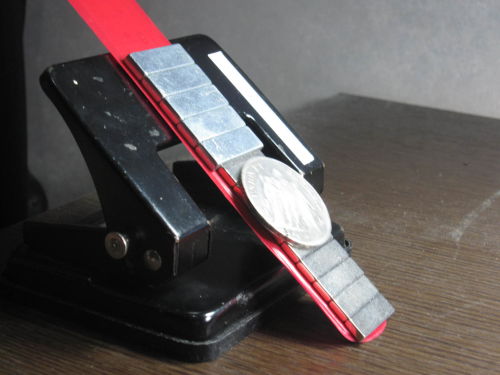 |
|
Pillar of the Community
United States
5362 Posts |
wonghinghi A neodymium magnet slide can be a good substitute for low level SG testing but it produces only an approximate result - intuitive as opposed to a numerical result.
The one caution serious I would make is that neodymium magnets have a surface hardness of 5 on the mohs scale while silver is 2.5. If the magnets have any surface marks (cuts, nicks, chips or scratches) they can scratch silver coins. I would not use the slide for high grade coins at all. Neodymium in magnet form is a rather easily damaged material (there is a caution warning about snapping them together) so I would check to make sure there are no surface irregularities before testing any coin. Also make sure they are nickel plated to reduce surface defects and extend life.
|
|
Pillar of the Community
United States
4883 Posts |
|
| |
Replies: 25 / Views: 3,650 |







 Posted 05/16/2015 12:08 am





