Posted 06/11/2015 08:50 am


I paid $30 for one back in 2009. 
For any given coin series, I have observed that you really need strong local demand in order to generate large price differences between rare or "key" dates and common dates. New Zealand went through a spike in interest in coin collecting when they reformed their coinage, which caused a resultant price spike. But I think the interest has settled back down to background levels now.
The mintage might be around 40,000 but that's still more coins than there are coin collectors in New Zealand - which means that just about anyone who wanted one probably already has one by now.
It's probably a good exercise to compare it to another modern New Zealand "rarity": the 2 cent NZ-Bahamas mule, which apparently has an estimated mintage of about the same size. CV for those is around AU$30 in Unc, but they seem to sell for more like $50 to $100 on ebay. The mule, of course, has more worldwide interest as world error collectors want one, so with less worldwide demand I would expect that the "natural price level" of the 2004 5 cent would be lower. Krause CV for the 2004 5 cents is still only $3 in Unc.
Two other factors affecting the price:
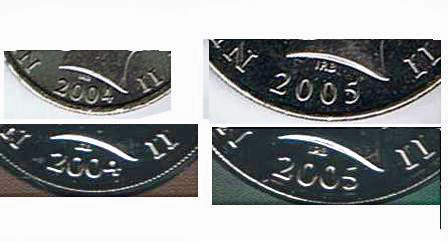
- Judging from current completed listings of the 2004 5 cent coin, there's somebody over in NZ that seems to have an awful lot of these things for sale; nobody intelligent is going to "invest" in something claimed to be "rare" but which seem to be as common as rocks.
- Unlike the Mule, a 2004 5 cent coin is readily available in New Zealand 2004 mint sets. True, it's not "the same" as the circulation 2004 5 cent coin because it was struck at a different mint, but only a mad keen variety hunter would obsess over such a difference, especially when there isn't a clear, obvious mintmark. So in that sense, the 2004 5 cent coin isn't all that different from the other "found in sets only" NZ coins.
For any given coin series, I have observed that you really need strong local demand in order to generate large price differences between rare or "key" dates and common dates. New Zealand went through a spike in interest in coin collecting when they reformed their coinage, which caused a resultant price spike. But I think the interest has settled back down to background levels now.
The mintage might be around 40,000 but that's still more coins than there are coin collectors in New Zealand - which means that just about anyone who wanted one probably already has one by now.
It's probably a good exercise to compare it to another modern New Zealand "rarity": the 2 cent NZ-Bahamas mule, which apparently has an estimated mintage of about the same size. CV for those is around AU$30 in Unc, but they seem to sell for more like $50 to $100 on ebay. The mule, of course, has more worldwide interest as world error collectors want one, so with less worldwide demand I would expect that the "natural price level" of the 2004 5 cent would be lower. Krause CV for the 2004 5 cents is still only $3 in Unc.
Two other factors affecting the price:
- Judging from current completed listings of the 2004 5 cent coin, there's somebody over in NZ that seems to have an awful lot of these things for sale; nobody intelligent is going to "invest" in something claimed to be "rare" but which seem to be as common as rocks.
- Unlike the Mule, a 2004 5 cent coin is readily available in New Zealand 2004 mint sets. True, it's not "the same" as the circulation 2004 5 cent coin because it was struck at a different mint, but only a mad keen variety hunter would obsess over such a difference, especially when there isn't a clear, obvious mintmark. So in that sense, the 2004 5 cent coin isn't all that different from the other "found in sets only" NZ coins.
Don't say "infinitely" when you mean "very"; otherwise, you'll have no word left when you want to talk about something really infinite. - C. S. Lewis