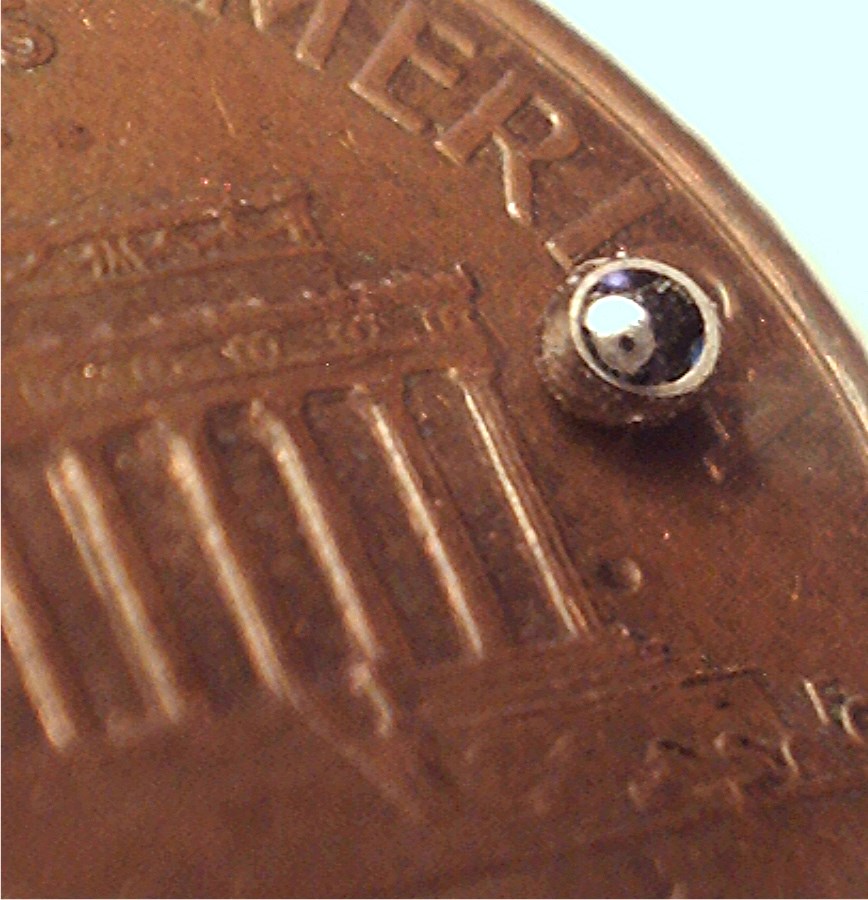
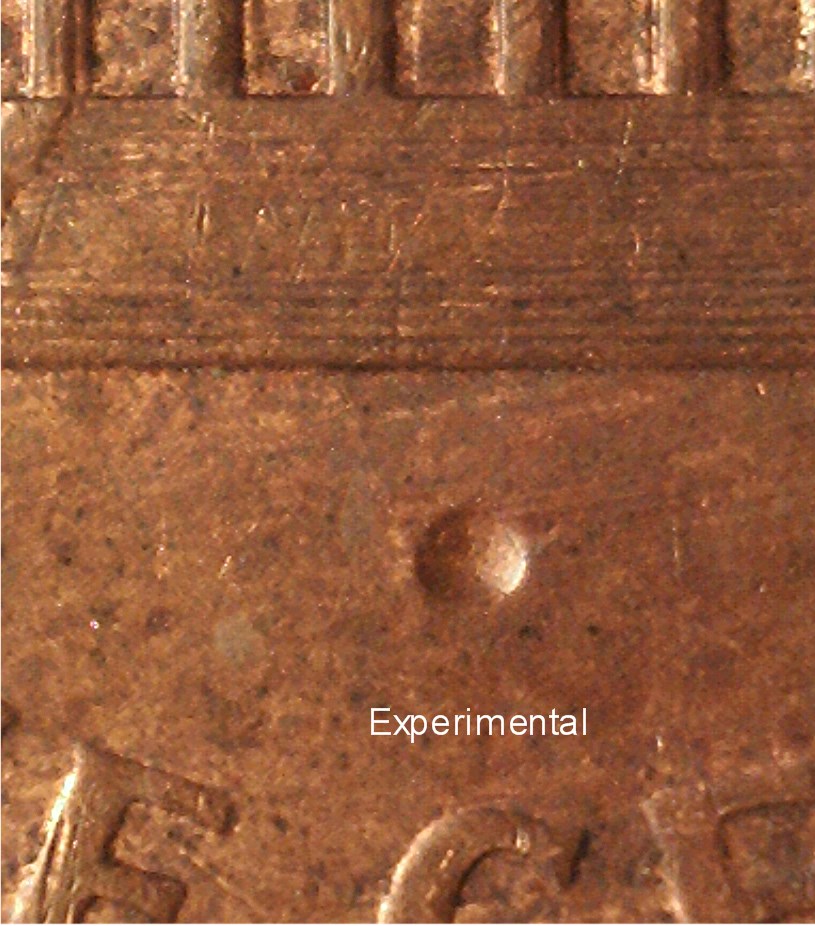
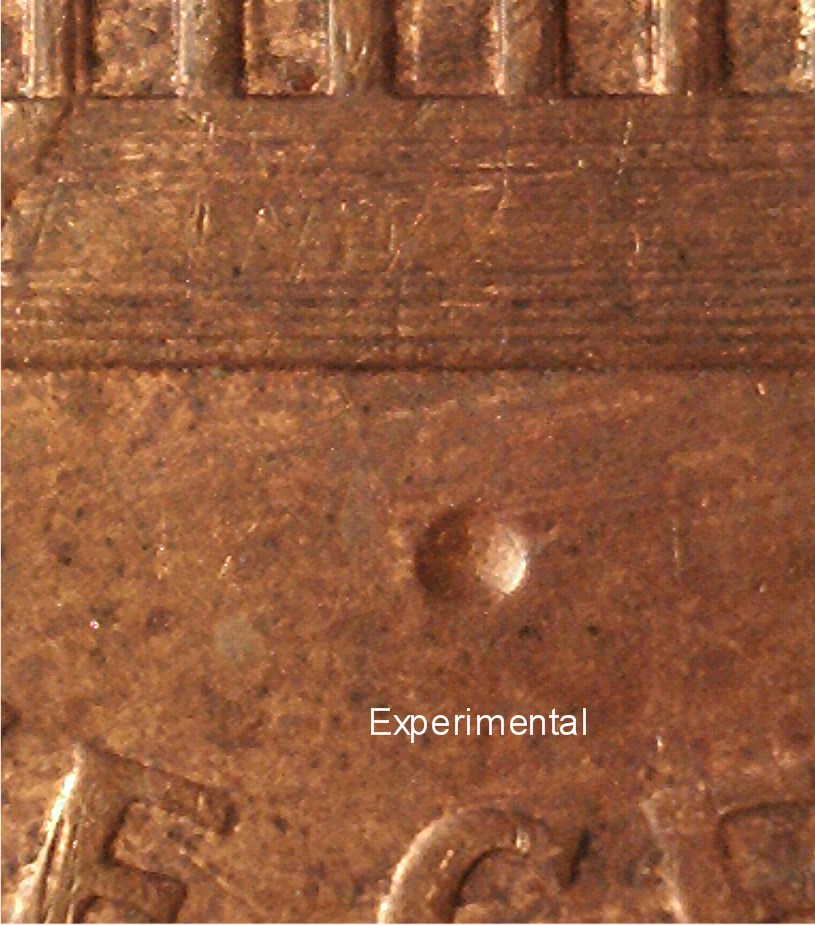
I thought that I would address the notion that it may be possible for the hemispherical depressions seen on some Lincoln Cents to have been caused by a BB strike. I have done a few calculations to try to see what a BB strike would need to look like. The calculations are easier if the imagery is reduced to a circle with a chord, representing the surface of the coin, cutting through it (rather than a sphere with a plane cutting through it).
The formula to calculate a chord length = 2 x the square root of (the radius squared - the distance of the chord from the center of the circle squared). (It is a lot easier, even, to use a Chord Calculation site such as:
https://www.easycalculation.com/are...h-circle.phpI invite you to check out my math.
Imagine a sphere which makes an indentation on a blank. If it indents ½ way (a full hemisphere), then it leaves a mark with a diameter = the diameter of the sphere. If it indents ¼ (a ½ hemisphere) then it leaves a mark of approximately 2/3 the diameter of the sphere.
The caliber of a normal BB gun is 4.5 mm. The normal diameter of a BB is 4.4 mm.
For a Rockwell Ball indenter, "B" Scale, the diameter is = 1.58 mm
The diameter of many of the marks we are seeing on these Lincoln cents is in the neighborhood of ½ to 1 mm.
The depth of the mark is what translates into the hardness number and also what translates into the diameter of the mark. The strike of the die will also adjust the diameter a bit and may also give it some elongation.
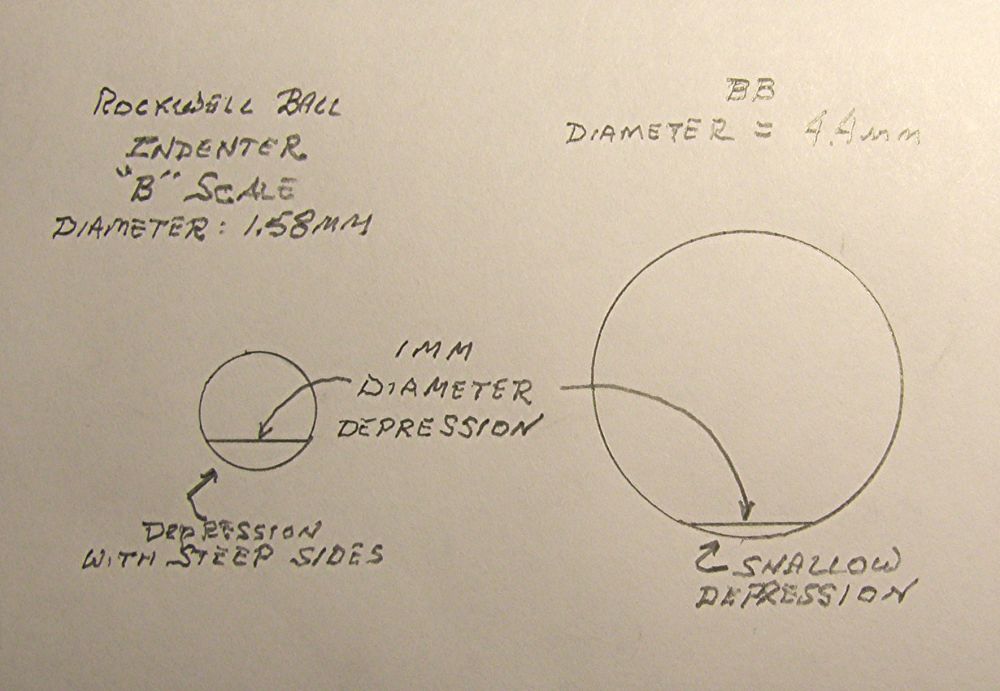
For a "B" Scale Rockwell indenter, a 1 mm diameter will represent an indentation of approximately ½ of the hemisphere. This is enough to leave rather steep sides to the mark.
For a BB to leave a 1 mm diameter indentation, the depth of the indentation must be only about 1/20 of the diameter of the BB - which would leave an extremely shallow slope to the sides of the mark.
This means that most of the marks we have been thinking are BB strikes have sides which are too steep to be made by a BB. They are, in other words, too deep to be made by a BB
and also leave only an approximate 1 mm diameter depression. The 1 mm diameter depression left by a BB strike would be almost flat! A smaller diameter mark would be even flatter and
very shallow! In addition, a BB would most likely leave a pressure ridge around the circumference of the depression. It may also leave a raised area on the opposite side of the coin.
I have made a crude drawing in an attempt to illustrate this. It is not exactly to scale, but I think that it is close enough so that the concept can be understood.








 First Page
 Previous Page


 Posted 08/24/2015 8:21 pm