| Author |
 Replies: 52 / Views: 5,822 Replies: 52 / Views: 5,822 |
|
|
|
Moderator
 United States
196946 Posts |
Could it have been a gear and later worn down in circulation? I have no reason to doubt a clock guy though. My grandfather was a clock guy.  |
|
Rest in Peace
United States
10625 Posts |
There is no way a clock could have run if this were used as a gear. The irregular so called gear teeth (especially between 7 and 9 o-clock) would have stopped the clock before completing the first complete revolution. There's no way that would have meshed with another gear. It may be a different story if it were used as a ratchet gear.
I agree with OldSkool, none of the Large cents on the link were likely used as gears.(at least successfully)
|
|
Moderator
 United States
16709 Posts |
Let's forget clocks for right now.
Can we agree this was made for something? Ok, it could be a crude crimper or really crude gear.
If you look down Gary's list of coins, you will come to one that says pie crimper. I am 100% convinced that that was it's application.
I can't say with 100% certainty that this wasn't made as a crude gear.
Guess we'll never know.
Now jbuck, where is that time machine I've been asking for? :-)
swcoin.ecrater.com
|
|
Moderator
United States
196946 Posts |
Quote:
If you look down Gary's list of coins, you will come to one that says pie crimper. I am 100% convinced that that was it's application. I liked that assessment since the first post you made and I still like it now. Quote:
Now jbuck, where is that time machine I've been asking for? :-) Still working on it. It seems that fissile material is not that easy to obtain.  |
|
Bedrock of the Community
United States
12057 Posts |
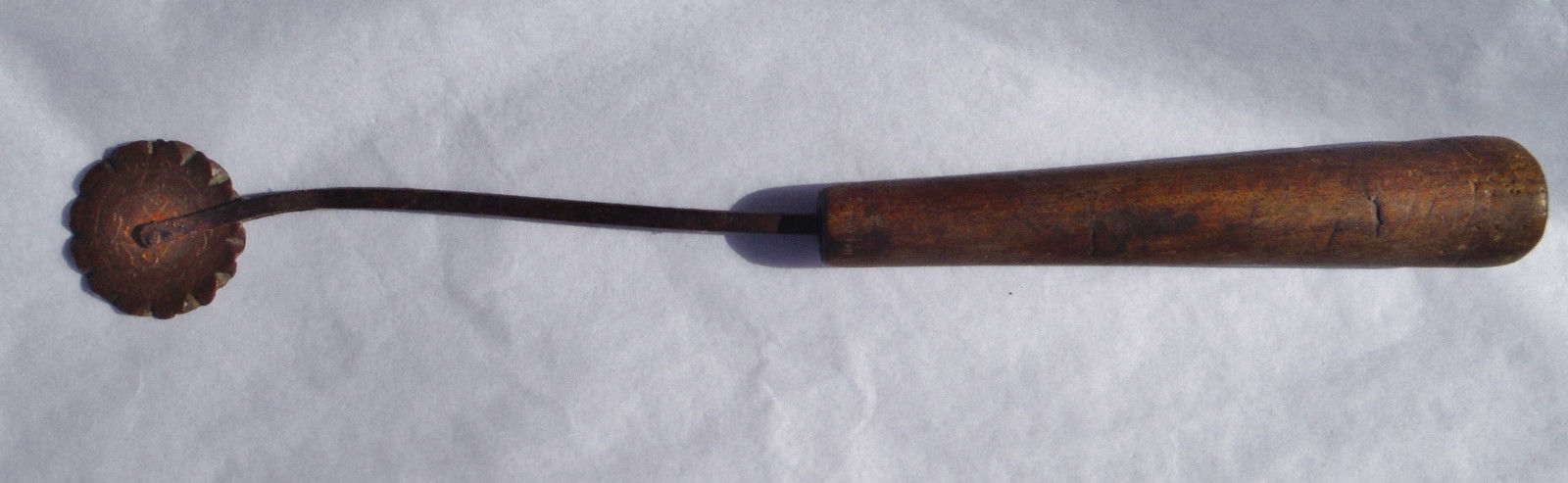
I don't care if it was used for nothing at all, it has history and I like it. It looks almost like a ratchet or pawl type gear, i.e. one with teeth only on part of the circumference.
People had to be enterprising, especially on farms, and ingenious. It wasn't like you could load up your implements and drive the trailer down to the local John Deere or IH service center, or have spare tractor parts shipped to your doorstep overnight by express mail, so if something broke, you either fixed it or didn't use it, and not using it was not often a valid option. I've seen cream separators, churns, hide tanning tools, and all sorts of farm implements fixed with "Creative repurposing" of various things.
I would cast my vote for pie crimper. The copper was more suitable for the job than iron (which rusted immediately) -- it was a long time before the age of stainless steel, and I don't recall ever seeing a silver pie crimper, that would have been extravagant. Besides, most clock gears were a low friction application and so cast out of hard-wearing (high copper) brass, which would not have seen enough mechanical stress to require replacement with the possible exception of a ratchet-type mainspring winder.
Member ANA - EAC - TNA - SSDC - CCT #890 "Most of the things worth doing in the world had been declared impossible before they were done." -- Louis D. Brandeis |
|
Moderator
United States
196946 Posts |
Nice breakdown, paralyse. |
|
Moderator
United States
16709 Posts |
Excellent analysis.
Yeah, folks in that era as well, made every dollar count so self repairs and ingenuity (when applicable) were common place.
BTW, it's "reeded" all the way around.
swcoin.ecrater.com
|
|
Bedrock of the Community
United States
12057 Posts |
I'm like my Dad, if I'm not reading at least 3 or 4 books a week, check me for a pulse. Always gotta be learning. :)
Member ANA - EAC - TNA - SSDC - CCT #890 "Most of the things worth doing in the world had been declared impossible before they were done." -- Louis D. Brandeis |
|
Moderator
United States
196946 Posts |
|
|
Pillar of the Community
United States
2077 Posts |
Quote:
Your expertise on clocks or your expertise on gears in general..and their various uses?
I don't have experience in gears for various applications..do you?
That's what I'm trying to establish. Then, what are these and why were they made in your opinion? I had training in gear design way back in my ME classes, but most of my practical experience is with clocks. There are three things that tell me it was not a clock gear, nor were any of the others in the link (besides the ratchet wheel). A gear needs to make contact with the mating pinion with multiple teeth on order to carry load without breaking. This requires a fairly deep root, which none of these have. A gear also needs extremely precise spacing on the teeth to operate with constant inertia and minimal backlash. Again, these do not exhibit that. Dividing wheels have been around for over 300 years and can be used to create gears precise to fractions of a degree. Lastly, the hole in the center isn't large enough. Clock gears aren't fitted directly to shafts. They are fitted to a larger shoulder and staked into place. Given the thickness of the cent and diameter of the hole, an adequate (non slipping) fit would be impossible. Also, in early movements, the only wheel that even comes close to the diameter of an LC is the escape wheel. This is the one that engages with the pallets and must be light, precise, and have extremely deep roots. Here's a picture to show how far off these are from an escape wheel. 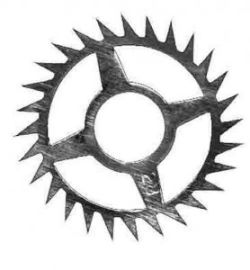 These coins all share enough similarity to show that they served some regular purpose in early American life. Strange that none exist attached to whatever mechanism with which they were used. I have never heard of anyone pulling back a clock dial and seeing a large cent as part of the movement, although I did see one with a Wheat cent soldered to the plate to fix a worn bushing. I'm going with pie crimper. I like pie. Edited by OldSkoolMadSkilz
08/25/2015 12:58 am
|
|
Pillar of the Community
United States
2077 Posts |
Pie Crimper 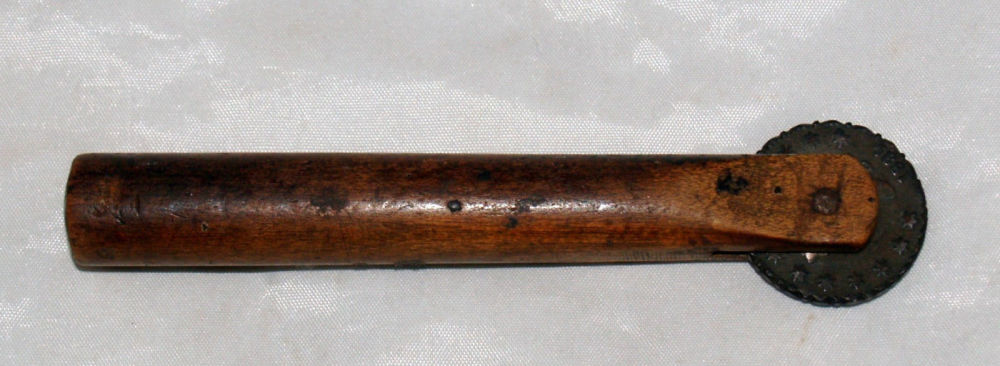 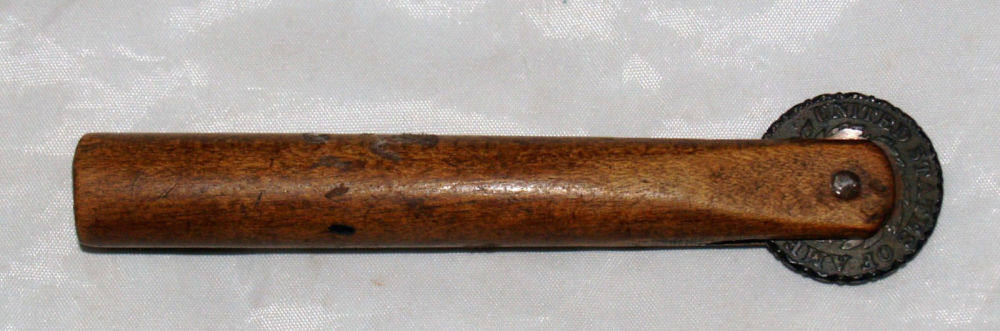 |
|
Pillar of the Community
United States
8537 Posts |
Oregon coin geek.....*** GO BEAVS ! ! ! ***
|
|
Moderator
United States
196946 Posts |
Quote:
I'm going with pie crimper. I like pie. Love pie. Apple the most.  I enjoyed reading your first post and view the photos in the second. Well done. |
|
Moderator
United States
16709 Posts |
Pumpkin for me  swcoin.ecrater.com
|
|
Pillar of the Community
United States
3253 Posts |
All you apple and pumpkin pie fans may be wondering why one would need a tool like this to edge a pie. I'm convinced crimpers (or pastry jiggers, as they're called in Britain; here's a great collection: http://www.michaelfinlay.com/MF_WEB...GGERS_1.html ) were primarily for the heavy "hot-water" crust of the savoury meat pies that are still favorites in the English North and Midlands, and once were staples in colonial America and the early US. The medieval origins of the hot-water crust required enough strength for a pie to be carried away from the bakehouses, often for days over rough roads. Dave, if your up for it, I propose that you send your jigger to whichever of our members is mechanically-inclined enough to put it in a handle reproducing 52Raymo's device. They can send it on to me, and I can access some British pastry-making sources, and create, on video, some of the first large-cent-crimped pork pies to be made in Philadelphia for the last 200 years! Or we can skip the handle and free-wheel it; did you see the copper posted on the Metal Detecting Forum, with scalloped edge, but no hole? Edited by philadelphian
08/25/2015 2:06 pm
|
| |
Replies: 52 / Views: 5,822 |





 First Page
 Previous Page


 Posted 08/24/2015 12:53 pm