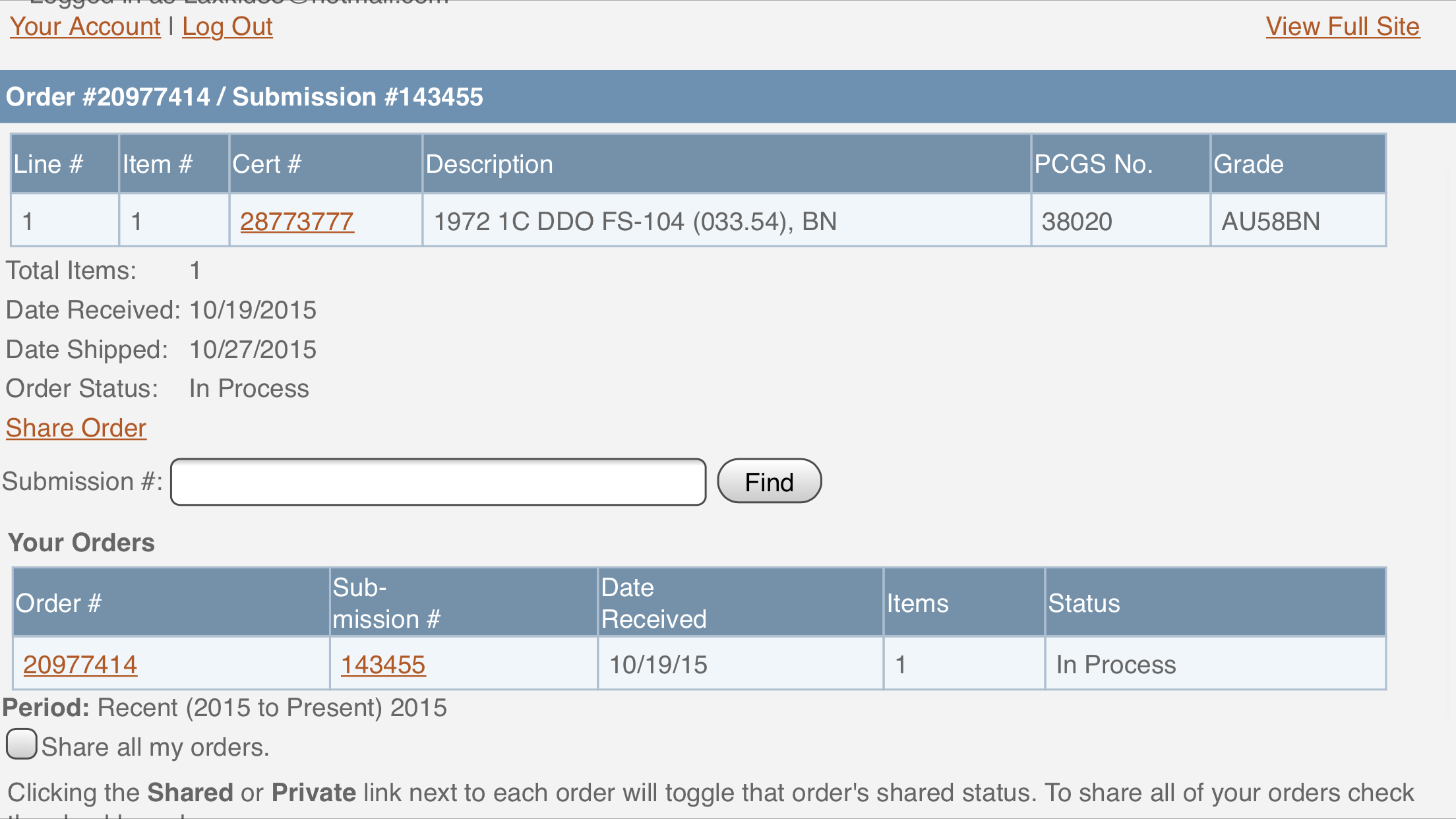
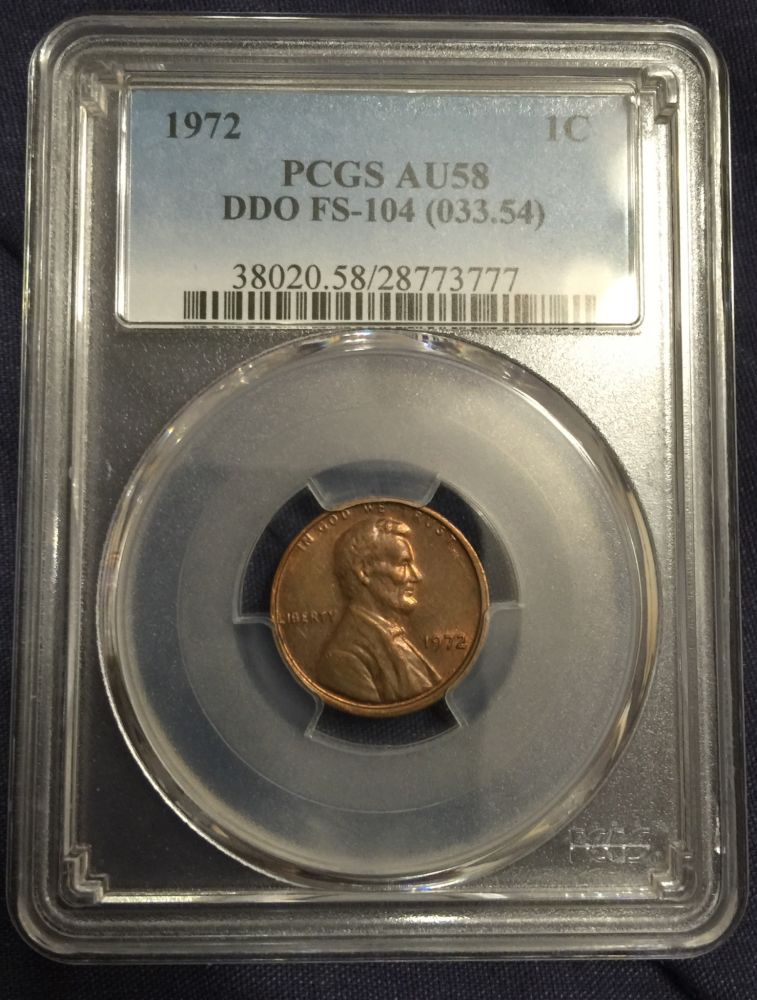
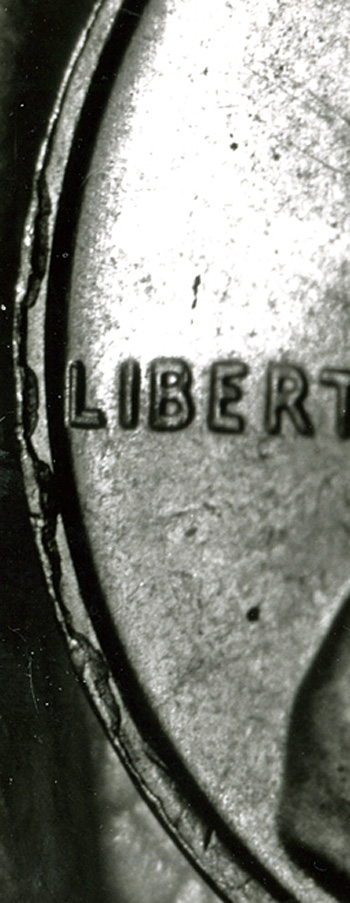
These images of the rim
Cuds appear to be a match to the #4 I shot and have on file.
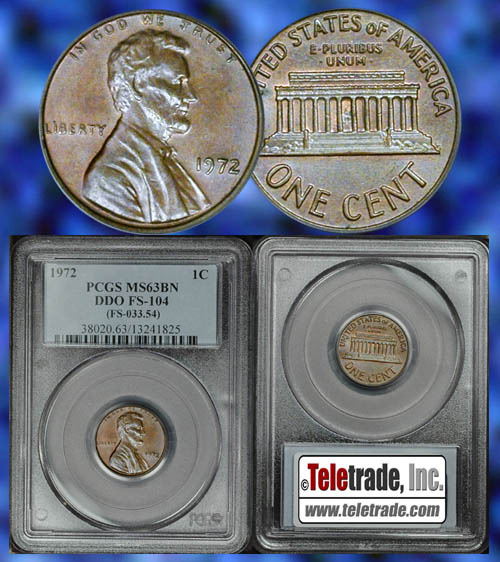
One of these sold in Teletrade on Jan 25, 2009 in MS63 BN for $2250.00.
My
Coin World story is below.
"Minor" 1972 Double Die Sells for $2,250.00
by Ken Potter
Special To
Coin World1/28/2009
You might want to think twice before referring to any 1972 doubled die obverse
Lincoln Cent, except the major Die #1, as minor! A Professional Coin Grading Service graded example of the 1972 doubled die obverse #4 in Mint State 63 Brown was auctioned off by Teletrade as Lot 1159 in Auction 2644 on January 25 for a whopping $2,250.00. This is almost ten-times the price of the major 1972 Doubled Die #1 in the same grade which lists on the PCGS Price Guide at a mere $260.00.
According to Teletrade spokesperson, Karen Bridges, ten unique bidders competed for the lot. It is one of only two specimens graded by PCGS with the other grading MS64. Numismatic Guaranty Corporation has graded five specimens, one in About Uncirculated 55 Brown, an MS62 Red/Brown, one MS65 Red and two MS66 Red. Most seasoned variety coin experts have only seen one or two specimens of the variety in their entire career vs. hundreds of examples of many of the other minor 1972 doubled die cent varieties.
While Die#4 is not the most minor doubled die obverse for the 1972 series, in my opinion, of the eight other Class 1 rotated hub doubled dies known it only beats out Die #6 in strength. It exhibits light to moderate CCW doubling on IN GOD WE TRUST, LIBER of LIBERTY and light doubling on the date. One of the most important diagnostic markers used in its identification is a series of connected rim
Cuds on the left side of the obverse. Reverse markers are a die scratch Southwest from lower N of UNITED, numerous die scratches East-West above and below the Memorial building and die scratches East-West running from the seventh through the ninth bays of the Memorial building.
Brian Allen, author of several variety books, was first to alert me of this sale. He said that some 10 years ago the late Russ LeBeau (who owned two examples) swore that DDO#4 was worth thousands more than the DDO#1. I thought he had lost his mind but he appears to have been correct said Allen. Allen obtained the example he now owns from within a lot of 20 circulated 1972 unidentified minor doubled dies that he purchased from error-variety dealer, G. J. Lawson a few years ago now graded PCI Extremely Fine 45.
Billy Crawford, author of A Detailed Analysis of
Lincoln Cent Varieties said, "I have examined two specimens, one with and one without the rim
Cuds. However, both coins exhibited the same well-known and documented die markers for this particular variety. In my opinion, I believe it remains a very elusive variety." Crawford is the only observer who reports seeing a stage of the die prior to the development of rim
Cuds. This indicates that examples that appear to be Die#4 without the obverse rim
Cuds need to be checked further using reverse die markers.
Chuck Daughtrey, author and Webmaster of Coppercoins.com said, "Almost all examples of reported Die#4 I have seen turned out to be the very similar Die #7 . I do not have one, nor have I ever owned one." A lesson here is that if you think you have a Die #7, maybe you should double check it to make sure it is not a Die#4! Another Coppercoins.com attributer, Bob Piazza, noted he has only attributed one Die#4 in a slightly circulated grade with the rim
Cuds and other markers present.
John Wexler who's penned over a dozen variety books (and co-authors,
Coin World's, Varieties Notebook column with me) has seen a total of three specimens. He said, "I have two stages for this variety listed in my files. The first shows a rim
Cud to the left of the L in LIBERTY. The second shows several rims
Cuds between 8:00 and 10:00. I haven't seen any without the rim
Cuds. The reverses are the same for both stages. I suspect that the die deteriorated rapidly and had to be removed from use. Over the years it has proven to be an extremely rare variety."
Combined Organizations of Numismatic Error Collectors of America, 20th Century Variety Coin attributer, and author James Wiles agreed with Wexler on the rapid
Die Deterioration possibility and said, "I have only seen one copy in 20 years." It grades MS64 Red.
John Bordner, author and President of the National Collectors Association of Die Doubling said he believes Die#4 to be the most rare of all the 1972 doubled dies.
I have only seen one example that I photographed for Kevin Flynn back in May of 1994. It was in early die state and contained all the
Cuds along the left rim. Over the years I have handled hundreds of the other minor doubled dies but never a Die#4.
Bill Fivaz and J.T. Stanton list the variety in the
CherryPickers' Guide To Rare Die Varieties fifth edition as FS-01-1972-104 with a Universal Rarity Scale rating of 6. URS-6 indicates an estimate of 17 to 32 pieces known. Stanton stated he sold "full red BU" sometime in the late 1980s or early 1990s from his and Fivaz's JOJA JEMZ catalog for about $35.00 to $40.00. CPG currently estimates the value for an MS63 at $350.00, which just goes to show you that even in a weak economy, true rarities can shatter records or preconceived notions of value given in price guides!
Hub doubling, or what collectors commonly refer to as a doubled die, is possible due to a phenomenon known as work hardening. This causes the metal of the face of a die to become too hard and too brittle to allow a complete image to be sunk into the die in one operation without causing it to crack or shatter (during the multiple hubbing process). As a result, several impressions or hubbings are required to produce a die when using this process. (The U.S. Mint largely replaced the multiple hubbing process in recent years by the more modern "single squeeze" restrained hubbing process). Between each hubbing the die is removed from the press and annealed (softened) thus allowing for another impression without shattering the die. If for some reason a partially finished die is reinstalled into a press for strengthening and the hub and die is improperly indexed, resulting in a misalignment of images, or if the hub varies in design from the one(s) used for earlier impressions -- hub doubling will result.
In the case of the 1972 DDO#4, (and all the varieties listed from #1 through #8), we have what is referred to as Class 1 Rotated Hub doubling. This class occurs when there is a rotational misalignment between images. As can be seen in the images shown here the final overlying image is rotated counter clockwise in relation to the earlier underlying image. The direction of spread on hub doubling is defined as the direction you must more from the underlying images to the usually stronger overlying image. Thus, this variety is defined as a Class 1 Rotated Hub with CCW doubling.
Macro photographs shown here are courtesy of Teletrade while the photomicrographs are courtesy of James Wiles/CONECA.




 First Page


 Posted 08/27/2015 02:23 am