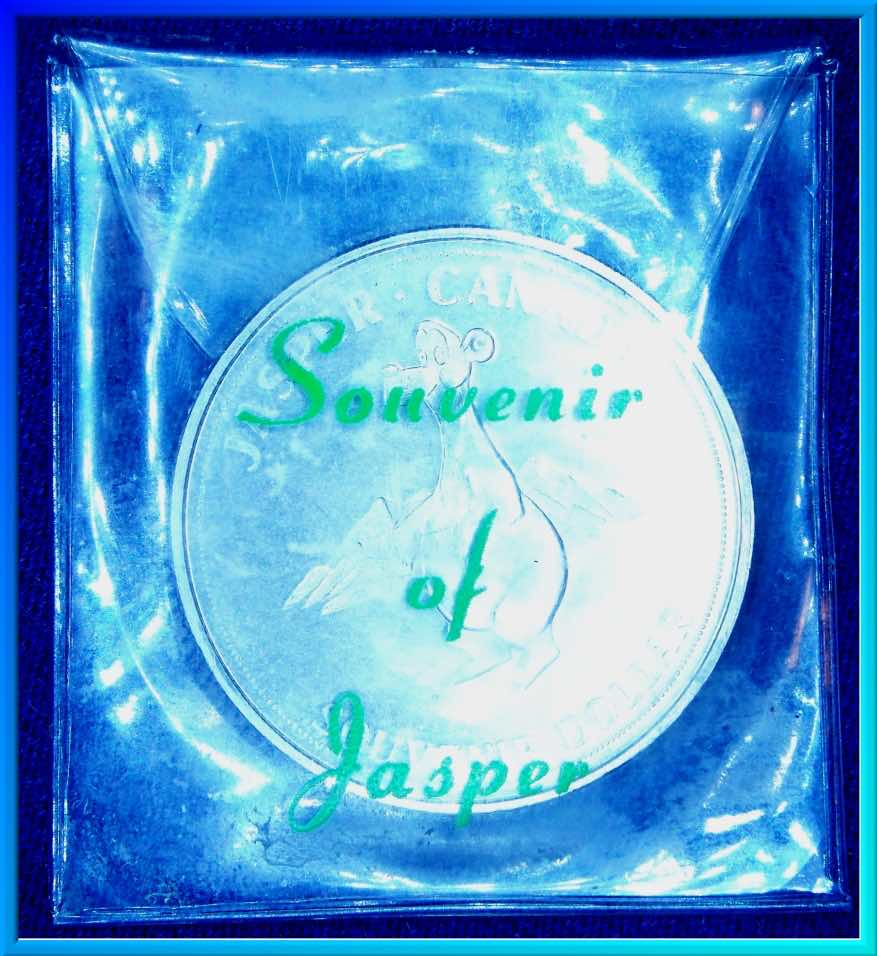
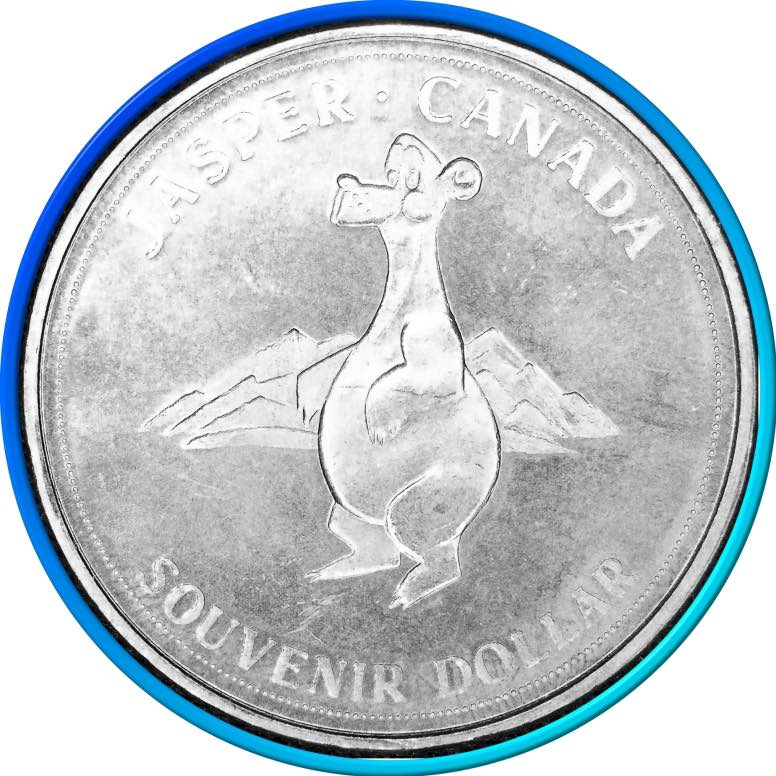
Here's another thread about a series of Canadian local tokens. Although I have yet to complete this (long) set, the end is near! Previously, I had kind of given up on these tokens, because my only catalog was from 1993, and Jasper tokens continued production into the 21st century, so who knows how many I would be missing. But yesterday I had the good fortune of finding a newer catalog from 2006. This new catalog, and a conversation with someone at the Jasper Museum, definitively tell me that Jasper issued tokens starting in 1970 and stopping in 2005. (Next time I go there, I will have to bring some of mine to donate to their collection.) I find that Jasper tokens are worth collecting because their designs are very well-crafted.
Alberta has two major cities, Edmonton and Calgary. Calgary is bigger, more famous, and more vivacious, but Edmonton seems less belligerent and more authentic (or is that more resentful?). What I've always found interesting is that, if you drive to the West until you hit the mountains, this rivalry is mirrored in the two Rocky Mountain national parks that you find. Banff, west of Calgary, is world-famous, right on the Trans-Canada Highway, swamped with tourists, and the park's townsite even has a shopping mall - Jasper, west of Edmonton, is less touristy, perhaps more charming, and you have to take the less popular Yellowhead Highway to get there. So, this basically explains Jasper - Banff is the famous one, Jasper is the other one.
Interestingly, Ian Stanford Fleming (who had attained a high position in the Canadian Pacific Railway) originally suggested that the first railway to cross Canada should go north through Edmonton, Jasper, and the Yellowhead Pass. If this plan had become reality, Edmonton would probably be the only major city in the province in the same way that Winnipeg dominates Manitoba - and Jasper would probably be quite a lot bigger as well. As it is, it took decades of lobbying just to get the road from Edmonton to Jasper paved for its entire length. Don't think that Jasper is an empty, unspoiled wilderness, free from the modern tourist industry, though - the ski lodges and the hotels are still crowded. If you want the real wilderness experience, I've heard good things about the Willmore Wilderness Park just next door.
Every token from Jasper features Jasper the Bear on one side, the town's official mascot. There is a life-sized statue of him in a little town park. Apparently, Jasper the Bear also used to star in a weekly newspaper comic. The character is older than Smokey the Bear.

The first Jasper issue commemorates the opening of the Yellowhead Highway, which runs from Winnipeg to the Haida Gwaii off the B.C. coast. Along the way, the highway intersects Saskatoon, Edmonton, Jasper, and Prince George. This made Jasper a more viable tourist destination. This first token is slightly under-sized and has a plain edge, setting it apart from subsequent issues.

This token and the next issue are definitely some of the most beautiful tokens I own. With its historical fur-trading theme, this token's design has similarities to some promotional medallions produced by the Sherritt Mint, all of which featured the fur trader and explorer Anthony Henday.

The 1972 Jasper Souvenir Dollar is apparently the rarest of the lot. Back in the "good old days", when trade tokens were apparently in high demand, this one could sell for more than $60 - I got mine for less than 50 cents. Its train design is very appealing.

In 1973, the material switched from nickel to nickel-brass for some reason. Perhaps this was just a one-year experiment? Pyramid Mountain is just one of many nearby mountains.

Fred Brewster was the builder of Tent City, the predecessor of today's Jasper Park Lodge, the hotel that the railway built when it eventually passed through.

Maligne Lake helps keep the stock photo industry afloat - if you memorize this coin's design, you might start to see it all over the place.

The Icefields Parkway connects Banff and Jasper and is considered one of the world's most scenic highways. The Columbia Icefields are the largest icefields in the Canadian Rockies. They are also rapidly shrinking, so it's best to visit this attraction sooner rather than later. Interestingly, water from the Columbia Icefields eventually makes its way to no less than three oceans - Pacific, Arctic, and Atlantic.

In 1977, Jasper National Park celebrated its 70th anniversary - it's not as old as Banff National Park.
From 1978 to 1988, every Jasper souvenir dollar (with one exception) depicted some local wildlife. These tokens are all pretty similar so I won't bother with any commentary.


Here is the one exception - a token that commemorates the centennial of Parks Canada.


Unfortunately, I don't have a 1989 token in my collection. It depicts a skier and celebrates the 25th anniversary of Marmot Basin, the local ski hill. We now return to our regularly scheduled programming.


Edith Cavell was a British nurse who saved lives indiscriminately and helped hundreds of Allied soldiers escape Belgium in WWI. Apparently this was punishable by death, and she was executed by the Germans. This was a mistake because she immediately became a martyr, thus helping both sides to pretend that they were fighting a righteous and justified war. For these deeds, a mountain was named after her in Canada, a country she never actually visited.

In 1992, Canada officially turned 125 years old. All Canadian coins from 1992 feature the double dates "1867 1992". This token followed suit. (Get hyped for Canada's 150th birthday! It's less than 2 years away!)

This is the last of the "generic wildlife" tokens. They are nice to look at, but not enormously interesting.

No souvenir dollars were issued in 1994, so to make up for it, two were issued in 1995. This commemorative has the highest mintage by far of any Jasper Souvenir Dollar at 100,000.

Later in the year (perhaps all 100,000 Canada Games tokens had sold out?) a new type was released, commemorating the RCMP's Crime Stoppers program.
After this, there is a large gap in my collection. More souvenir dollars were issued in 1996 and 1998, and in 1999, the denomination was increased to "Souvenir
Two Dollars". Every year from 1999 to 2005 saw a new issue of these 2-dollar tokens, but mintages were very low, ranging from 10,000 to just 2,000 (!), so I've only found one of these so far.

The last Jasper token commemorates the 100th anniversary of the Province of Alberta, created from a chunk of the North-West Territories on September 1, 1905. (The bighorn sheep is the official provincial mammal.) It's nice that they ended the series with a significant commemorative. This last issue is made of nickel-plated copper rather than nickel-bonded steel, and it has weak reeding - this tells me that it was produced somewhere else after the closure of the Sherritt Mint. Just another mystery in the already-mysterious field of Canadian local dollars...
The series of Jasper souvenir dollars is unusual, because of its longevity, and because these tokens do not have any validity information on them to detract from the beauty of their designs. With 35 different types to collect, and with fairly low mintages (usually around 20,000), completing the set of Jasper souvenir dollars takes some work but is pretty rewarding... not that I would know.




 Posted 08/26/2015 3:26 pm