| Author |
 Replies: 22 / Views: 5,382 Replies: 22 / Views: 5,382 |
|
Pillar of the Community
United States
1674 Posts |
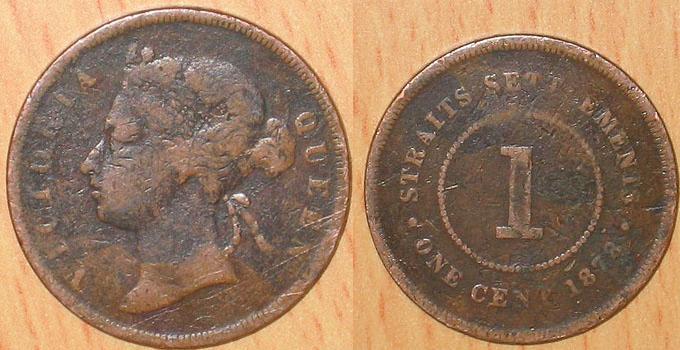
Great recent find off a very cheap ebay auction lot! Condition is kind of rough, but I'd say there is enough detail for a grade of Fine. On in VF recently went for $2200 at auction despite an estimate of only $350. The gems are out there if you keep looking =) Image:  Picture118.jpg.jpg Picture118.jpg.jpg75 KB |
|
|
|
Moderator
 United States
6563 Posts |
$2200?...wow
Krause lists F as $180 and VF as $500
|
|
Pillar of the Community
 United States
1674 Posts |
|
|
Pillar of the Community
Australia
3841 Posts |
Nice - it definately is worthwhile searching through those low end coins. You'll never know what you can find. Nice one!
|
|
Pillar of the Community
United States
5362 Posts |
Does anyone but me have a problem with the color of the last two numerals in the date?
I don't know or really like the series, but when two digits are a different color it always makes me suspect a simple date alteration. Were the originals of the 1878 struck with a die that had two digits struck into the die at a different depth? Also did they change the font of the 7 between 1874 and 1877? The 1874 clearly seems to have a shorter thinner serif and longer stem.
|
|
Pillar of the Community
United States
1674 Posts |
That's definitely something I looked at very closely. There is blotchy discoloration on parts of the coin, including part of the date. I checked out the date under 15x magnification and found no evidence of an over-strike or difference in depth of the strike, just a little corrosion and wear.
I don't know much about the serif of the 7, though I can say that I've seen many slight date and legend variations in this series.
I know sometimes you find fakes of these types of coins that are like a brass-colored base metal and has a specific scent and lighter weight. This one is a full 9.3 grams and is copper.
If there are other ways to determine for sure if something has been altered, will you please inform me?
Thanks a bunch!
|
|
Moderator
 United States
23731 Posts |
Swamperbob I see what your saying about the 7 & 8, there does seem to be a slight difference in the style from others in the series. Here is an 1872-H from my collection the 7 is what is usually seem but on this coin the 1 is a little different. (enhanced imaged). To me it looks like the coin is dirty which may explain the difference in color. Other than that it looks good. Condition wise I would only grade it as VG tops. $75-100.  |
|
Pillar of the Community
United States
5362 Posts |
I am most familiar with the Cap and Ray series of Mexico, but in that case the coin doctors are working overtime making rare dates out of low grade REAL coins. That way the metal and the weight are right. The low grade coins are also unevenly toned, have damage and dirt spots that can be very helpful when covering the work of the dosctor's.
There are a few ways to expose a fake but it depends on how the forgery was done. So often you have to look for different types of clues until you are sure none apply.
The transition between the numerals and the field are CRITICAL. Nothing else on the coin matters but the number 7 and possibly the nimber 8.
First look at the edge - it must be plain. If a doctor started with an 1888 - a very common date - then he has to remove the reeding. The 1888's were reeded and the 1878's were plain. Make sure the edge has not been "made" plain.
Second look for the all important transition between the numeral and the field. You need to find areas with no dirt and intact surfaces. You will need a binocular microscope and a magnification of 100x or 200x to be positive. Even worn coins should have some portions of this transition.
Third if you have a 200x scope focus on the top of the first digit 8 then move the coin over to the 7. If the top surface of the 7 is out of focus you may have a problem. The dies should be cut to the same level - these were not made with individual element punches at this point in time. The same technique can be used to check the level of the field (see below).
If the last digit or last two of the date were ground off and new ones glued on (the easiest and most common technique) you can often remove the letters with acetone. There are some glues that are better and harder to remove - but dirt is often used to cover the seam. Acetone will not harm a coin in this grade so I would start with a soak. If the numbers stay on look for a seam. You may need to remove some of the dirt, but as long as dirt covers a potential seam location you do not know what you have. The process of removing the old digits often damages the field or adjacent numerals so look for that type of damage.
The second technique I see quite often is the deposition of a drop of metal onto the surface from which a new letter or letters are engraved. Often the metal is softer than the original metal to allow for easy engraving. This is far easier to spot and is usually detected with a high power microscopic examination. Once again dirt (like black goop made with carbon black) is often baked onto the coin to hide the lines. Make sure the 7 is a die struck feature - look for traces of flow lines at the transition.
The next technique is very much like the last. It involves lowering the field around the letters involved and they engrave the letters out of the field material. This alteration results in a depressed area around the digits. Once again dirt is used to obscure the work involved.
This coin has the date so far in toward the center that I doubt the addition of a digit from the edge drilling technique could be used - but check the rim for damage at that point anyway. The technique involves a hole being drilled from the edge to a point beneath the number to be added. A die is then inserted and the number is added with pressure. The hole is filled and the evidence at the edge is covered with a rim bump.
One wild technique seen on cobs is the reconstruction of elements with colored plastic applied to the surface. In one case, a friend of mine had a full date 8R cob in which the entire date was made from a dark plastic material that melted away totally when immersed in acetone.
|
|
Pillar of the Community
United States
1674 Posts |
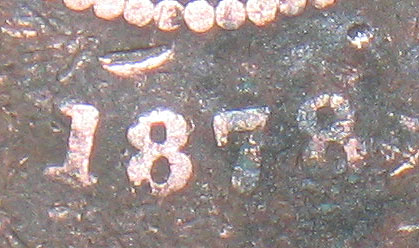
I managed to get some of the dirt off to better see the date, though some corrosion still persists. I also compared the rim to others I have of this type and did not find any significant differences. Please scrutinize this close up pic. Thanks! Image: 18.jpg.jpg62.97 KB |
|
Moderator
United States
23731 Posts |
I'm by no means an expert, but I can't see any signs of the date being altered. I still say it's OK.
|
|
Pillar of the Community
United States
5362 Posts |
Hi Numismat - The enlargement of the date does a nice job. If you notice - there is apparent corrosion around an ON both of the digits that I am concerned with - the 7 and the 8 but nothing similar is visible on the other two digits or the beaded circle. There may be some in the fields but it is not as clear in any other area on this enlargement. I did a blow-up of the 8 on the picture because it has a "feature" I have seen before on doctored coins. The surface of the suspect letters are crazed (cracked) as if the material has shrunk. These cracks form in a pattern seen in clay at the bottom of a dry river bed. The apparent cracks run side to side the full width of the 8 but do not extend out onto the fields. This cracking does happen on letters that are molded or sculpted from a soft matrix that then hardens... The shape of the 8 is very good and it may have been molded from the first 8 but if you put a ruler on the picture you can see that the 8's are NOT the same width. The easiest to measure is the upper loop of the 8 - the edges are sharp and two measurements that should be the same are found not to be identical. I did a rough outline of some of the big seams in yellow and placed both the original picture and the enlargements side by side. Can anyone else see what I mean? Image Insert: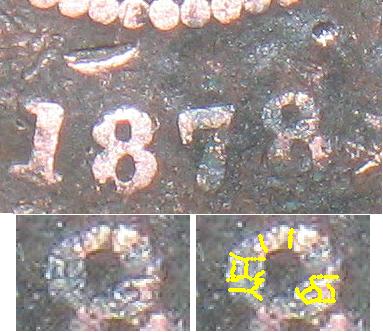 |
|
Moderator
United States
23731 Posts |
Swamperbob, I defer to your expertise and I see what you are saying. Can this not also be caused by wear and corrosion?
|
|
Pillar of the Community
United States
5362 Posts |
Yes, it can be caused naturally. It is just very suspicious when it happens primarily on the two digits that would have to be altered to tuen a 10 cent coin into one worth $100.
Perhaps I am simply too suspicious, but I handle quite a few forgeries each and every week and nothing surprises me.
|
|
Pillar of the Community
United States
1674 Posts |
This is really excellent information. These marks on the 8 would definitely be good evidence for doctoring on a high grade coin, but the surface is so marked up and corroded that it almost seems normal for those cuts in the date, as echizento pointed out. I agree it looks suspicious that the cracks are only on that part of the date.
I think that since this is a low grade coin, it's not as big of a deal. Had it been Unc and doctored that would truly be heartbreaking =)
I'll keep and enjoy it nontheless, just being a little wiser now on how to spot these things.
Thanks swamperbob for this excellent info, I feel like I should pay you for the time and great lesson! =)
Thanks again,
- Dmitry
|
|
Pillar of the Community
United States
1674 Posts |
I actually also noticed that on the right side of the second 8, there is not so much of a pronounced indent between the loops as the first 8 and even the right side of the same 8. So if indeed it was doctored, would the most likely candidate?
There is no 1879, so would the 1874 be the closest? It also would have the plain edge like my coin.
|
|
Pillar of the Community
United States
5362 Posts |
Without knowing the individual die varieties (actually the hub varieties) I can not be sure at all which date this could be. Actually if I were doing it I would start from an 1876, but this does not seem to be a re-worked 6. The 1874 is the most common so it could be a 74.
|
| |
Replies: 22 / Views: 5,382 |





 Picture118.jpg.jpg


 Posted 01/19/2008 6:24 pm





 18.jpg.jpg


