Coin Community Family of Web Sites Join Thousands of Coin, Bullion, & Money Collectors
Specializing in Modern Numismatics Coin, Banknote and Medal Collectors's Online Mall Royal Estate Auctions - $1 Coin Auctions300,000 items to help build your collection! Vancouvers #1 Coin and Paper Money Dealer Join Thousands of Coin, Bullion, & Money Collectors Royal Canadian Mint products, Canadian, Polish, American, and world coins and banknotes.


Username:
Password:
Save Password
Forgot your Password?


This page may contain links that result in small commissions to keep this free site up and running.

Welcome Guest! Registering and/or logging in will remove the anchor (bottom) ads. It's Free!

What Is This Coin?

To participate in the forum you must log in or register.
Author Previous TopicReplies: 22 / Views: 3,842Next Topic
Page: of 2
Pillar of the Community
swamperbob's Avatar
United States
5362 Posts
 Posted 11/30/2015  11:48 pm Show Profile   Bookmark this topic Add swamperbob to your friends list Get a Link to this Message Number of Subscribers
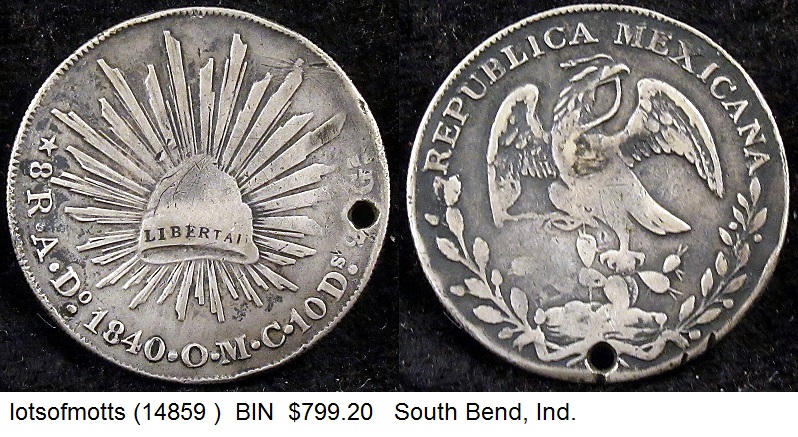
There is a coin on ebay that ends tonight.

What-Is-This-Coin?

My question is - what is it? and more importantly WHY do you say that?
Bedrock of the Community
sel_69l's Avatar
Australia
21788 Posts
 Posted 12/01/2015  01:22 am  Show Profile   Bookmark this reply Add sel_69l to your friends list Get a Link to this Reply
The total of posts in this thread will be an education for me; way outside my specialities.
Moderator
Learn More...
John1's Avatar
United States
56855 Posts
 Posted 12/01/2015  04:54 am  Show Profile   Bookmark this reply Add John1 to your friends list Get a Link to this Reply
Looks like a Mexican silver peso that was holed to be a necklace. Or am I missing something?
John1
Edited by John1
12/01/2015 04:55 am
Pillar of the Community
Australia
3831 Posts
 Posted 12/01/2015  05:44 am  Show Profile   Bookmark this reply Add gxseries to your friends list Get a Link to this Reply
Rotated die error? This is mainly based on the hole.
My partial coin collection http://www.omnicoin.com/collection/gxseries
My numismatics articles and collection: http://www.gxseries.com/numis/numis_index.htm
Regularly updated at least once a month.
Pillar of the Community
scstrawn's Avatar
United States
536 Posts
 Posted 12/01/2015  10:15 am  Show Profile   Bookmark this reply Add scstrawn to your friends list Get a Link to this Reply
8 Reales - Durango KM 377.4 (In this condition, not worth $800, even if it's an overdate)
Pillar of the Community
colonialjohn's Avatar
United States
1757 Posts
 Posted 12/01/2015  1:00 pm  Show Profile   Bookmark this reply Add colonialjohn to your friends list Get a Link to this Reply
Never seeing this in regal or anytime prior to today as I don't collect C&Rs - at all. In the listing it has it as silver plated bronze pattern. As we discussed with Ian I mentioned in that thread with the end ribbon DEBATE that many references default in MEX to the alloy bronze. They also use the word silver plate not realizing that later 19thC counterfeits could be electroplated as we also discussed. Not sure of the pattern status as I am away from my KM. It also has a hole - in many cases this may mean a jewlery piece but it can also mean a cancellation hole from a vendor or shopkeeper realizing its a fake or of the piece being heavily debased. No weight is listed. The surfaces to me at this point ... and still learning here from using the E-Bay magnification tool ... even if this is an electroplated CC C&R appears to be based on how we see the gap areas around the legend motifs showing the core area? Maybe? The surfaces here appear to be a surface Ag film rather than that heavy pasty look Sheffield plates sometimes exhibit on circulated examples showing break-through near the edges or on the edges in most cases.
Even if I am wrong in my new book I explore early Sheffield CCs (ie., English Silver Crowns 16thC foils and plates)/Birmingham Sheffields (High end GNL Type 1's)/Electroplated C&Rs (briefly) with suggestive attributes as this is totally a new territory to me and everyone else. Remembering silvering goes all the way back to the Roman coin period with even silver foil being used and being applied by a hammering method.

Whatever ... OK ... Bob ... let me have it ... its REGAL.

Its a real silver plated bronze? pattern.

LOL.

JPL
Edited by colonialjohn
12/01/2015 1:11 pm
Pillar of the Community
swamperbob's Avatar
United States
5362 Posts
 Posted 12/01/2015  2:17 pm  Show Profile   Bookmark this reply Add swamperbob to your friends list Get a Link to this Reply
So far two critical observations have been made. I also have some questions that need answers - they will be in quote boxes.

The coin has been holed - unlikely for suspension because the hole would suspend the cap on its side and the eagle would be on his head.


Quote:
So why would someone place a hole in a coin in this location?


The second observation that the coin was struck with just under a 90 degree rotation is also critical in my opinion.


Quote:
Why are coins struck with rotated dies? How common are die rotations?


I also have one fact that was disclosed about the coin in the description.

The coin is silver plated bronze.

Now what do you think?

Pillar of the Community
United Kingdom
1321 Posts
 Posted 12/01/2015  3:02 pm  Show Profile   Bookmark this reply Add andyg to your friends list Get a Link to this Reply
If the coin was on a chain around your neck and you wanted to kiss/bless whatever was on the coin (in this case the eagle) then once you picked it up (while still on the chain) it would have the correct orientation.....
I've seen a few medals with the hole in this fashion over the years in Europe - but it's probably not relevant in this case.
Pillar of the Community
Czech Republic
803 Posts
 Posted 12/01/2015  3:49 pm  Show Profile   Bookmark this reply Add TwoKopeiki to your friends list Get a Link to this Reply
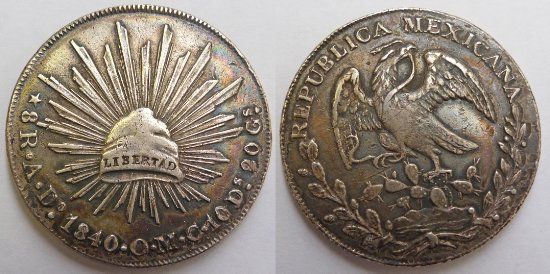
It's a pattern. This one usually comes in silver-plated bronze (Sheffield plate), although it is known in white metal and silver (both very rare). The plated variety is plentiful as patterns go, maybe 32-64 known.

They are thought to have been struck in Spain.

I owned one briefly in 2012.
Pillar of the Community
Czech Republic
803 Posts
 Posted 12/01/2015  3:54 pm  Show Profile   Bookmark this reply Add TwoKopeiki to your friends list Get a Link to this Reply
Found an old image of the one I had:

What-Is-This-Coin?
Pillar of the Community
swamperbob's Avatar
United States
5362 Posts
 Posted 12/01/2015  4:50 pm  Show Profile   Bookmark this reply Add swamperbob to your friends list Get a Link to this Reply
My last post was actually written prior to John's last post. So he has let the cat out of the bag.

Here are the facts about the coin:

1. It has a non-sense legend that reads A. Do 1840 O.M.C. - which no one noticed sorry to say.
2. It is made of Silver plated bronze according to the seller, however, based on the copy I own it is actually a Sheffield Plate over copper strike.
3. The hole is positioned like a typical cancellation mark not a suspension hole. My copy of this coin is also holed and in addition it was test cut. The hole in my coin is also eccentric.
4. The coin has an about 90 degree die rotation - which is common among counterfeits but rather uncommon for genuine coins.
5. The coin has very odd looking 1 punch and on my copy several letters appear to be repunched.
6. The lettering is poorly layed out - crowded near the date widely spaced in the assayer notation.
7. The coin has a distinctive eagle - rather attractive but never employed at any mint. While the upper portion of the eagle is attractive, the lower portion is not as well done. Notice the crude way the foot "grasps" the cactus with toes extended horizontally in a very unnatural pose.

For me the conclusion when I first saw this coin was both simple and obvious - the coin is a Contemporary Circulating Counterfeit. It looks like a typical counterfeit and in fact has many of the characteristics of a counterfeit.

But John has now identified the coin as a rare pattern made for Durango - which is how Krause and several other works portray the coin.

I ran into these same posts long after I had collected my example of the 1840 A.Do O.M.C coin. So imagine my shock to find that in my collection of counterfeits sat a Rare Pattern.


Quote:
But is this coin a pattern as it purports to be?


It didn't seem to fit the facts, so I did some research.

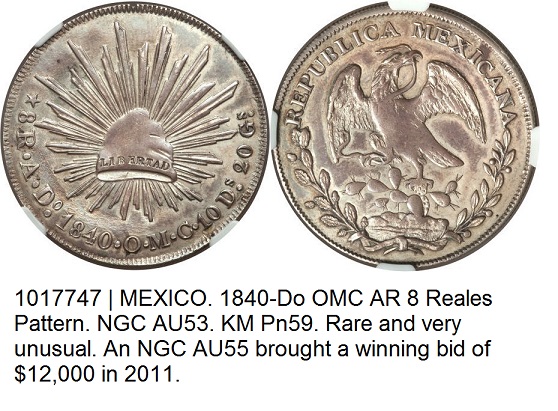
Here is one of the highest graded examples of this "rare" coin as it appeared in a Stacks Auction.
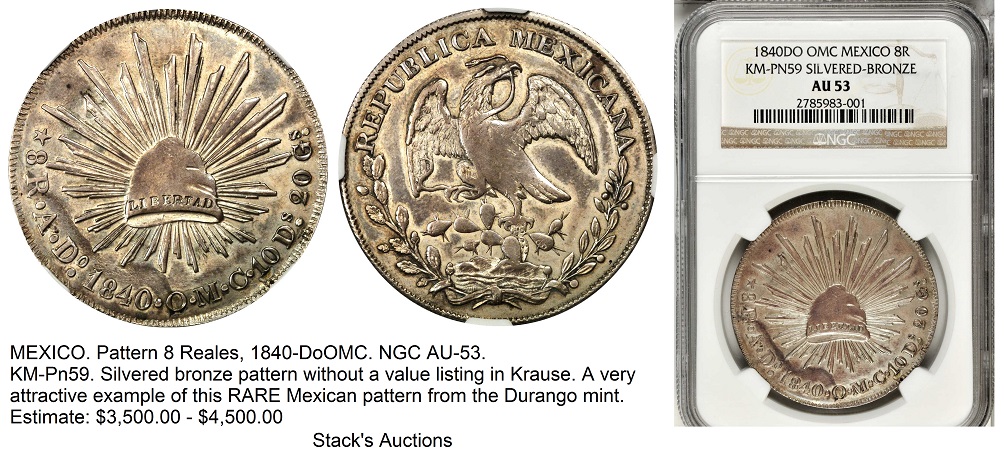

What-Is-This-Coin?


The coin is actually listed in several references, but some confusion exists. In Krause Fourth Edition 1801-1900 it is listed as:

Pn59 1840 Do 8 Reales Silver Plated Bronze no price.

Directly above the Pn59 listing and between Pn59 and the partial picture of the 1840 version is listed another pattern:

Pn57 1836 Do 8 Reales Silver $ 1,500.

Photos of all patterns are not given so I have to presume that the 1836 and 1840 Do patterns are unrelated.

The next entry is for PnA58 and Pn58 which might have been listed between 57 and 59 numerically except that PnA58 has an accompanying photo. Pattern PnA58 is a partially dated 184x Do in copper and Pn58 is listed as 1840 Do in white metal. Both of these are associated with a picture of a coin that uses the concave wing eagle seen on Guanajuato 2 reales.

We all know that Krause is noted for compiling errors, so I did more looking and found:

In 1967 Neil S. Utberg listed some patterns in his "Numismatic Sidelines of Mexico". Included is a picture of this same coin with a poor accompanying photo. The entry reads:

D6-3 Durango 8R Pattern . Milled edge. Silver. Proof.
* 8R A Do 1840 OMC 10Ds 20Gs This being the first year that three assayer initials used. Octavio Martinez de Castro. Use of "A" not known by me..... $ 250.

The coin is very reflective silver and appears to be high grade. Dies are the same. However, Utberg makes a statement at the end of his list of seven patterns that I find very interesting.


Quote:
This list of patterns for 8 reales is far from complete . I do want to stress the fact again that many people buy, sell, and display so-called patterns and trial strikes of Mexico that are nothing but brass or copper counterfeits. A pattern or trial strike will always have a beautiful appearance (even if mis-handled).


I think the 1840 A.Do fits into the counterfeit category because the coin is not beautiful - it is poorly finished - the dies were poorly punched and the surface were poorly ground before striking. Shiny or reflective does not mean the coin has a beautiful appearance. Anyone familiar with patterns will note that this coin does not look like a typical pattern.

I am concerned that a Sheffield plate coin has once again passed as silver and has been mistaken for a rare genuine issue.

Here is another instance where the coin was published:
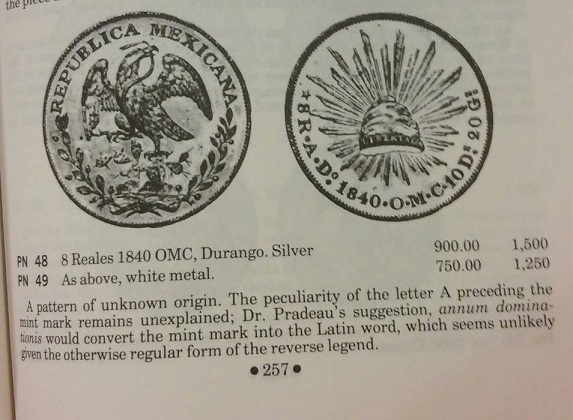
What-Is-This-Coin?

Here the reference is different - there is a claim there are silver and white metal copies listed as PN48 and PN49.

So are there silver, white metal and silver on copper copies? Or is there one single type silver on copper Sheffield?

There is a Heritage listing as well:
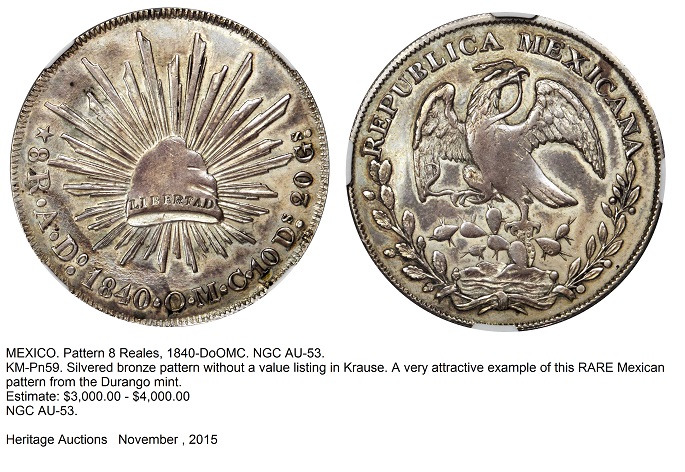
What-Is-This-Coin?

And here is another from 2011:

What-Is-This-Coin?

Where are the others? All three copies I can trace seem to be silver on copper or bronze. John can attest to how often copper is misidentified as bronze.

I will address the problems with the die work in a subsequent post.

Pillar of the Community
jgenn's Avatar
United States
1156 Posts
 Posted 12/01/2015  5:24 pm  Show Profile   Bookmark this reply Add jgenn to your friends list Get a Link to this Reply
The Stacks listing of the AU53 appears to be the exact same coin in the two Heritage listings.
Pillar of the Community
swamperbob's Avatar
United States
5362 Posts
 Posted 12/01/2015  6:31 pm  Show Profile   Bookmark this reply Add swamperbob to your friends list Get a Link to this Reply
andyg Interesting comment about veneration. I am not aware of anyone who venerates the Mexican symbol or eagles as they would a religious icon. However, while an inverted suspension makes it easier to kiss the image right-side-up I would be more concerned that the inversion would be considered insulting or sacrilegious. The only other answer I have read for an inverted coin was as a protest with regard to unpopular French Kings.

TwoKopeiki Regarding Sheffield Plate - it does not work with bronze. Sheffield plate worked when the core metal was Copper or German Silver. The components did not expand and bend at identical rates with other alloys. Electro-plates on the other hand can use many different cores. Regarding the other facts - origin of the coin in Spain, the rarity of silver and white metal versions and the population of silver plated examples - where did they come from? Is it a conflation of other sources or from one definitive source?


Pillar of the Community
swamperbob's Avatar
United States
5362 Posts
 Posted 12/01/2015  7:31 pm  Show Profile   Bookmark this reply Add swamperbob to your friends list Get a Link to this Reply
jgenn Yes the coins I showed are in fact the same coin. What I found to be most odd was the prices this pattern has gotten.

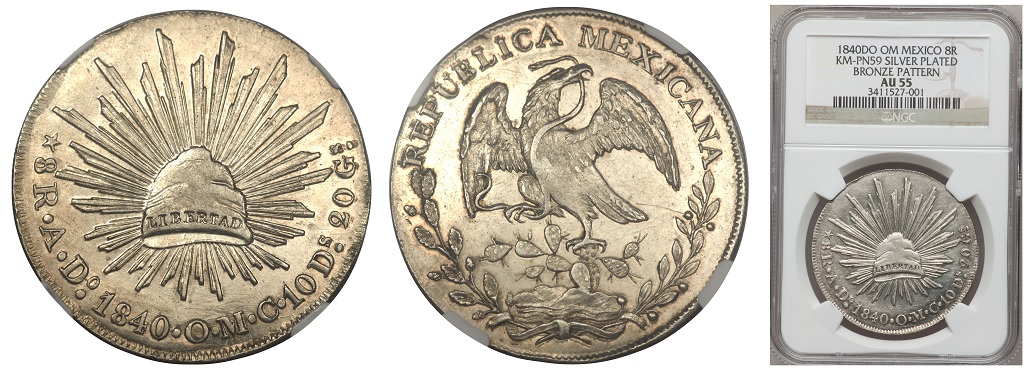
A slightly better version NGC AU55 sold for $13,800 as part of 2011 September Long Beach Signature World & Ancient Coins Auction #3015 Lot # 25311.

What-Is-This-Coin?

The coin I showed in the earlier posts is an NGC AU53 which sold for $ 2,232.50 as part of 2014 September 3 - 10 Long Beach Expo World Coins Signature Auction - Long Beach #3035 Lot # 31201.

Yet that same coin sold for $ 11,000 in 2011 at Stacks.

I am wondering if these people are buying the holder or the coin.

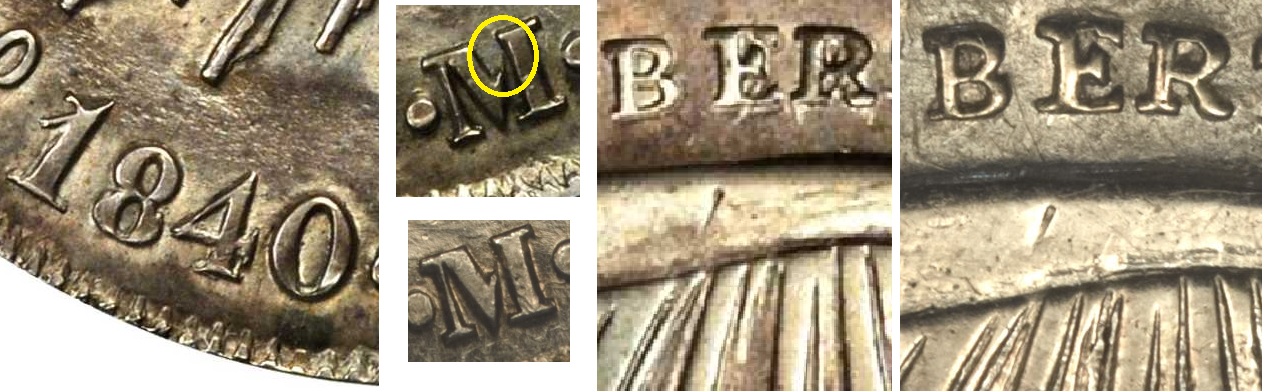
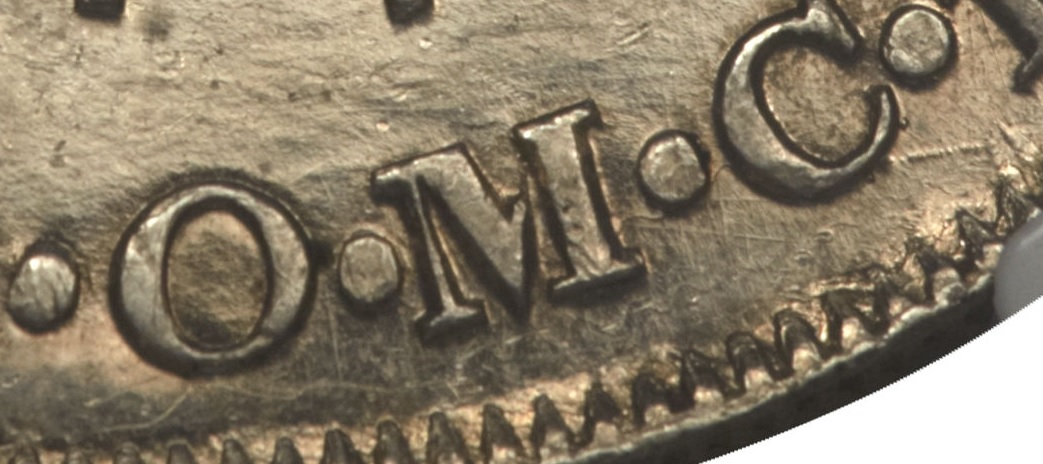
I said earlier that I would post pictures of what I see as indications in the die and surfacing that this coin is not up to the typical quality of a pattern. Here are just two. The first is a group of poor punches and the second shows the horrible die finish. I suggest that anyone review this in full size by going to the Heritage site and finding the coin that brought $ 13,800.


What-Is-This-Coin?


What-Is-This-Coin?
Pillar of the Community
Czech Republic
803 Posts
 Posted 12/01/2015  7:34 pm  Show Profile   Bookmark this reply Add TwoKopeiki to your friends list Get a Link to this Reply
Bob,

My information comes from a collector of mexican patterns, who's been researching them for close to 20 years. He doesn't post on these forums, but his handle at PCGS is pruebas. I will send him a note about this post and hopefully he can chime in.
Pillar of the Community
swamperbob's Avatar
United States
5362 Posts
 Posted 12/01/2015  8:08 pm  Show Profile   Bookmark this reply Add swamperbob to your friends list Get a Link to this Reply
TwoKopeiki Looking forward to hearing from him.
  Previous TopicReplies: 22 / Views: 3,842Next Topic
Page: of 2

To participate in the forum you must log in or register.


Disclaimer: While a tremendous amount of effort goes into ensuring the accuracy of the information contained in this site, Coin Community assumes no liability for errors. Copyright 2005 - 2026 Coin Community Family- all rights reserved worldwide. Use of any images or content on this website without prior written permission of Coin Community or the original lender is strictly prohibited.
Contact Us  |  Advertise Here  |  Privacy Policy / Terms of Use

Coin Community Forum © 2005 - 2026 Coin Community Forums
It took 0.48 seconds to rattle this change. Forums