Particularly in a coin in a casting mold.
180X Mexico City CCC 8R. Bronzed Cast. 38.28 mm. Plain Edge. Weight irrelevant but of a 20.9 gram result.
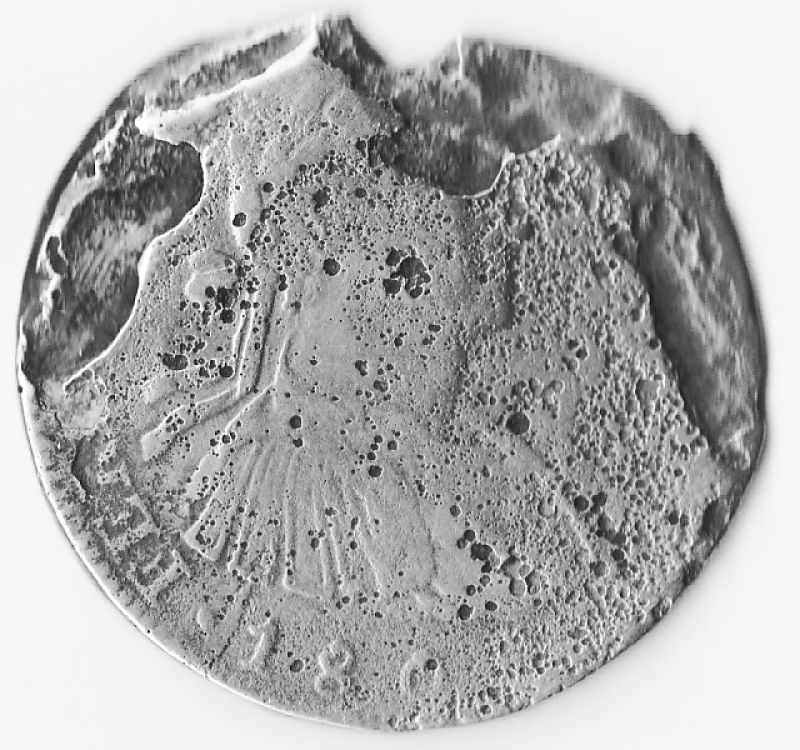
XRF analysis basically identified Cu (80%) and Sn (20%) with other trace elements but NO LEAD. Lead is required in a casting alloy to lower the boiling point so the mixture does not become very volatile and spits out of the casting mold.
Brief Overview describing cast English GII counterfeit 1/2d's:
Casting molds were usually made with a special "green" casting sand; this was a naturally occurring product consisting of a mixture of fine sand, clay and water. Finer, rather than course, sand was used as it would made a more accurate impression. The terminology "green " does not refer to the color of the mixture but rather to the fact that the product was not cured, that is, the mold was not baked before use. If the proper mixture was attained the wet clay would hold the mold together so baking was not necessary. However, if the mold was baked it was known as a dry mold and would also serve the purpose.
In addition to molds made of green casting sand a individual also needed access to a hearth, similar to one used by a blacksmith, where metal could be brought to a melting point. As most cast coins were coppers the majority of the metal would be copper (which has a melting point of 1083°C). Struck counterfeit coins were made of almost pure copper as copper was soft enough so that it would not destroy the dies too quickly. However cast counterfeiters added several less expensive metals, notably lead, tin and sometimes zinc. Apparently there was no standard alloy, whatever metal was available was added to the mix. Three examples from the Smith and Mossman study demonstrate the variety of alloys used; there was a 1737 George II halfpenny made from 91.3% copper, 5% lead and 3.7 tin; a 1740 George II halfpenny made from 66% copper, 25.9% zinc, 4.7% lead and 3.2% tin; and a 1775 George III halfpenny composed of 82.9% copper, 12% lead and 5.1% tin.
Because of the various mixtures of these metals there is no standard weight for cast coppers. Generally cast halfpence were in the same weight range as stamped counterfeit halfpence, namely 90-125 grains (while regal halfpence averaged about 145-155 grains). However, due to the use of heavy metals, such as lead, some cast examples equaled or even exceeded the authorized regal weight. The example given above with a 12% lead content was the heaviest halfpenny in the Smith and Mossman study weighing 172.8 grains! Among the forty cast halfpence studied by Smith and Mossman there was the following weight distribution:
78.4 grains - 1
90 to 99 grains - 6
100 to 109 grains - 9
110 to 119 grains - 6
120 to 129 grains - 5
130 to 139 grains - 6
140 to 149 grains - 2
150 to 159 grains - 3
160 to 169 grains - 1
172.8 grains - 1
This sample included the following halfpence varieties: 1 - George I; 28 - George II; 3 - George III; 3 - Irish George II, and 5 - Irish George III (generally the Irish examples were at the lighter end of the scale with the lightest example being a 1783 George III Irish halfpenny).
IMO - Cast CCC8R's are rare and if the counterfeiter forgets to add Pb - their down right RARE. Never seen a GII English GII without lead or a coin which LOSS half its mass spitting out of a casting mold.
An incredibly instructive specimen for the specialist. My most challenging specimen yet in 2016 - OBVIOUSLY. I initially assumed it was pulled out or FORMED INCORRECTLY and possibly left a good portion of metal behind in the mold.
JPL









 Posted 03/11/2016 8:53 pm


