| Author |
 Replies: 19 / Views: 6,081 Replies: 19 / Views: 6,081 |
|
Pillar of the Community
United States
5362 Posts |
I know this post involves a Graded US coin but I have a reason for placing it in the world coin section. Many if not most of the people familiar with how 8 reales counterfeits are made tend to follow this section. They are the actual target audience for this post because they understand what I have said about Sheffield Plate coins. Background: The coin is an NGC graded US dollar. It received a grade of MS-62. The dealer that called me for an opinion is the dealer that submitted the coin - it just came back last week. He called me because after it returned he noticed something that he had not seen before on a Morgan dollar. He is familiar with my work on 8 reales and he also understands what a Sheffield Plate counterfeit is. He asked me if it was a Sheffield Plate copy. First off here is the coin in the NGC holder. Obverse , Reverse and the tag on the slab. 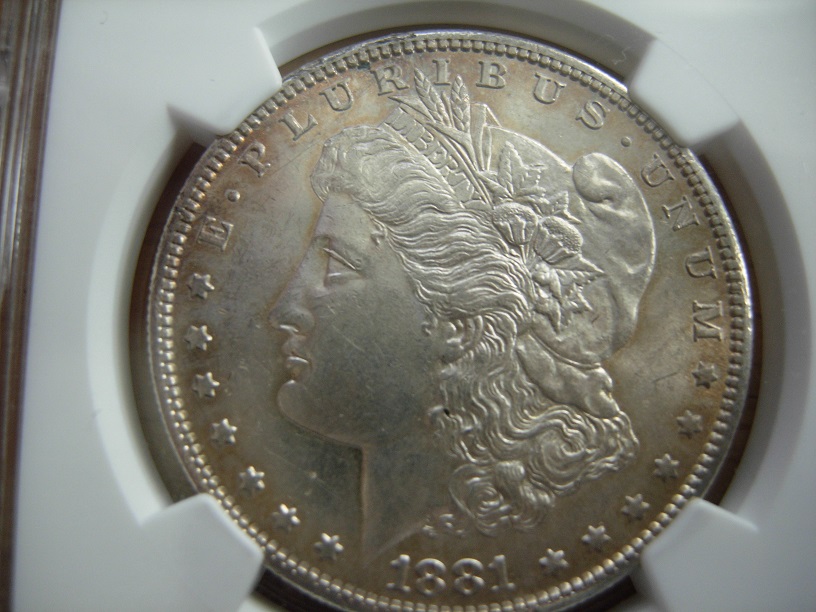 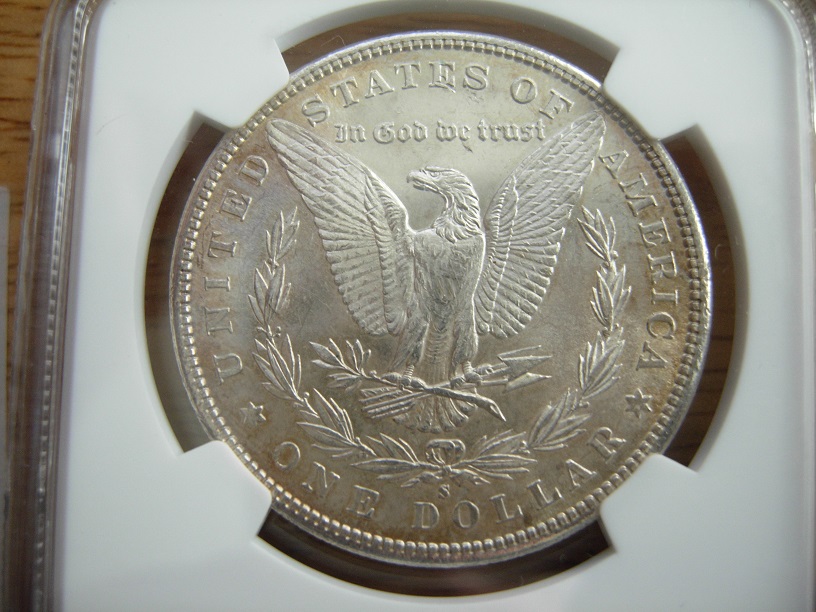  Next is an enlargement of a portion of the obverse near the rim above and in front of Lady Liberty. Notice what appears at a glance to be rim damage of some sort.  Here is the same area enlarged further and inverted. Note in particular the area marked which shows that there is a layer of silver metal OVER what appears to be a completely black interior. At the rim note that what looked like rim damage is actually a split in the outer metal layer with a portion that fell away. The surface inside is clearly darker than the outer layer.  Now I have two questions I would like readers to consider and answer before I post my results. 1. Should NGC have graded this? 2. Is this a Sheffield Plate? Edited by swamperbob
03/17/2016 04:00 am
|
|
|
|
Pillar of the Community
United States
6370 Posts |
Very interesting. You seem to think it is counterfeit, so I'll assume that is your conclusion. I have a manufacturing question. I cannot fathom how a plated coin can have luster like this coin. I'm genuinely curious as it might answer my questions about an IHC that seems to be plated but it looks like luster. |
|
Pillar of the Community
Canada
5291 Posts |
When NGC grades and slabs, does that not imply that they have authenticated it (consider it genuine) as well?
|
|
Pillar of the Community
United States
717 Posts |
Interested in where this goes.  |
|
Pillar of the Community
 United States
5362 Posts |
TypeCoin971793 One comment you made touches on a key issue concerning what the dealer believed. Quote:
I have a manufacturing question. I cannot fathom how a plated coin can have luster like this coin. To understand the answer to your question you need to understand what Sheffield Plate actually is. It is a sandwich of metal where two thin outer plates of 90% silver (92.5% in the UK) are fused to a central ingot of copper. The composite mass is then rolled as you would a fillet ingot of solid silver. They key to the metals in the sandwich is that they behave as if they were a homogeneous alloy. The metals stretch, bend and perform in all respects as if they were a solid 90% silver copper alloy. This includes surface flow when struck so that MS examples of Sheffield Plate counterfeits DO HAVE mint luster. That is one reason why they were so successful as counterfeits. The surface is actually 90% silver so acid tests do not work. The surface plate is many times thicker than electroplates of silver. And most critically the color of the coin is correct unlike electroplates where pure elemental silver is deposited on the surface. So they can even fool low power XRF tests. Your opening comment now needs to be examined. Quote:
You seem to think it is counterfeit, so I'll assume that is your conclusion. Humm?  Do I? oriole You say: Quote:
When NGC grades and slabs, does that not imply that they have authenticated it (consider it genuine) as well?
The answer is of course yes. NGC says they do not slab counterfeits. However, I own several slabbed counterfeits done by NGC so we know they do make errors. I have a few contemporary counterfeits that were slabbed and a couple recent Chinese forgeries as well. In addition to counterfeits I also pick up TPG error slabs when I run into them. Just yesterday on another forum I pointed out a couple contemporary counterfeits sold by Heritage. One was an NGC slabbed 8 reales. 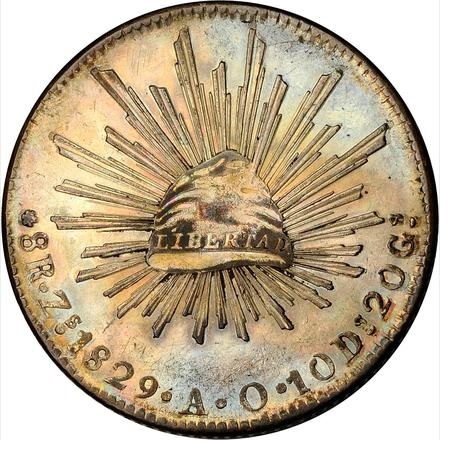 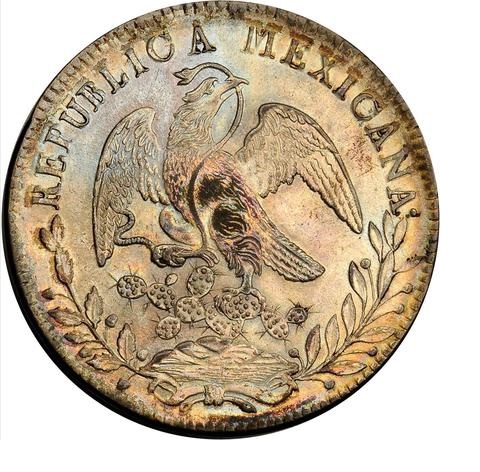 So just to restate the old truism - Buy the COIN not the SLAB. TPGs do make errors. Keep your eyes open and your wallet closed. gymcoachdon I am waiting as well. Over 100 people have read the post only three have replied.
|
|
Moderator
 United States
34552 Posts |
It is never good to bet against swamperbob when it comes to the question of a coin's authenticity. With that said, I'm going to go with not plated. I see the scratch and I see the black area. I'm not convinced that this represents an area of flaked off plating though. If it were, I would expect the scratch to be variable in its depth and sharpness as it zigs and zags between the plating and the underlying non-silver substrate.
To answer your questions then:
1. Yes
2. No
I look forward to being proven wrong!
"If you climb a good tree, you get a push."
-----Ghanaian proverb
"The danger we all now face is distinguishing between what is authentic and what is performed."
-----King Adz
|
|
Pillar of the Community
United States
5362 Posts |
spence You are basically correct. Should NGC have graded the coin? That is a slightly qualified Yes. There is some post strike damage limited to the small Z shaped scratch that was in fact used to peel off a surface lamination in the silver. The fact that the silver lamination is present is visible in the last picture I posted. I chose that picture because it shows rather accurately that a thin sheet of silver (possible debris) was on the surface of the planchet when struck. It extends over the rim onto the edge slightly. If you look at the letter R in the final picture above you can see a line diagonally crossing the R rising from the left to the right. This line is where the scrap meets the planchet. The scratch removed a small detached piece of the lamination above the seam. The black color underneath is silver oxide or silver sulfide. I was wondering if it could be copper fire scale but the planchet would have been annealed and bathed in acid just before striking so it is unlikely to be copper fire scale provided the scrap piece of silver entered the coining chamber with the planchet. I do not believe the scrap was rolled onto the ingot because it crosses over to the edge. I first noticed the mark on the R and followed it both terminations. The seam is actually visible on the very first picture. See below where I highlighted the seam and where it crosses to the edge: 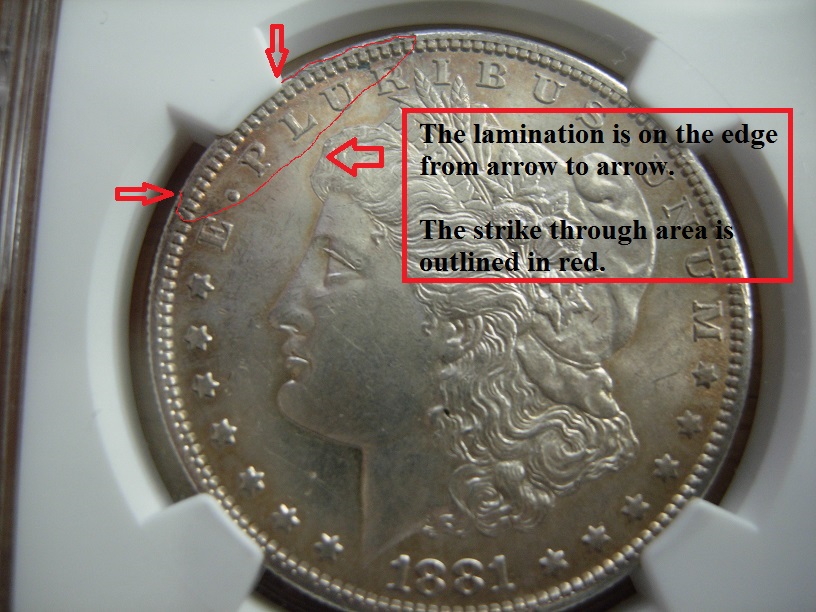 I would have hoped that NGC would have noticed the retained strike through but since they were not asked to slab the coin as an error I can let it slip. The answer to question number 2 is NO - the coin is not counterfeit. It is not a Sheffield plate coin.
|
|
Pillar of the Community
United States
5362 Posts |
I just spoke to the dealer and he is mildly upset. He says that a retained strike through of this nature reduces the value of the coin. I did confirm that an actual Sheffield plate copy of a Morgan dollar would be much more valuable (they are actually unknown right now as a cold fused Sheffield). I know it would be worth more as a counterfeit because NGC is paying a bounty for slabbed counterfeits of $100 so they can remove them from the slab. I was wondering if regular collectors see a retained strike through as so common that it reduces the value of the coin? Edited by swamperbob
03/17/2016 3:12 pm
|
|
Rest in Peace
United States
17900 Posts |
I'm very glad that turned out as it did. Without paying the extra $15 and an additional 5 business days waiting, even a coin with an error won't be listed as such on the holder.
|
|
Pillar of the Community
United States
6370 Posts |
Quote:
To understand the answer to your question you need to understand what Sheffield Plate actually is. It is a sandwich of metal where two thin outer plates of 90% silver (92.5% in the UK) are fused to a central ingot of copper. The composite mass is then rolled as you would a fillet ingot of solid silver. They key to the metals in the sandwich is that they behave as if they were a homogeneous alloy. The metals stretch, bend and perform in all respects as if they were a solid 90% silver copper alloy. I was under the impression that plating would be done after the coin was struck. My thought process was that the plating would be too thin to not crack open when struck and reveal the base metal core underneath. I guess I learned something new. |
|
Pillar of the Community
United States
717 Posts |
Retained struck through debris, interesting that it looked similar to Sheffield plate. Thanks for the post!
|
|
Pillar of the Community
United States
5362 Posts |
TypeCoin971793 That happens an awful lot in numismatics. The definitions used in any discussion must be clear to all players or assumptions substitute for facts.
The danger of Sheffield Plate especially the earliest types (because they had very thick plates of silver) was that they were difficult to detect. Electro-plates deposit VERY thin layers measured in microns of pure metal. Sheffield plate is thicker than paper and some reach 1/100th of an inch (10 thousandths). At the time I wrote my book the thickest I had encountered was 7 thousandths. A layer of silver that thick can not be penetrated by XRF. Most Sheffield plate coins are tested with XRF in worn spots or inside of test scratches.
Specific Gravity my old standby test that I use for raw dollar coins is still best for discovering heavy Sheffield plate.
|
|
Pillar of the Community
United States
1962 Posts |
Happen to overhear a dealer and patron next to me at a show over the weekend... Guy showing the dealer some oddities including an XF-AU or so Morgan with a big lamination or strike-through on the cheek (maybe 4 mm? I peeked quickly). Their concurred reaction was more "eh, yuck" than "oh, interesting".
This piece has that very typical early S-mint soft, deep luster... I'm always a big fan of knowing what the surfaces of a given series should particularly present as - it's an easy cheat to help confirm things.
|
|
Rest in Peace
United States
4078 Posts |
Swamperbob, thanks for this very informative post.
|
|
Valued Member
United States
70 Posts |
I was wondering if the ring(sound) of a Sheffield Plate coin would be that of a pure silver coin. I know in this example it is slabbed but if a raw coin were Sheffield Plated would the ring sound different ?
|
|
Pillar of the Community
Canada
4944 Posts |
Very interesting post. I'm not entirely sure how the counterfeiting process works with the Sheffield Plate process, but wouldn't identifying whether the coin is a known VAM be a way to determine whether this coin is a counterfeit or not? Based on the pictures provided, this would be a very highly detailed counterfeit. |
| |
Replies: 19 / Views: 6,081 |







 Posted 03/17/2016 08:17 am





