| Author |
 Replies: 25 / Views: 6,406 Replies: 25 / Views: 6,406 |
|
Valued Member
United States
411 Posts |
Quote:Our proposal is to eliminate high denomination, high value currency notes, such as the €500 note, the $100 bill, the CHF1,000 note and the £50 note. Such notes are the preferred payment mechanism of those pursuing illicit activities, given the anonymity and lack of transaction record they offer, and the relative ease with which they can be transported and moved. http://www.hks.harvard.edu/centers/...ns/awp/awp52 In this well publicized paper, some people were surprised to see the £50 note included with the other notes. The banknote £50 = € 64 = 70 CHF = $72 is not nearly as valuable as the other three. As of Feb 28, 2015 there are only 235.76 million in circulation, a number far fewer than the 611.8 million €500 notes, or the 10,800 million $100 notes in circulation. There are also 41.8 million 1000CHF notes, 47.5 million 200CHF notes, and 111.8 million 100CHF banknotes in circulation. The £50 note was introduced on Mar 20, 1981, and it transitioned to a second version between Apr 20, 1994 and Sep 20, 1996 and a third version between Nov 2, 2011 and Apr 30, 2014. The first version never circulated above 1 note per capita, the second version never circulated above 2 notes per capita. The note took a long time to be trusted in areas outside of London. While it is not particularly shocking that criminals prefer working with larger value banknotes, it is also probable that they can easily adapt to smaller notes, especially if the factor is only £50 vs. £20 . The advantages of handling 1000 CHF vs. 100 CHF are more profound. So, tomorrow is the 35th anniversary of the start of circulating the £50 banknote. About 440 million of the third series of £50 notes have been produced. Should the UK circulate all of these notes until they are worn out, but not produce any new ones or develop a polymer version like the designs which will replace the £20, £10, and £5? Or is this academic paper ridiculous? Edited by PacoMartin
03/19/2016 8:34 pm
|
|
|
|
Valued Member
Canada
405 Posts |
Chk out the old limelighter song "Salt"
|
|
Valued Member
Canada
405 Posts |
Sorry I was a little off ....s/b a a story of a shopkeeper who's son returns from business school and convinces the shopkeeper to eiminate items because they are not turning over fast enogh/have too poor margin....finally the only item left in the store is salt. If we reduce the range of currency we reduce its utility, people will stop using it and we all be holding useless metal tokens and paper.
My apologies for my initial off target reply
|
|
Valued Member
 United States
411 Posts |
I don't know that song, but there are a class of jokes about efficiency and mathematics experts introducing their skills on family businesses. The guys in The Big Bang Theory used one of the better known ones that ends with the punchline that physicists know "assume a spherical cow". High denomination notes like Canadian $1000, the Swedish 10,000 crown, the Singapore $10,000 and the Latvian 500 Lat notes have been removed in the past. Certainly there have been essays written 40 years ago about removing the $100. But the attention seems to be going up in these days of ZIRP and NIRP. Change from previous year in millions of £50 notes circulating.
A negative change is when both a new and old series are circulating at the same time. More of the old notes are destroyed before new ones can be introduced.
Feb 28, 1982 5.48 Feb 29, 1996 5.03 Feb 29, 2012 -0.82
Feb 28, 1983 7.18 Feb 28, 1997 3.39 Feb 28, 2013 8.48
Feb 29, 1984 5.52 Feb 28, 1998 7.25 Feb 28, 2014 14.04
Feb 28, 1985 3.60 Feb 28, 1999 6.52 Feb 28, 2015 15.26
Feb 28, 1986 2.88 Feb 29, 2000 4.66
Feb 28, 1987 4.84 Feb 28, 2001 9.24
Feb 29, 1988 5.60 Feb 28, 2002 10.92
Feb 28, 1989 5.98 Feb 28, 2003 4.88
Feb 28, 1990 4.76 Feb 29, 2004 5.90
Feb 28, 1991 1.66 Feb 28, 2005 6.80
Feb 29, 1992 2.80 Feb 28, 2006 8.56
Feb 28, 1993 4.34 Feb 28, 2007 3.90
Feb 28, 1994 3.04 Feb 29, 2008 16.42
Feb 28, 1995 -0.64 Feb 28, 2009 23.30
Feb 28, 2010 11.14
Feb 28, 2011 13.84
Edited by PacoMartin
03/19/2016 10:31 pm
|
|
Bedrock of the Community
Australia
21789 Posts |
Australia has a Law: the
Cash Transactions reports Act,
where ANY cash transaction over 10,000 has to be reported. That includes making a deposit, or withdrawing more than $10,000 from a bank.
This Law was specifically enacted to help track the movements of drug dealers.
Having said that, I have just paid $20,000 in cash to buy a car, (money withdrawn from a bank). I saved $2,000 by paying in cash.
All paid for in $100 notes, and I really wish they were in $500 or $1,000 notes, but they are not issued. The bundle was 40mm thick.
If, for example, I had to pay in $20 notes, the bundle would have been eight inches thick, and there would have been 1,000 notes to check count, and to make that count perfectly, three times. I would have not looked forward to counting 3,000 notes!
|
|
Valued Member
United States
411 Posts |
The USA Bank Secrecy Act of 1970 was the first to use the $10,000 limit, and many other nations copied that limit. The year before Richard Nixon gave an executive order not to print any banknotes in the future higher than $100 and to try and destroy all the existing banknotes in the government's possession printed before WWII in denominations of $500, $1000, $5000, and $10000. The 1969 series printed by the BEP included 142.7 million $100 bills ( a then unprecedented amount). In August 1971, President Richard Nixon's actions ended dollar convertibility to gold. The $100 dollar bill was printed in mass numbers after Nixon resigned in August 1974 so that circulation reached 1 banknote per capita (i.e. 210 million) by 1976. In 1976 the first well publicized proposal to terminate the $100 banknote as a crime prevention tool was made by a Danforth fellow at Harvard. Circulation of the $100 banknote has passed 33 per capita in the USA, 11-12 per capita in Canada and Australia. In the USA a legal unit of payment is called a "brick" which is 4000 banknotes shrink wrapped and containing markings by the BEP. It weighs 4 kilograms, and is convenient since the notes don't have to be individually counted. It is primarily used in transport of currency by armored car, but sometimes gamblers like them. 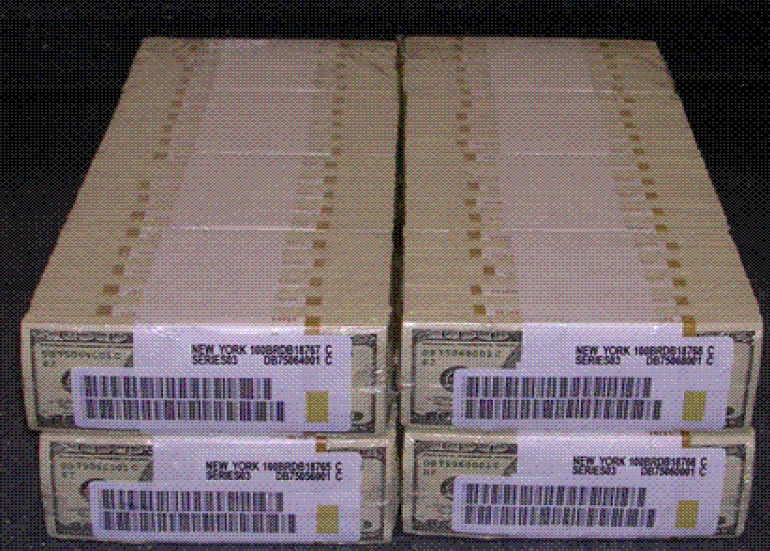 http://cdn.historycommons.org/image...22-15703.jpg http://cdn.historycommons.org/image...22-15703.jpg |
|
Pillar of the Community
United States
1285 Posts |
Well, if you consider what will occur once paper currency no longer exists and you have to pay for everything via electronic methods who's watching who? In other words, once cash is gone ALL your financial transactions can be monitored/tracked/examined/questioned, etc., etc. AND if your bank balance is maintained electronically, do you really have any $$$ at all or just what they say you have?
So goes conspiracy theories.
P.S. Remember that all conspiracy theories aren't theories at all. LOL
|
|
Pillar of the Community
United Kingdom
1688 Posts |
For the average person living in the UK, they probably would not notice if the £50 banknote is eliminated.
I moved from the US to the UK in July of 1998 and I have never held a £50 bankote.
Every ATM that I have used in the UK only gives out £10 or £20 notes.
Many shops don't even accept £50 notes or require a manager to approve the cashier to accept one.
Average person also makes the bulk of their purchases with a credit or debit card with contactless payments accepted up to £20 or £30 pounds.
|
|
Valued Member
United States
411 Posts |
The Sir Christopher Wren £50 note was introduced on Mar 20, 1981, and
it transitioned to a Sir John Houblon £50 note between Apr 20, 1994 and Sep 20, 1996 and
which transitioned to a a Boulton and Watt £50 banknote between Nov 2, 2011 and Apr 30, 2014.
The Wren version never circulated above 1 note per capita,
the Houblon version never circulated above 2 notes per capita.
Given kena's comments about "contactless payments" I was shocked when they produced 440 million of the "Boulton and Watt" version over a 4 year period.
A total of 254 million Houblon's were produced over a 7 year period
and there were fewer than 200 million Houblon versions in circulation at the time.
I actually wrote to the Bank of England and they were kind enough to reply.
They said that they were anticipating an increased demand.
I have read articles about how central banks measure demand for currency, but the results seem counter-intuitive to me.
Edited by PacoMartin
03/21/2016 03:49 am
|
|
Valued Member
United States
411 Posts |
On January 14, 2014 the Bank of England estimated
63 million (£3.2bn) are Houblon £50 notes were still in circulation.
The BOE gave formal notice that the notes would be invalid after 30 April.
On 30 April BOE estimated that 53 million were still not turned in. The notes were no longer legal tender, but could be exchanged at Barclays, NatWest, RBS, Ulster Bank and the Post Office (up to 4 notes) until 30 October 2014.
The Bank of England continues to exchange Houblon £50 notes, as it would for any other Bank of England note which no longer has legal tender status.
Edited by PacoMartin
03/22/2016 1:13 pm
|
|
Valued Member
United States
411 Posts |
The 2016 statistics were just published. The Bank of England had the biggest increase in £50 notes in circulation since the note was first produced in 1981.Change from previous year in millions of £50 notes circulating. A negative change is when both a new and old series are circulating at the same time. More of the old notes are destroyed before new ones can be introduced.
Feb 28, 1982	5.48	Feb 29, 1996	5.03	Feb 29, 2012	-0.82
Feb 28, 1983	7.18	Feb 28, 1997	3.39	Feb 28, 2013	8.48
Feb 29, 1984	5.52	Feb 28, 1998	7.25	Feb 28, 2014	14.04
Feb 28, 1985	3.60	Feb 28, 1999	6.52	Feb 28, 2015	15.26
Feb 28, 1986	2.88	Feb 29, 2000	4.66	Feb 29, 2016	27.38
Feb 28, 1987	4.84	Feb 28, 2001	9.24
Feb 29, 1988	5.60	Feb 28, 2002	10.92
Feb 28, 1989	5.98	Feb 28, 2003	4.88
Feb 28, 1990	4.76	Feb 29, 2004	5.90
Feb 28, 1991	1.66	Feb 28, 2005	6.80
Feb 29, 1992	2.80	Feb 28, 2006	8.56
Feb 28, 1993	4.34	Feb 28, 2007	3.90
Feb 28, 1994	3.04	Feb 29, 2008	16.42
Feb 28, 1995	-0.64	Feb 28, 2009	23.30
			Feb 28, 2010	11.14
			Feb 28, 2011	13.84
So the Harvard article urging the BOE to reduce the £50 note had no effect. Over the 8 year period when Sweden decreased the value of banknotes in circulation by 37%, the Bank of England increased the value of banknotes in circulation by 50%. Edited by PacoMartin
04/07/2016 3:22 pm
|
|
Pillar of the Community
United Kingdom
2624 Posts |
Ridiculous considering the purchasing power of a £50 is a fraction of what it was... in 1981 if would probably fill your tank 10 times and now you could not fill the average car with one.
I really dont know what it would solve to reduce this denomination...
|
|
Bedrock of the Community
United Kingdom
18523 Posts |
I've seen very few £50 notes in circulation. In the 1980s I had a job where I needed quite large sums of cash for road tolls (mostly on French motorways) and my employers used to give me a float in £50 notes. Nowadays I help out my brother at a stall selling model railroads two or three times a year, and almost everyone pays in cash, often quite large sums, but we never get more than one or two £50 notes although we probably handle £20,000 - £30,000 in cash over each weekend.
I can solve the mystery of one of the missing Houblon notes - I saved a nice crisp Merlyn Lowther one with an M01 prefix for my collection! So that still leaves 52,999,999 not accounted for!
|
|
Valued Member
United States
156 Posts |
Yes, this notion is being championed by Larry Summers, former president of Harvard University who was forced to resign because he managed to insult just about everyone with his tactless approach, former presidential economic adviser who called the real market on "solid ground" less than six months before the whole the thing imploded and took the global economy with it. Now in a desperate bid to remain relevant, he is trying to insure that any transaction over $10k (US) must be done by wire, thereby generating even more fees for banks (the idea of going after criminals is, I believe, a red herring). It amazes me that anyone is still listening to him on any subject whatsoever.
|
|
Valued Member
United States
411 Posts |
NumisRob In the 1980s I had a job where I needed quite large sums of cash for road tolls (mostly on French motorways)... Circulation of the £50 banknote in the 1980's never went above 45 million. It would be very rare to see one. Even today with circulation at 263 million, with a population of 65 million (4 notes per person) I would think they would be unusual. £50 notes in circulation in millions of banknotes
Feb 28, 1982	5.48	Feb 28, 1995	57.04	Feb 29, 2012	197.98
Feb 28, 1983	12.66	Feb 29, 1996	62.07	Feb 28, 2013	206.46
Feb 29, 1984	18.18	Feb 28, 1997	65.47	Feb 28, 2014	220.50
Feb 28, 1985	21.78	Feb 28, 1998	72.72	Feb 28, 2015	235.76
Feb 28, 1986	24.66	Feb 28, 1999	79.24	Feb 29, 2016	263.14
Feb 28, 1987	29.50	Feb 29, 2000	83.90
Feb 29, 1988	35.10	Feb 28, 2001	93.14
Feb 28, 1989	41.08	Feb 28, 2002	104.06
Feb 28, 1990	45.84	Feb 28, 2003	108.94
Feb 28, 1991	47.50	Feb 29, 2004	114.84
Feb 29, 1992	50.30	Feb 28, 2005	121.64
Feb 28, 1993	54.64	Feb 28, 2006	130.20
Feb 28, 1994	57.68	Feb 28, 2007	134.10
			Feb 29, 2008	150.52
			Feb 28, 2009	173.82
			Feb 28, 2010	184.96
			Feb 28, 2011	198.80
Mar 20, 1981: introduction of Sir Christopher Wren note Apr 20, 1994 - Sep 20, 1996: transition to Sir John Houblon Nov 2, 2011 - Apr 30, 2014: transition to Watt & Boulton Afab67 (the idea of going after criminals is, I believe, a red herring)There was an comprehensive article by a Harvard professor written in 1976 when Nixon's removal of the USA from the gold standard allowed the Fed to print a rash of $100 banknotes. The total number in circulation by 1976 reached 210 million (about the population of the USA at the time). This Harvard professor called for the removal of the $100 banknote as a means of hindering organized crime for essentially the same reasons that Larry Summers is proposing today. Today, the USA is rapidly approaching 11 billion c-notes in circulation. Here is the final paragraph from the 1976 article on eliminating the $100 banknote. Quote:
This nation spends about $15 billion a year on police, prisons, and courts. We know from bitter experience that there is no simple relation between more dollars and less crime. Most of this $15 billion, by far, is spent on attempts to reduce street crime. Comparatively little attention is paid to white-collar crime, whose economic effects, at least, are far more serious. Currency reform would be a simple, inexpensive way to identify white-collar criminals, and to make their continued operation more difficult.
Calling in the Big Bills by James Henry-The Washington Monthly, May 1976, pp. 26-33
A monetary detective finds a painless way to catch the tax evaders and cripple organized crime
James Henry is a Danforth Fellow in economics and law at Harvard University. But if the UK had listened to the same advice in 1976 they never would have put the £50 banknote into circulation. As a final note, I want to point out that the Mexican government introduced a 1000 peso banknote ( = £40 ) over 11 years ago, and today the 500 peso banknote still outnumbers to 1000 peso banknotes by a factor of 20X. The £20 banknote outnumbers the £50 banknotes by a factor of only 7.8X . But the Bank of England has not announced a date to convert the £50 to polymer, while they have announced a time frame for £5 ,£10, and £20 so perhaps they intend to remove it after all.
Edited by PacoMartin
04/07/2016 11:30 pm
|
|
Valued Member
United States
411 Posts |
float
British English A sum of money used for change at the beginning of a period of trading in a shop or stall etc., or for minor expenditures.
That's not a term that is normally used in AmE except as part of the idiom "float a loan".
But number of £20 banknotes/number of £50 has remained between 7.8 and 8.9 since 2004 so they are not super rare. In the USA the ratio of $20s to $50s is about 5.4 , but there are actually more $100 bills in circulation than $20s. Still the majority of people never or rarely handle a $100 bill.
Is there anyone on this forum that agrees that the £50 banknote should be eliminated?
Edited by PacoMartin
04/07/2016 11:26 pm
|
| |
Replies: 25 / Views: 6,406 |
To participate in the forum you must log in or register.
Disclaimer: While a tremendous amount of effort goes into ensuring the accuracy of the information contained in this site, Coin Community assumes no liability for errors. Copyright 2005 - 2026 Coin Community Family- all rights reserved worldwide. Use of any images or content on this website without prior written permission of Coin Community or the original lender is strictly prohibited.
Contact Us | Advertise Here | Privacy Policy / Terms of Use
|
| Coin Community Forum |
© 2005 - 2026 Coin Community Forums |
| It took 0.5 seconds to rattle this change. |
 |
|










 Posted 03/19/2016 8:34 pm


