| Author |
 Replies: 12 / Views: 2,881 Replies: 12 / Views: 2,881 |
|
|
Valued Member
United States
91 Posts |
I was wondering if I should even take the time to post pictures here up some coins I got while buying silver bullion from someone in Houston. I have 9 Bicentennial Kennedy half dollars that are DDO / DDR'so 100%. AND I have 8 in plastic Uncirculated P/D 01,02,03,Kennedys that are either DDO or DDR all are one or the other or both. Also I have some 2000 P/D Sacagawea dollars thato are also DDO / DDR's. With the pain in the butt, it is to take multiple pictures on my phone come to the site resize them then post them I was wondering where these common errors for Kennedy and Sacagawea or is this something to look further into and post some pictures for the experts? Also does anyone know a good camera app for a Galaxy Note 4 that could help in the picture taking department? Edited by Red Man
10/26/2016 07:57 am
|
|
|
|
Valued Member
 United States
91 Posts |
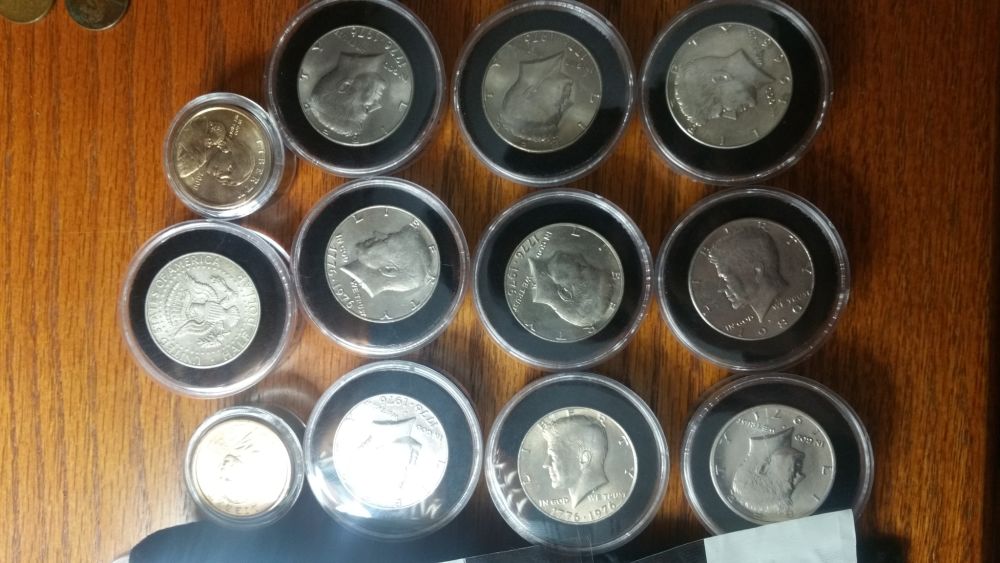 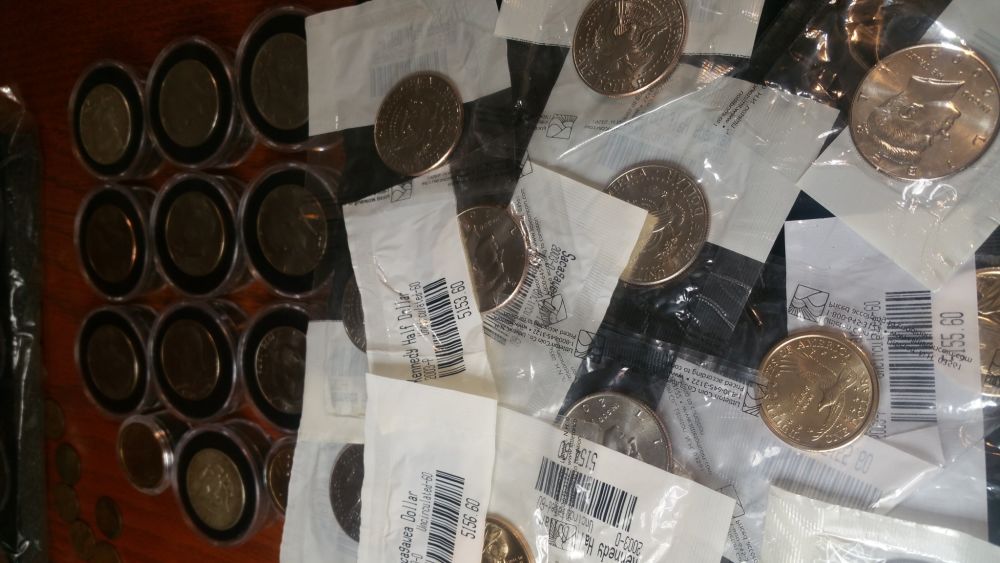 I am trying to find a camera app for coins. I guess if any pros are on let me know if this is something I should further look into or something I should not get excited for. Tyvm |
|
Pillar of the Community
United States
5196 Posts |
the pictures will be the only way to know for sure if they're DDR's, DDO's or just plain md's . we need them. I'm sure somebody will let you know of an app for your phone. I just use a no to expensive digital ( celestron) microscope. |
|
Rest in Peace
United States
7075 Posts |
You can search this site for threads on doubled dies for those coins and see if your coins match anything that has already been posted. coop has posted a lot of good pics with descriptions explaining the difference between doubled dies and Mechanical Doubling which is common and worthless. So just searching for "doubled dies" or DDO or DDR will give you a lot to look at. They don't have to be the same coins to learn what to look for. If studying those pics doesn't clear it up for you, then you will need to post pics. |
|
Bedrock of the Community
United States
62064 Posts |
Please post them one at a time close up to see what you are seeing. Post one and wait a few days then post a second one. If they are the same date, put that in the title and coin 1, 2 or whatever to keep track of them. I checked Variety Vista and they have a few listed for the Denver mint and a few for San Francisco. Wexler doesn't have any listed for 1976 for all mints. The 'Chrry Pickers Guide" Lists just two San Francisco mint doubled dies. So if you can show us what your are seeing, it would be a great help. But keep in mind that the large denomination coins suffer a lot of machine damage after the strike on them. That will look like this: 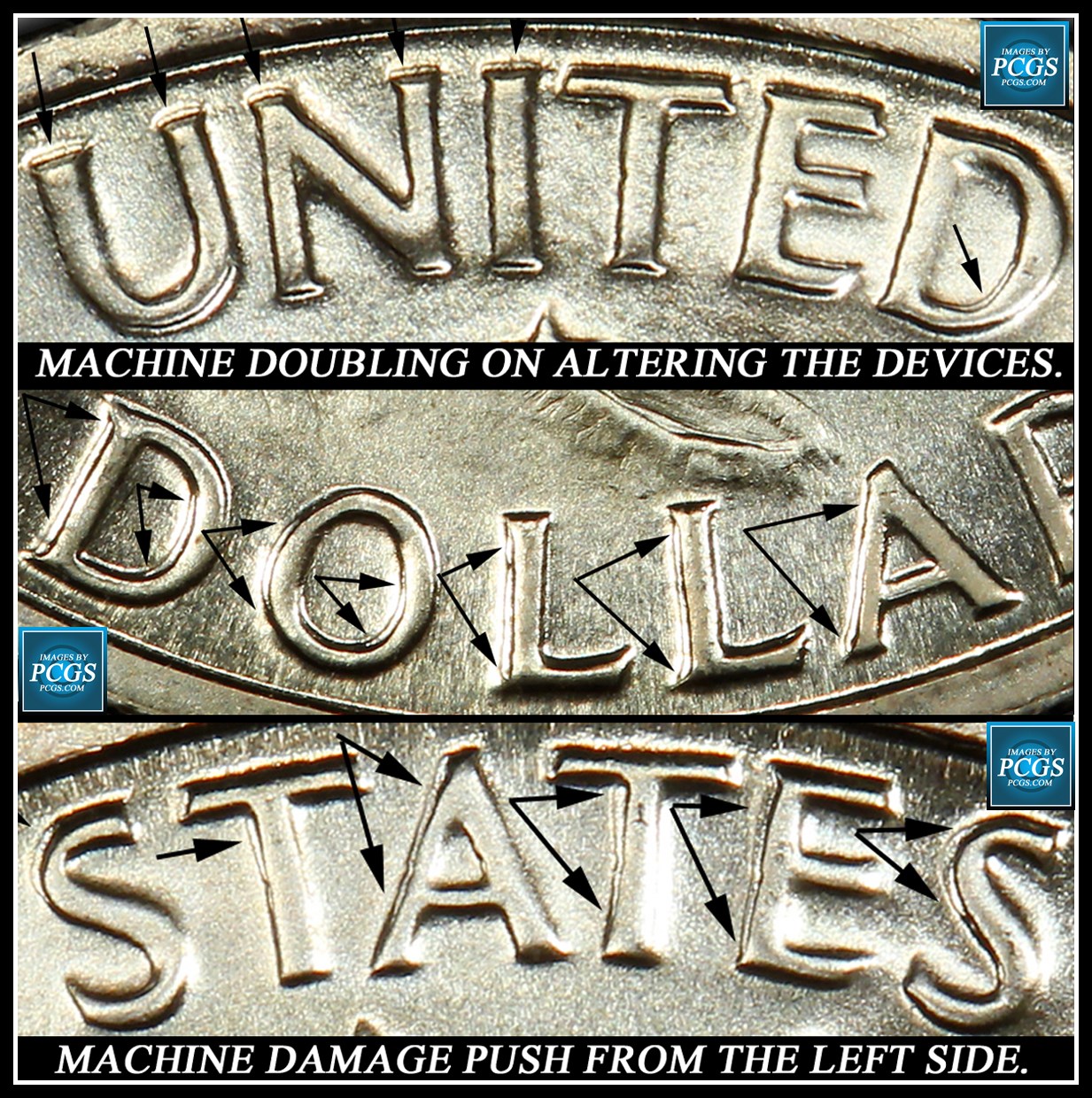   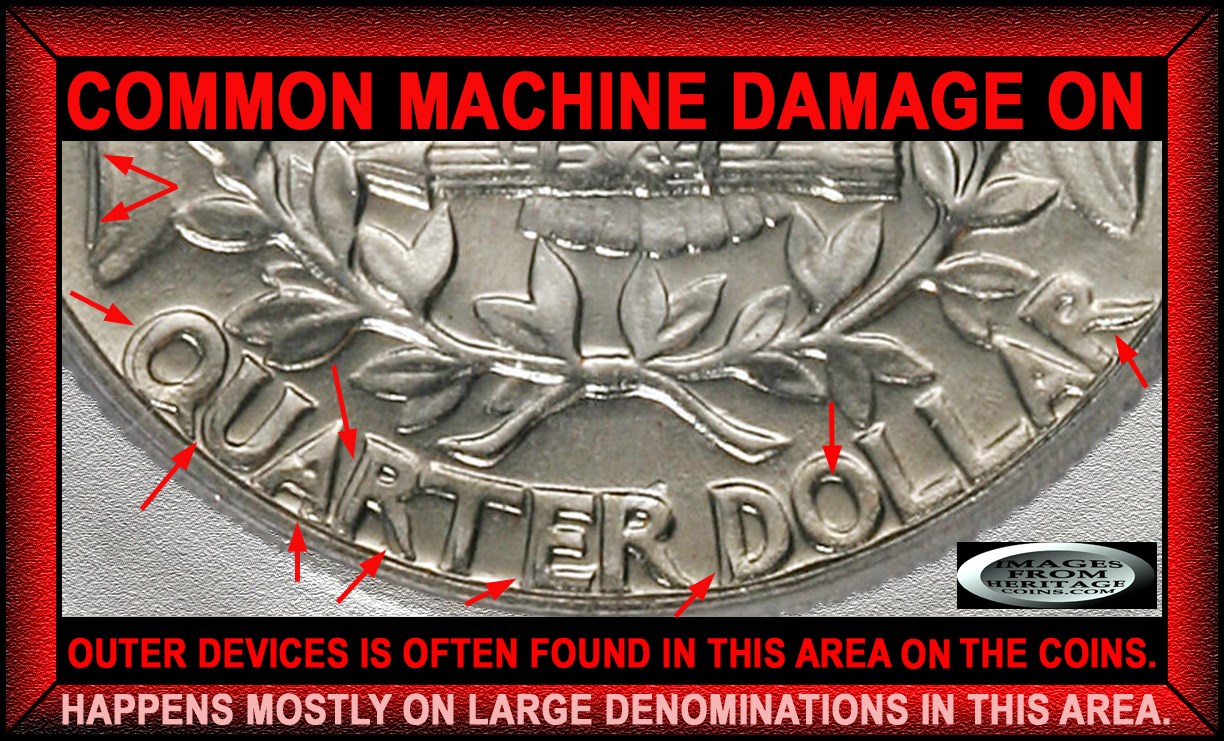 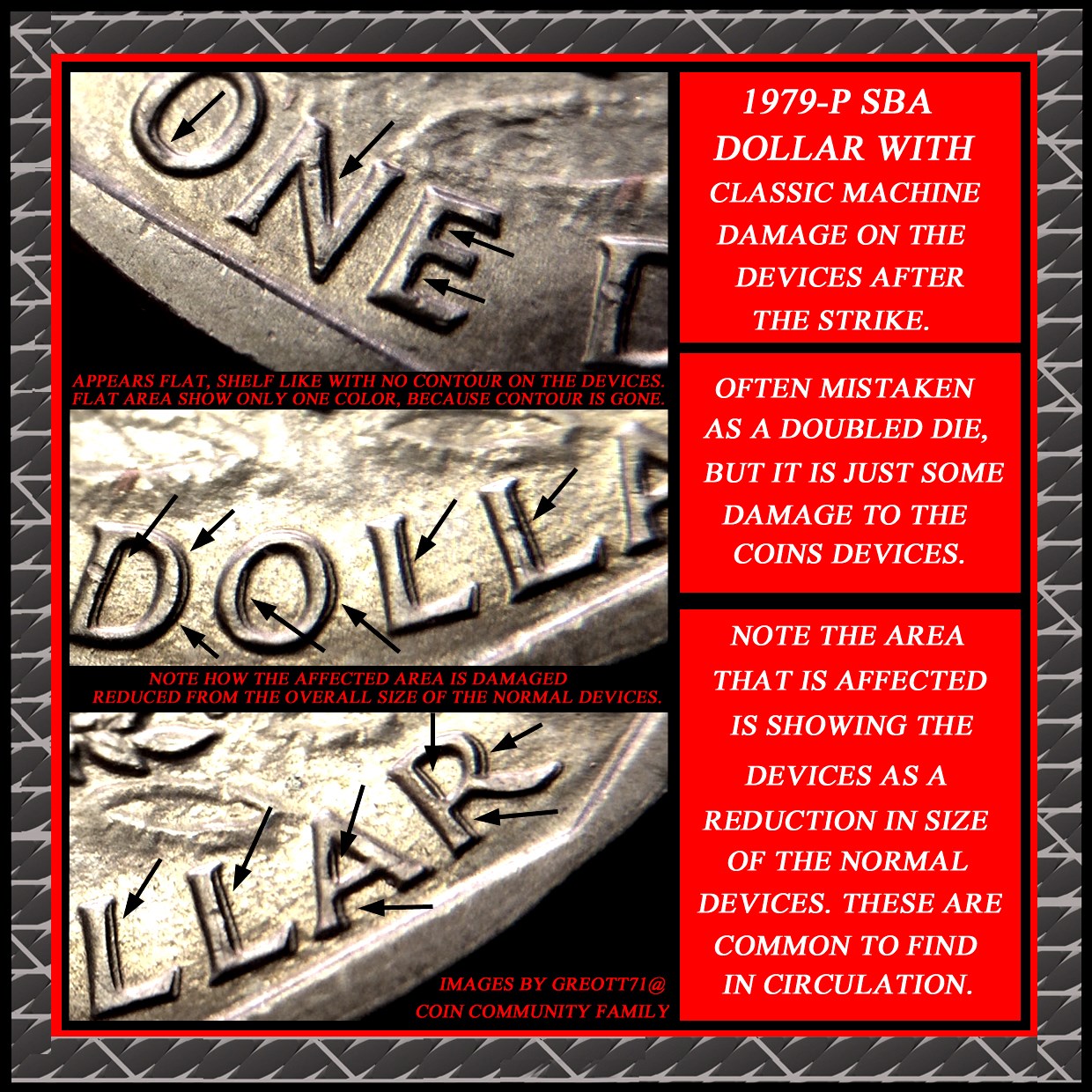 If it looks like these examples I posted, it is what I call 'Machine Damaged' the coin was struck and the machine damaged those devices after the strike. This is caused by the machine and not on the die, like what we see on doubled die. The hub that created the die was slghtly incorrect during the creation of the die. So the doubling is on the die, thus the term 'doubled die.' Those are the collectable examples. On the half dollars it is easy to find machine damaged coins. They are in high number, It is almost harder to find them without the machine damage on the halves and dollars. So they are just normal coins that have MD. Hope this helps, if not ask another question. we are here to help, not give you a bad time. |
|
Bedrock of the Community
United States
10065 Posts |
OK - sticking my neck out on this one. I probably will say.. OH...THAT's what you mean and be kicking myself.
I continually see remarks like "notice how MD reduces the size of the devices." The simple answer for me is... no.
I am not sure what part of the individual letters/devices appear to be reduced. Since, to my mind, I would need a side by side comparison to a normal of same device.
If, let's say, the letter T has MD on its right side. Is the "reduced" T's main stem now thinner side to side than on a normal coin? Is this how the T is "reduced?" How do I tell without another of same coin side by side to compare the letters T?
Or another way of seeing this:
Suppose a letter A has MD on the right. To see the "reduction," do I compare the left leg's width to the damaged, right leg's width and see the right leg is more thin?
Now of course since the letter A does not always have legs of equal width, this would not work anyway.
Sorry my brain is having a Microsoft Moment on this since other people seem to "get it" right away. Sometimes my very literal mind makes me a bit dense.
But I ain't afeared of askin'!
|
|
Bedrock of the Community
United States
62064 Posts |
Good point. I'll add that idea on new images I create. 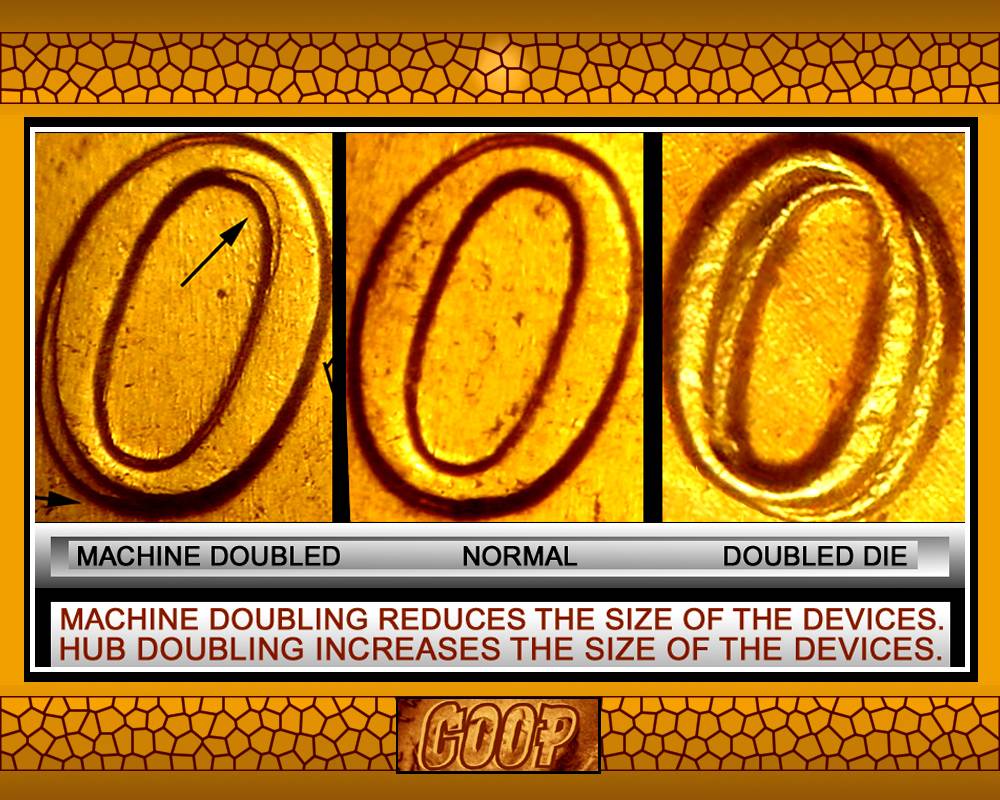 Here is one I've shown hundreds of times. |
|
Bedrock of the Community
United States
10065 Posts |
Thanks Coop - so in other words I AM looking at the thickness as compared to the same device on a normal coin... this is "reduction?"
So the "reduction" above means noticing the 1:00 position of the leftmost O shows a drastically smaller width than the 1:00 position on the O in the middle. Correct?
Edited to add: And also the 7:00 positions on the left is thinner than the 7:00 on the right.
Edited by Earle42
10/26/2016 7:40 pm
|
|
Rest in Peace
United States
7075 Posts |
I have trouble with this, too.
In coop's pic, it looks like the doubled die is also thinner at the 1 and 7 o'clock points.
I just look for the roundness that shows up with the doubled die. The MD's are flat.
Of course, I have no luck in my searches. LOL
|
|
Bedrock of the Community
United States
10065 Posts |
@Buddy, I think this is what Coop was saying in his response to me. I am waiting for his verification on my last post. I also thought I had a great grasp on this until I saw the 1964 DDR quarter. http://goccf.com/t/239753 |
|
Bedrock of the Community
United States
62064 Posts |
Also something else to note: color. When a normal device is contoured, we see the light to dark on the device. Note the normal device in the center. The color denotes roundness. (which most devices are make to show) On the MD example o the left, we see the MD area, not the color is all the same? Why? Because it is flat. The Machine damage that happened after the strike, made that area flattened. On the doubled die, we see in this case two sets of letters with both showing light to darkness on the bottoms of the devices. Earle: When looking at the normal device, the MD reduces the normal size of the device. It is again flat because that area what snowplowed when the dies moved after the strike. Damaging that area on the device. You have it correct. That is the reduction I speak of. When you see them side by side with Md-normal-doubled die, it makes it easier to see what happened. The MD can vary from strike to strike. I found in two OBW rolls examples of a coins that were struck by the same dies and differed from strike to strike. 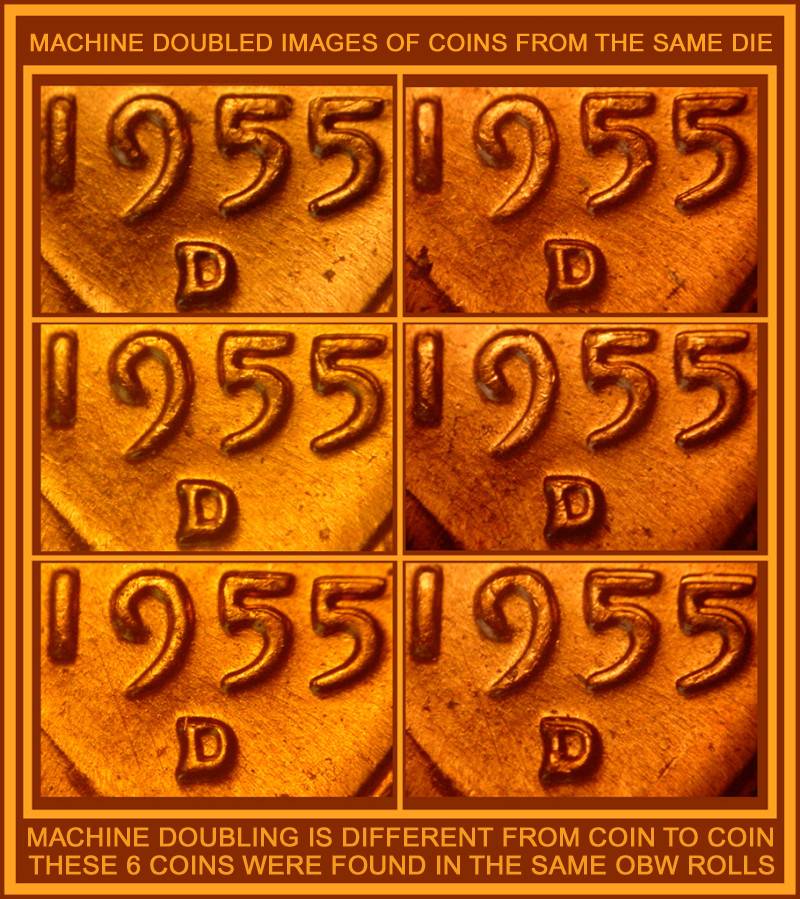 Note how they are slightly different. Here is a side by side with a normal coin and a machine damaged coin side by side to see the reduction of the devices easier:  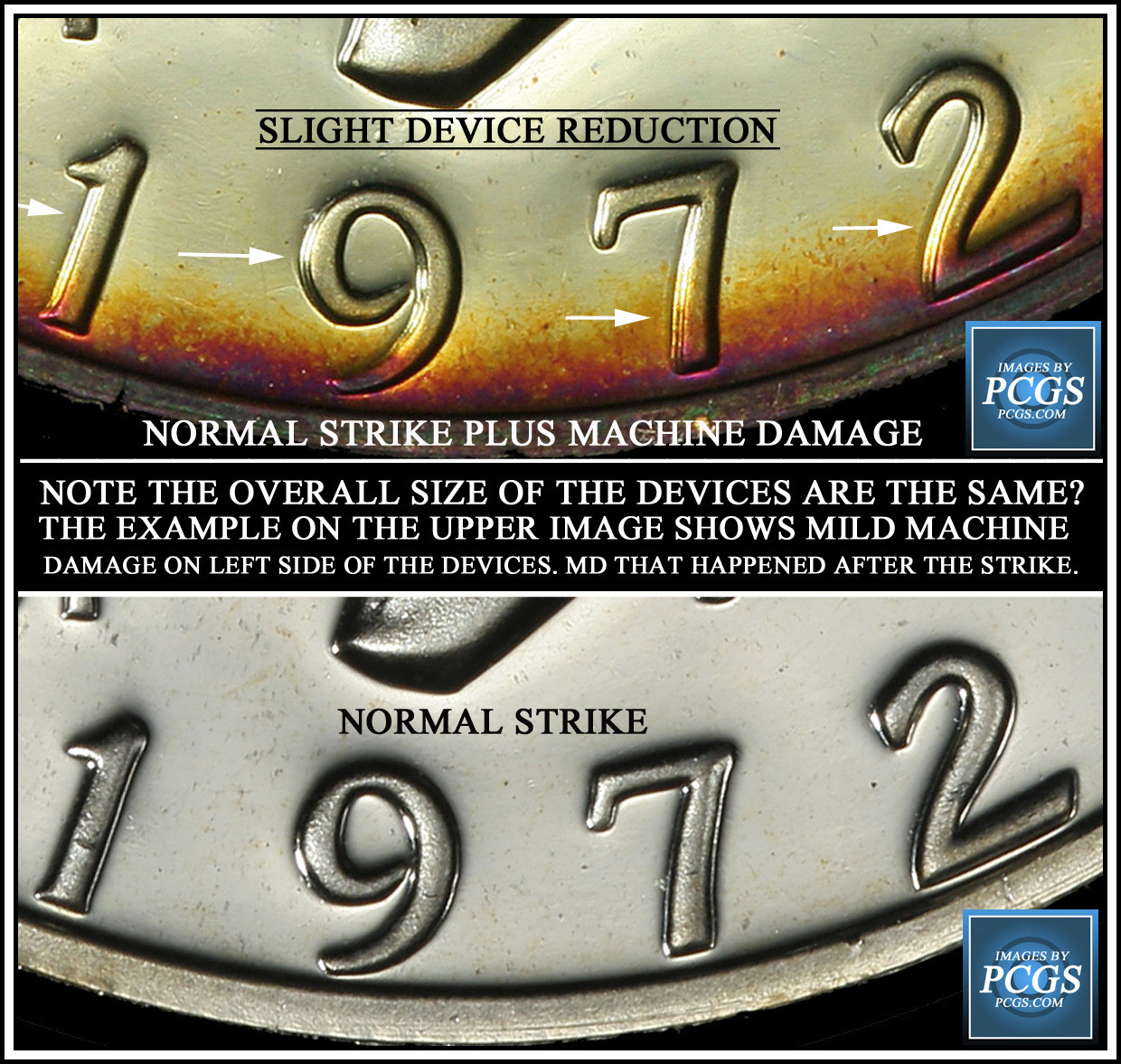 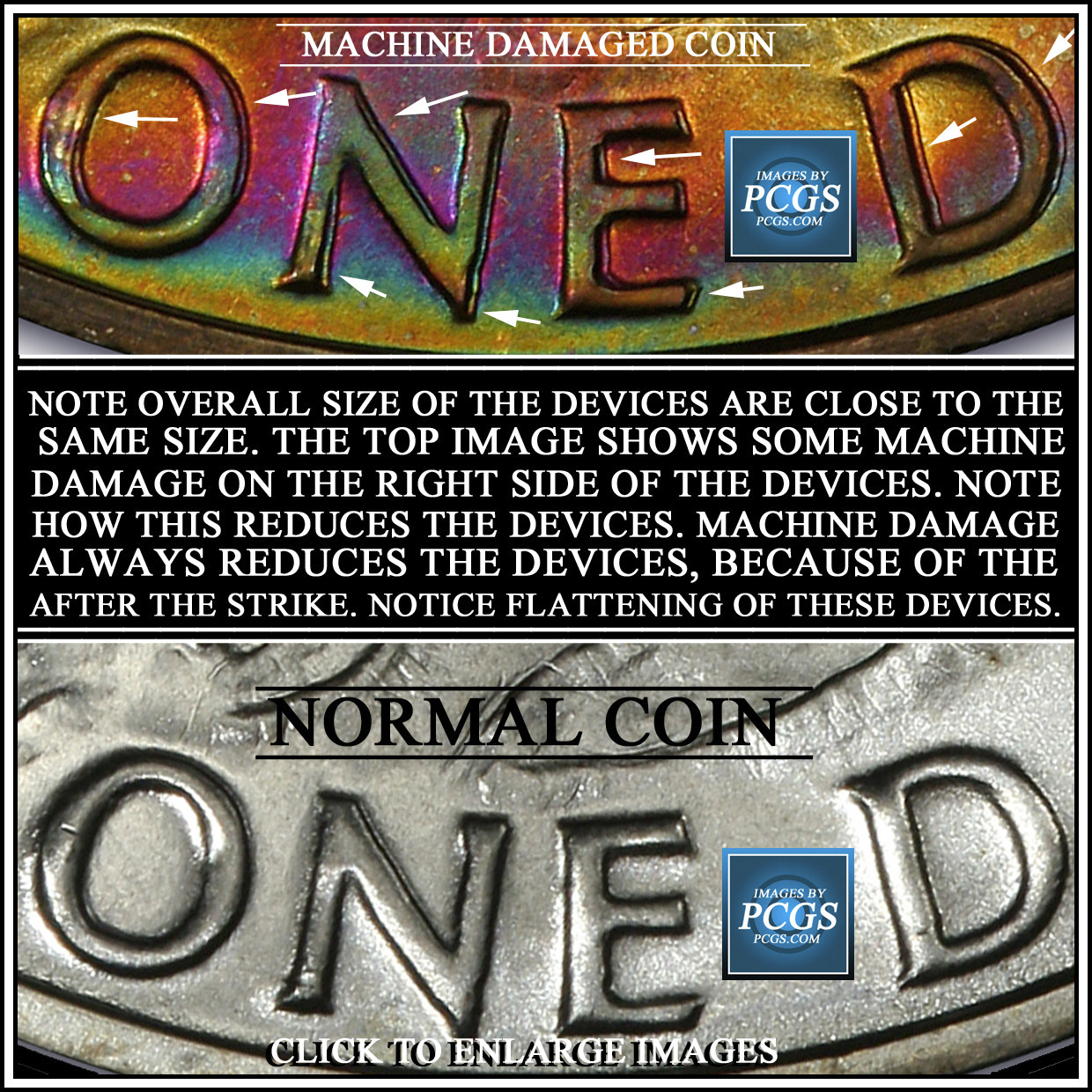 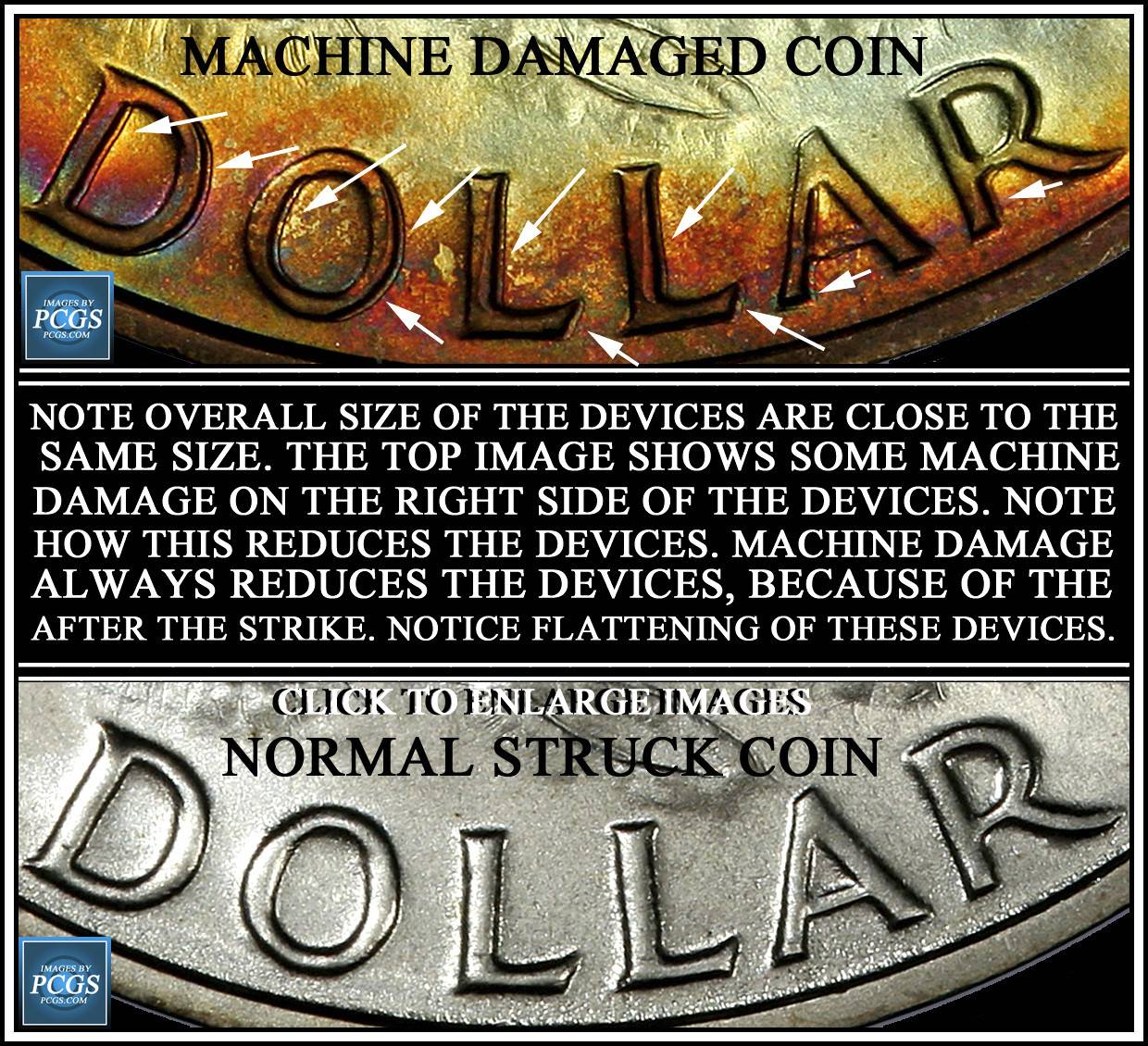 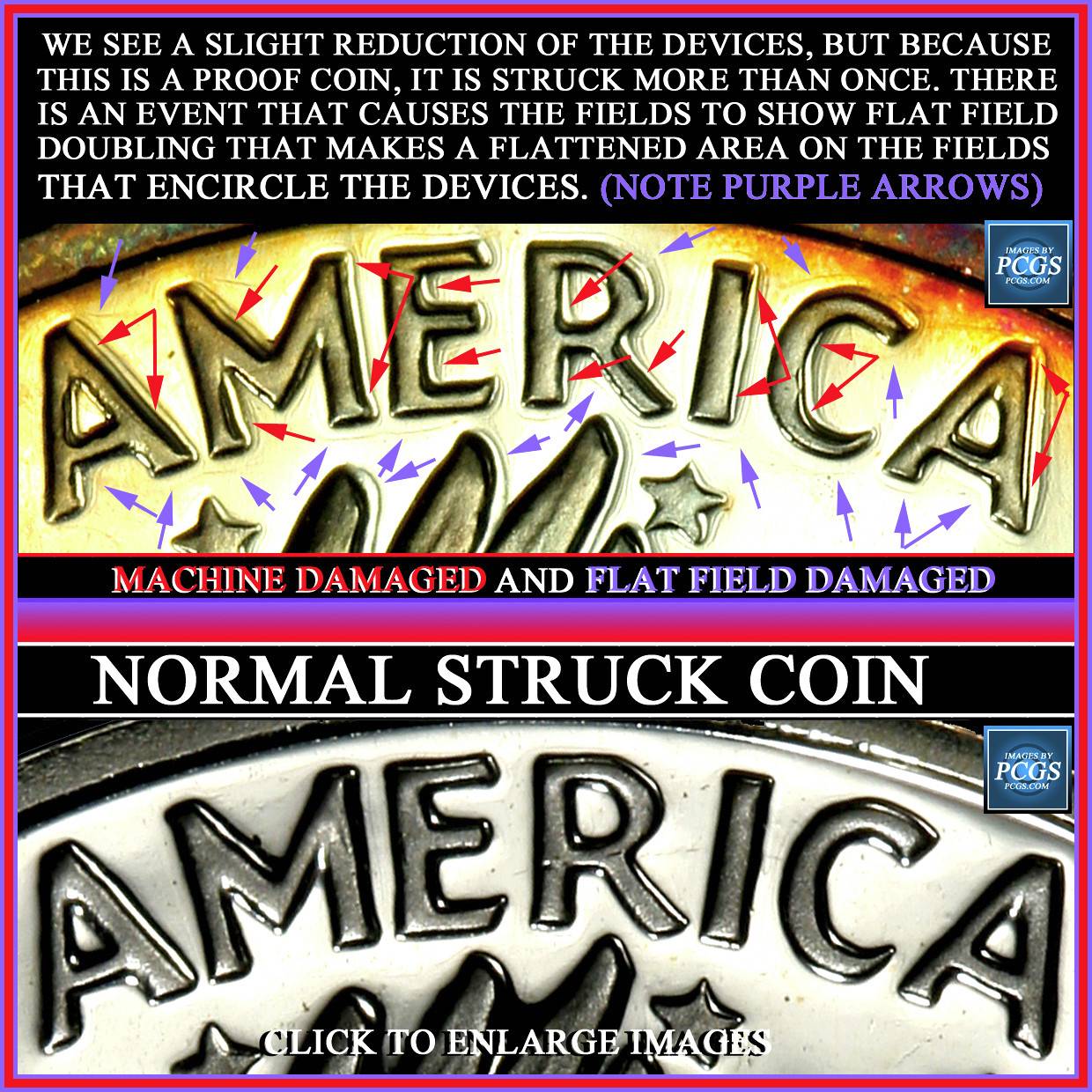 Edited by coop
10/27/2016 4:35 pm
|
|
Valued Member
United States
64 Posts |
Great explanation and excellent pictures Coop.
|
|
Bedrock of the Community
United States
10065 Posts |
FINALLY! I think I got it! I now understand how you are deinfing the term "reduced." It makes a lot of sense now and I am happy to say that today when I saw a 1958 cent that was very obviously MD'd, Coops info came back to mind and I saw more in/about the MD than I had before (hope that makes sense!).
Thanks again Coop - your are one of the greatest helpers to all of us in the CCF family.
How much squash could a Sasquatch squash if a Sasquatch would squash squash? Download and read: Grading the graders Costly TPG ineptitude and No FG Kennedy halveshttps://ln5.sync.com/dl/7ca91bdd0/w...i3b-rbj9fir2 |
| |
Replies: 12 / Views: 2,881 |
|






 Posted 10/26/2016 08:07 am





