| Author |
 Replies: 19 / Views: 2,356 Replies: 19 / Views: 2,356 |
|
Moderator
 United States
54301 Posts |
What is the definition of "an error" when it comes to coins?
Items I am pretty sure are errors:
A coin struck multiple times.
A coin struck on the wrong planchet.
A doubled die (like 1955, or 1972 cents).
Is a blank planchet an error?
Is a grease filled strike an error?
Is a strike through a foreign object an error?
Is a coin with "trails" an error?
Is a clipped planchet an error?
Is a die break (crack) an error?
Is any coin not stuck properly an error? Show your financial support of the Coin Community Family (click here)See my topic on Mexican Numismatic Medals (click here) |
|
|
|
Pillar of the Community
Canada
4916 Posts |
any problem with the die-breaks, pitting, chips, Cuds, doubled dies, tooling etc. are varieties since there are multiple coins with the exact same since it was on the die. errors are unique, even two off center examples for example, will never be identical. Feel free to call me Will.
|
|
Pillar of the Community
Canada
3733 Posts |
agreed, there is error coins and there are variety coins. and the two words are constantly overly used for each other.
|
|
Bedrock of the Community
United States
62064 Posts |
My definition for Error, Variety and Die events 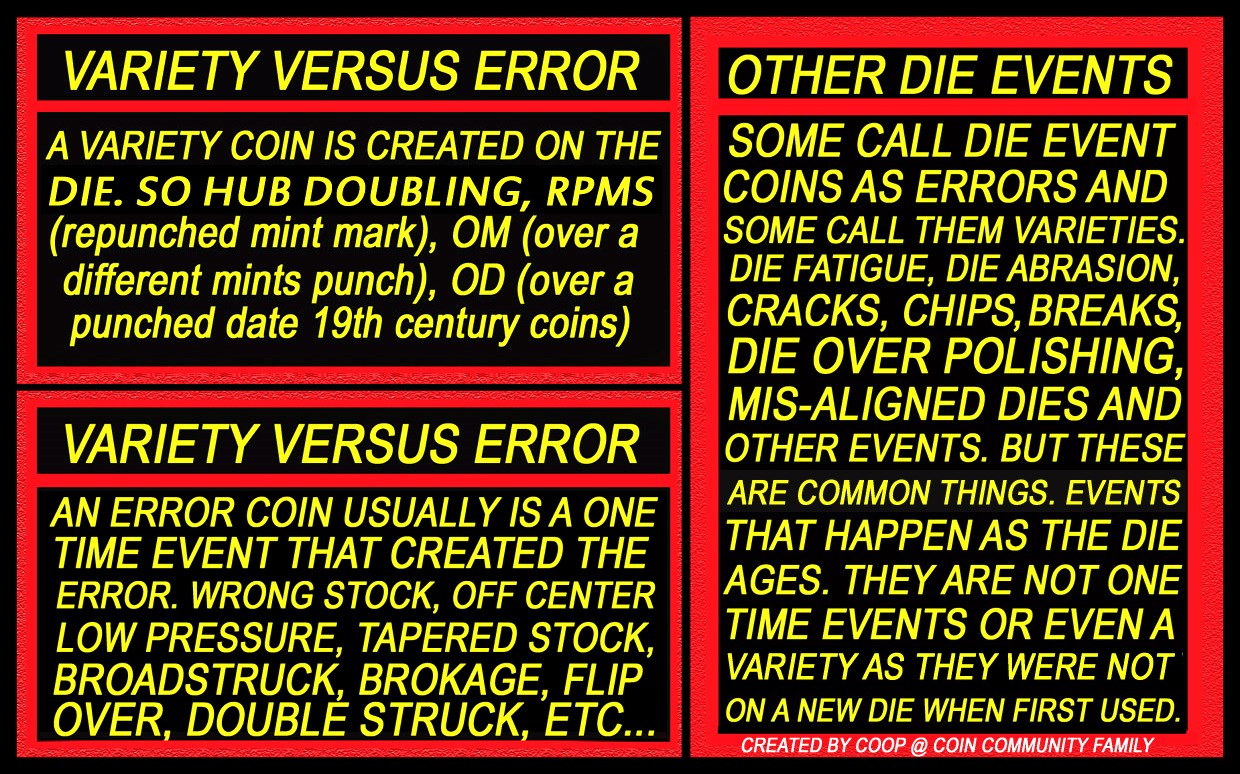 I know not all agree with me on this, but that is how I see it. |
|
Pillar of the Community
United States
3463 Posts |
Quote:Error Guide Part One An error occurs when there is a problem with the making of the coin, not in the die itself. There are three different types of errors, planchet errors, die errors, and mint striking errors. Some examples are: Strike Doubling, laminations, struck through, off center, clipped planchets, capped dies, Grease Filled Dies, die adjustment strikes, and die clashes. Varieties are mistakes in the die and many coins get minted that are exactly the same. There are literally hundreds of Lincoln Cent varieties. Some examples of different types of varieties are: doubled dies and re-punched mint marks. Many collectors today don't understand the difference between the two and will advertise a doubled die as an error coin and so on. http://www.lincolncentsonline.com/error.html |
|
Moderator
United States
16004 Posts |
Be mindful as well that an 'error' can be repeated across many coins struck in sequence ... they do not have to be specific to a single coin struck. Multiple coin errors could include die breakage causing Cud on many coins until the die is replaced ... die cracks that progress from bad to worse ... capped die strikes that occur until the die cap is removed, etc. Single coin errors could be clipped planchets, defective planchets, etc. What I've come to understand has already been stated above ... quite simply a variety is made by the design of the die ... an error is made by the minting process. David |
|
Pillar of the Community
United States
5964 Posts |
By the time you get ten replies you'll probably have ten slightly different answers. In my opinion, errors are unintentional. Varieties are repeated. There is such a thing as a Variety/Error, but it has to be exactly the same on each coin.
|
|
Valued Member
United States
64 Posts |
All good answers. I'm commenting so I can easily find this topic!
|
|
Bedrock of the Community
United States
17884 Posts |
A coin struck multiple times.
Yes with one small exception, several collector coins are deliberately struck multiple times.
A coin struck on the wrong planchet.
Yes that is an error.
A doubled die (like 1955, or 1972 cents).
No this is OT an error coin, it is a die variety. The DIE is an error, the coins are not.
Is a blank planchet an error?
No, it is exactly what it is supposed to be. It just shouldn't have gotten out.
Is a grease filled strike an error?
I would say yes, because every one is a little different, even from the same die pair.
Is a strike through a foreign object an error?
Yes, because once again they are all different.
Is a coin with "trails" an error?
No, the trails are a result of cleaing/polishing of the die. It would be a die stage.
Is a clipped planchet an error?
Yes, either a clipped planchet or a coin struck on a clipped planchet.
Is a die break (crack) an error?
No, it is a die stage. (Ever coin is a variety, the product of a given pair of dies. If the dies crack or break they are still the same dies and the same variety, just a later die stage.)
|
|
Pillar of the Community
United States
5964 Posts |
Quote:
Is a coin with "trails" an error?
No, the trails are a result of cleaing/polishing of the die. It would be a die stage. You may want to re-read Origin of Trails. Trail Dies are one of the Variety/Errors I referred to. They are unintentionally put on the die as it's being made. |
|
Moderator
 United States
54301 Posts |
Show your financial support of the Coin Community Family (click here)See my topic on Mexican Numismatic Medals (click here) |
|
Pillar of the Community
United States
1027 Posts |
What if you have (possibly) the only coin to escape the mint that was struck with a brand new die that had a severe manufacturing error? It is caused by a die defect (variety) but is a one of its kind coin (error). http://www.error-ref.com/2011-02-14/Is this an error coin, or a variety discovery coin, or just a variety? It has been six years since first reported and no other coins struck with this die have surfaced. |
|
Bedrock of the Community
United States
62064 Posts |
It is from a die, but I wouldn't call it a variety. The event that made this is not from a hubbing issue, or a mint mark punching issue. More like a die gouge or some event that created that on the die. If the die were polished, it could come off the die. While a variety is set deeper into the die.
|
|
Moderator
Australia
17030 Posts |
Quote:So, probably more than half of ebay listings with "error" in the title are not actually errors? Yes. But this is primarily because there is the perception amongst those on the numismatic fringe that "errors are valuable". So people with something weird happening on their coin will call it an "error", because they think they will get more money for it that way. Don't say "infinitely" when you mean "very"; otherwise, you'll have no word left when you want to talk about something really infinite. - C. S. Lewis
|
|
Bedrock of the Community
United States
62064 Posts |
Also for search purposes, they may include variety and error because someone may search using one term or the other.
|
|
Pillar of the Community
United States
1812 Posts |
Here's a error (double struck) on a 1998 Type 2 ( Wide AM) Reverse that I originally submitted to PCI as a double strike error before Coin World published the Type 2 Reverse Variety.. I'm guessing it was about 15 years ago when I crossed it over to ANACS and have yet to find a 2nd example.. 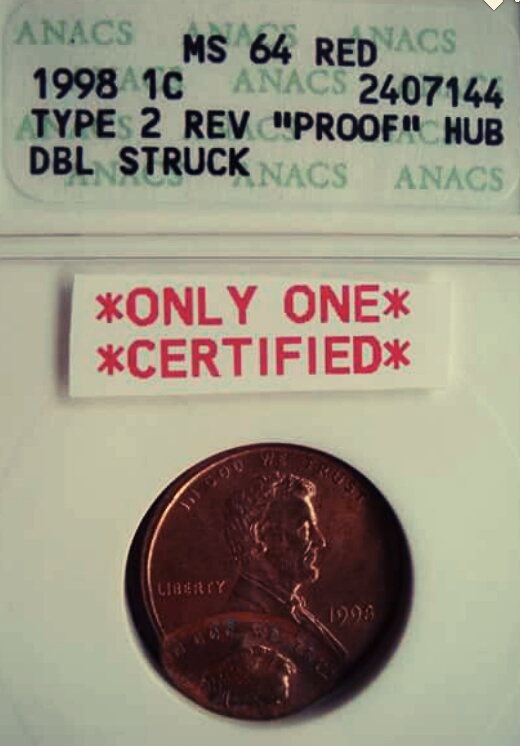 |
| |
Replies: 19 / Views: 2,356 |




 Posted 11/06/2016 6:41 pm





