










 Phil310 lots going on this one
 . I like those D/C also!!
 Posted 12/20/2016 7:05 pm


Phil.
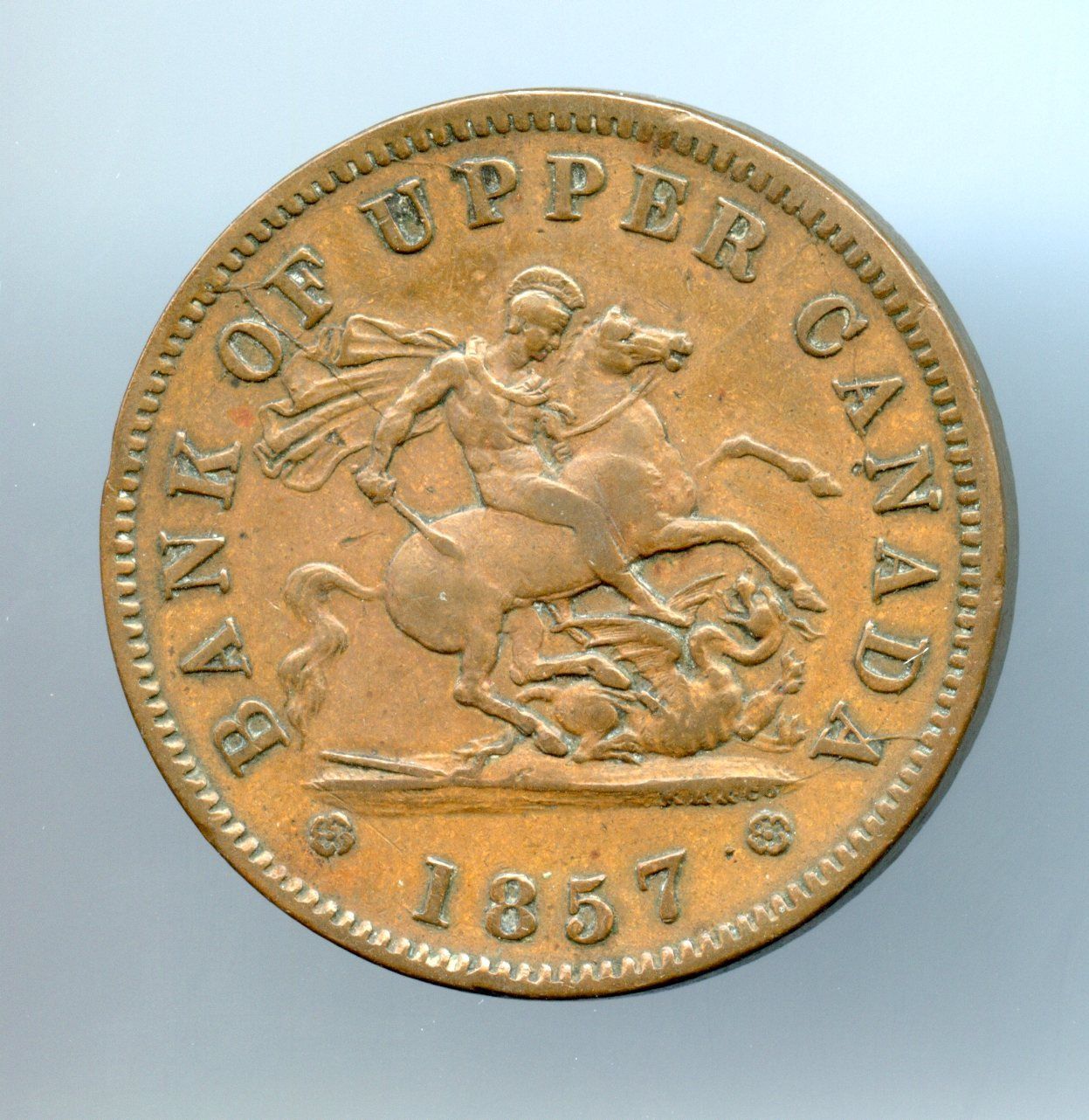
Welcome to the wonderful world of St. Georges. Yours is Courteau variety 303. Grade VF 20. Mid die state.
This is a cut and paste of my study of this variety. Trust it will fly. Forgive the pagenation and format. Something got lost in the mysterious conversion process.
I will post a subsequent response explaining some of the basics.
303 R-7. The inner Dots within the obverse Rosettes are large.
Dots are: 5 ½ X ½ 3 ½ X ½ 2 ½.
Obverse Characteristics:
The Mantle to the left of the Man's right Arm is nearly complete.
The lower end of the outline of the Mantle heavy, but does not extend completely to
the Man's right Arm. A narrow and poorly defined pleat is centred in the void
betwixt the lower outline of the Mantle and the pleat of the 6th and 7th Mantle Folds.
The 6th and 7th Mantle Folds are distant from each other; the hollow is narrow. The outer outline of the 6th Mantle Fold is indented.
The 7 is on-line with the left-section of the 4th Denticle to the immediate right of the numeral 5.
The top of the 7 is higher than the top of the 5.
The 7 is distant from the Denticles.
An imaginary line across the top of the 7 is on-line betwixt the left corner of the left Lobe of the right and the left corner of the upper Lobe of the right Rosette.
A fork of equal length branches is below the Man's right Arm. Both branches are forked.
This fork commences as a single line running across the muscle mass of the Man's right forearm and continuing a short distance horizontally into the field. A heavier line is superimposed atop the line and continues horizontally half way to the Man's body, then curves diagonally upward and terminates very close to the Man's Body. The tip of the line is cloven. A short light line extends from the upper branch of this fork and continues to the Man's Body. The upper branch of the main fork starts at the same place as the lower branch and extends diagonally upward then turns rightward towards the Man's Body and runs parallel to the lower branch. At the rightward turn of the upper branch another line emerges and runs parallel to and above the upper main branch. A long fork is to the upper branch of the main fork. A short fork is to the lower branch of the main fork.
Two Knob are to the Dagger Hilt.
The lower Knob is oval and of 'normal' size. The upper Knob is small, weakly struck, and fully attached to the apex of the lower Knob. The lower Knob is close to, yet clearly separated from the Man's right Hand.
The F in OF is re-cut.
The left Bridle Rein does not extend to the jowls of the Horse.
The left Leg of the Dragon is perfect.
From perfect and broken dies.
A Die-Crack is through the OF in OF to the Mantle.
This forked jagged straight Die-Crack is from atop the Rim above the mid-section of the Denticle above the right-side of the O in OF, forking with the Rim. The left branch exiting diagonally from the mid-section of the right-side of the same Denticle and the right branch runs along the right-side of the Denticle betwixt the O and F. Both branches merge on-line with the top of the Denticles and continue through the field toward the Upper Serif of the same F. Mid-distance to the F, the line Forks. The right branch continues to the Serif of the F in the same word and Forks again, into two parallel branches, both exiting to the upper Serif of the same F. The line exits the upper right corner of the same F and extends to the juncture of the Die-Crack to the you in UPPER (to be discussed in due order).
The primary branch extends perpendicularly into the field and Forks. The right branch extends betwixt the O and F and enters the Mantle at the 4th Mantle Fold, and continues through the Mantle and through the Man's Forearm and into the Field behind the Man's Back, transversing the Die-Crack through the Horse (to be discussed in due order), and exiting to the Man's Hip.
The left branch extends to the upper right shoulder of the same O and exits the mid-section of the left-side of the same letter, and exits to the underside of the right Serif of the Arm of the K in BANK.
A Die-Crack is through the numeral 1.
This straight Die-Crack is from the centre of the Denticle below the left-side of the numeral 8, extending through the Stand of the numeral 1, and exiting to the lower corner of the right Lobe of the left Rosette.
A Die-Crack is to the left Rosette.
This bent Die-Crack is from the right-section of the Denticle to the immediate right of the left Rosette, extending upward into the field, and turning diagonally leftward and extending to the right corner of the lower Lobe of the left Rosette. The Die-Crack exits the upper corner of the left Lobe of the same Rosette and extends through the left-section of the left ground, exiting the left corner of the plank of Lumber atop the ground, extending through the lower section of the Tail of the Horse, and extending through the lower sections of the ANK in BANK.
A Die-Crack is to the NK in BANK.
This straight diagonal Die-Crack is from the left-side of the Denticle above the Stand of the right Leg of the A in BANK, extending to the upper corner of the Serif of the left Upright of the N in BANK, and extending mid-distance along the Diagonal of the same Upright, and bending right-ward, exits the lower section of th right-side of the right Upright of the same word, and extends through the Stands of the K in the same word.
A Die-Crack is to the NK in BANK (another).
This Die-Crack is from the left-side of the Denticle to the immediate left of the N in BANK, extending to the top of the left Upright of the same word, exiting the upper section of the right-side of the Diagonal of the same letter, extending through the mid-section of the right Upright of the same letter, and exiting to the lower section of the left-side of the Upright of the K in the same word.
A Die-Crack is to the K in BANK.
The Die-Crack is from the right corner of the Denticle above the centre of the O in OF, extending through the Serifs of the K in BANK, exiting to the Serif of the right Upright of the N in the same word.
A forked Die-Crack is to PPE in UPPER.
This Die-Crack is from the left corner of the Denticle above the centre of the you in UPPER, extending toward the 1st P in UPPER and forking. The primary branch continues through to the upper corner of the Serif of the same letter, exiting the apogee of the curve of the same letter, and extending through the upper sections of the 2nd P and E in the same word, exiting to the centre of the Denticle above the Upright of the R in the same word.
The left branch extends diagonally, touching the left corner of the Stand of the 1st P and exiting to the left section of the Crest of the Man's Helmet.
A forked Die-Crack is to CANADA in CANADA.
This Die-Crack is from the left corner of the Denticle to the immediate right of the R in UPPER, extending toward the C in CANADA, and forking. The right branch continues to the Shoulder of the same C, exiting the mid-section of the vertical of the same letter, and extending through the lower section of the ANADA in the same word.
The left branch extends betwixt the R in UPPER and the C in CANADA and through the Throat of the Horse, and across the upper section of the Man's Thigh, exiting the Man's Hip, and exiting through the Horse, terminating at the Tip of the Dagger.
A Die-Crack is to the D in CANADA.
This diagonal Die-Crack is from across the Denticle above the 2nd A in CANADA, extending to the upper corner of the Serif of the D in CANADA, exiting the upper section of the Shoulder of the same letter, and exiting to the upper section of the left Leg of the 3rd A in the same word.
A Die-Crack is to the 3rd A in CANADA.
This Die-Crack is from across the rim and Denticle betwixt the D and 3rd A in CANADA, extending to the upper section of the left Leg of the same A at the same point of the Die-Crack from the D in CANADA (previously discussed). The Die-Crack exits the mid-section of the right Leg of the same letter, and curves to the Tip of the right ground.
A Die-Crack is to the Horse.
This long rather straight forked Die-Crack is from the bottom of the ground below the right rear Leg of the Horse, extending vertically through the left-section of the upper section of the same Leg and through the Body of the Horse, through the Tip of the Dagger, and exiting to the Man's upper Back.
Note - An abundance of other lesser Die-Cracks are evident.
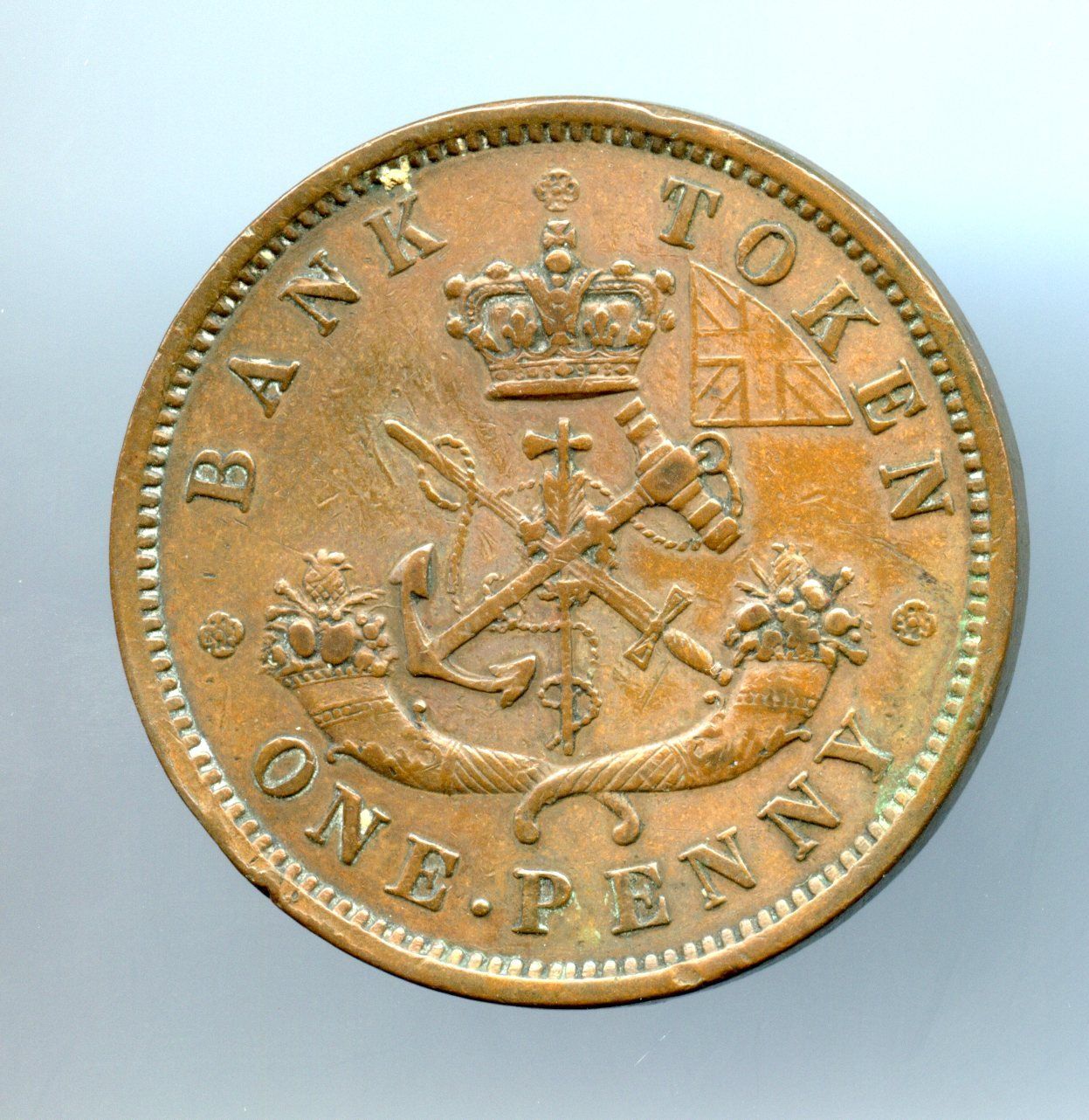
Reverse Characteristics: According to Doctor Courteau, the same as variety 279.
Note - Variety 303 is easily confused with that of variety 301 as a Dot close to the terminal of the Anchor Rope Dots is present. The Dot on variety 303 is weaker than that of variety 301. Additionally, the number of Anchor Rope Dots on either side of the Battle Axe can easily be confused. However, the Dots on variety 301 are well struck, uniform, and in-line with each other. In contrast, the Dots on variety 303 are smaller, more widely separated, and irregularly situated.
The Anchor Rope Dots are: 5 ½ X ½ 3 ½ X ½ 2 ½.
The relief of the Dots in the sector to the left of the Sword is poorly defined. The lower Dot is distant from the Anchor Rope. The 2nd, 3rd, 4th, and 5th Dots are separated from each other. The relief of the Dots within the second sector is adequately executed. What is referred to as the first ½ Dot is a rather large rectangular shaped design element diagonally situated close to the right-side of the Sword. This should more accurately be identified as a complete and independent Dot. The second Dot is more circular than the others, and is close to the terminal ½ Dot and distant from, and a trifle lower than the others. The 2nd and 3rd Dots within the second sector are of similar size and shape, being oblong, well defined, and close to each other, yet separate, and distant from the others. The terminal ½ Dot is large and attached to the Fledgling. The relief of the ½ 2 ½ Dots within the 3rd sector is poorly executed. The upper ½ Dot is as a thick line emerging from the upper right-side of the Fledgling. The two main Dots larger and distant from the Fledgling, and are oblong and placed in a staggered horizontal fashion. The last ½ Dot is 'pyramid shaped' and placed below the lower right corner of the 2nd main Dot. The last ½ Dot is close to the Anchor Shaft.
Note - The details may not be readily discernable on lower grade specimens.
The Anchor Ring is perfect.
Two Grass Blades shew.
The lower Grass Blade is short, horizontal, away from the fruit, and points to the right corner of the upper Lobe of the right Rosette. The upper Grass Blade is very faint.
Note - Diligence must be exercised here. The upper Lobe is understood as having the orientation of the Rosette Denticles at 6 o'clock. The first impression one has is the blade points to the left Lobe, but what appears to be the left Lobe is actually the upper Lobe.
Remnants of the edges of the lower Oak Leaf betwixt the Sword and Anchor shew.
The Oak Wreath Stem is strong.
The left Anchor Brace is narrower than the right Brace and extends to the vertex of the Fluke.
The Anchor Rope Dots terminate with two medium sized separated Dots.
Note - The Dots are unlike variety 279.
A Dot is to the left of the terminal Anchor Rope Dots.
From perfect dies.
Thus:
303 Perfect - no Die-Cracks.
303A A Die-Crack is to the OF in OF to the Mantle.
303B Die-Crack as above, plus a Die-Crack is to the NK in BANK (obverse).
Die-Cracks as above, plus a Die-Crack is to the K in BANK (obverse).
Die-Cracks as above, plus a Die-Crack is to PPE in UPPER.
Die-Cracks as above, plus a Die-Crack is to CANADA in CANADA.
Die-Cracks as above, plus a Die-Crack is to the 3rd A in CANADA
Die-Cracks as above, plus a Die-Crack is to the Horse.
Die-Cracks as above, plus a Die-Crack is to the numeral 1.
Die-Cracks as above, plus a Die-Crack is to the left Rosette.
Die-Cracks as above, plus a Die-Crack is to the NK in BANK (obverse).
Die-Cracks as above, plus a Die-Crack is to the D in CANADA.
Note - Only the first Die-Crack was noted by Doctor Courteau.
Note - Doctor Courteau often times uses the phrase 'several Die-Cracks, especially...' and proceeds to identify one or two. The question lingers, how many is 'several.'
This is the Die-Crack progression.
Welcome to the wonderful world of St. Georges. Yours is Courteau variety 303. Grade VF 20. Mid die state.
This is a cut and paste of my study of this variety. Trust it will fly. Forgive the pagenation and format. Something got lost in the mysterious conversion process.
I will post a subsequent response explaining some of the basics.
303 R-7. The inner Dots within the obverse Rosettes are large.
Dots are: 5 ½ X ½ 3 ½ X ½ 2 ½.
Obverse Characteristics:
The Mantle to the left of the Man's right Arm is nearly complete.
The lower end of the outline of the Mantle heavy, but does not extend completely to
the Man's right Arm. A narrow and poorly defined pleat is centred in the void
betwixt the lower outline of the Mantle and the pleat of the 6th and 7th Mantle Folds.
The 6th and 7th Mantle Folds are distant from each other; the hollow is narrow. The outer outline of the 6th Mantle Fold is indented.
The 7 is on-line with the left-section of the 4th Denticle to the immediate right of the numeral 5.
The top of the 7 is higher than the top of the 5.
The 7 is distant from the Denticles.
An imaginary line across the top of the 7 is on-line betwixt the left corner of the left Lobe of the right and the left corner of the upper Lobe of the right Rosette.
A fork of equal length branches is below the Man's right Arm. Both branches are forked.
This fork commences as a single line running across the muscle mass of the Man's right forearm and continuing a short distance horizontally into the field. A heavier line is superimposed atop the line and continues horizontally half way to the Man's body, then curves diagonally upward and terminates very close to the Man's Body. The tip of the line is cloven. A short light line extends from the upper branch of this fork and continues to the Man's Body. The upper branch of the main fork starts at the same place as the lower branch and extends diagonally upward then turns rightward towards the Man's Body and runs parallel to the lower branch. At the rightward turn of the upper branch another line emerges and runs parallel to and above the upper main branch. A long fork is to the upper branch of the main fork. A short fork is to the lower branch of the main fork.
Two Knob are to the Dagger Hilt.
The lower Knob is oval and of 'normal' size. The upper Knob is small, weakly struck, and fully attached to the apex of the lower Knob. The lower Knob is close to, yet clearly separated from the Man's right Hand.
The F in OF is re-cut.
The left Bridle Rein does not extend to the jowls of the Horse.
The left Leg of the Dragon is perfect.
From perfect and broken dies.
A Die-Crack is through the OF in OF to the Mantle.
This forked jagged straight Die-Crack is from atop the Rim above the mid-section of the Denticle above the right-side of the O in OF, forking with the Rim. The left branch exiting diagonally from the mid-section of the right-side of the same Denticle and the right branch runs along the right-side of the Denticle betwixt the O and F. Both branches merge on-line with the top of the Denticles and continue through the field toward the Upper Serif of the same F. Mid-distance to the F, the line Forks. The right branch continues to the Serif of the F in the same word and Forks again, into two parallel branches, both exiting to the upper Serif of the same F. The line exits the upper right corner of the same F and extends to the juncture of the Die-Crack to the you in UPPER (to be discussed in due order).
The primary branch extends perpendicularly into the field and Forks. The right branch extends betwixt the O and F and enters the Mantle at the 4th Mantle Fold, and continues through the Mantle and through the Man's Forearm and into the Field behind the Man's Back, transversing the Die-Crack through the Horse (to be discussed in due order), and exiting to the Man's Hip.
The left branch extends to the upper right shoulder of the same O and exits the mid-section of the left-side of the same letter, and exits to the underside of the right Serif of the Arm of the K in BANK.
A Die-Crack is through the numeral 1.
This straight Die-Crack is from the centre of the Denticle below the left-side of the numeral 8, extending through the Stand of the numeral 1, and exiting to the lower corner of the right Lobe of the left Rosette.
A Die-Crack is to the left Rosette.
This bent Die-Crack is from the right-section of the Denticle to the immediate right of the left Rosette, extending upward into the field, and turning diagonally leftward and extending to the right corner of the lower Lobe of the left Rosette. The Die-Crack exits the upper corner of the left Lobe of the same Rosette and extends through the left-section of the left ground, exiting the left corner of the plank of Lumber atop the ground, extending through the lower section of the Tail of the Horse, and extending through the lower sections of the ANK in BANK.
A Die-Crack is to the NK in BANK.
This straight diagonal Die-Crack is from the left-side of the Denticle above the Stand of the right Leg of the A in BANK, extending to the upper corner of the Serif of the left Upright of the N in BANK, and extending mid-distance along the Diagonal of the same Upright, and bending right-ward, exits the lower section of th right-side of the right Upright of the same word, and extends through the Stands of the K in the same word.
A Die-Crack is to the NK in BANK (another).
This Die-Crack is from the left-side of the Denticle to the immediate left of the N in BANK, extending to the top of the left Upright of the same word, exiting the upper section of the right-side of the Diagonal of the same letter, extending through the mid-section of the right Upright of the same letter, and exiting to the lower section of the left-side of the Upright of the K in the same word.
A Die-Crack is to the K in BANK.
The Die-Crack is from the right corner of the Denticle above the centre of the O in OF, extending through the Serifs of the K in BANK, exiting to the Serif of the right Upright of the N in the same word.
A forked Die-Crack is to PPE in UPPER.
This Die-Crack is from the left corner of the Denticle above the centre of the you in UPPER, extending toward the 1st P in UPPER and forking. The primary branch continues through to the upper corner of the Serif of the same letter, exiting the apogee of the curve of the same letter, and extending through the upper sections of the 2nd P and E in the same word, exiting to the centre of the Denticle above the Upright of the R in the same word.
The left branch extends diagonally, touching the left corner of the Stand of the 1st P and exiting to the left section of the Crest of the Man's Helmet.
A forked Die-Crack is to CANADA in CANADA.
This Die-Crack is from the left corner of the Denticle to the immediate right of the R in UPPER, extending toward the C in CANADA, and forking. The right branch continues to the Shoulder of the same C, exiting the mid-section of the vertical of the same letter, and extending through the lower section of the ANADA in the same word.
The left branch extends betwixt the R in UPPER and the C in CANADA and through the Throat of the Horse, and across the upper section of the Man's Thigh, exiting the Man's Hip, and exiting through the Horse, terminating at the Tip of the Dagger.
A Die-Crack is to the D in CANADA.
This diagonal Die-Crack is from across the Denticle above the 2nd A in CANADA, extending to the upper corner of the Serif of the D in CANADA, exiting the upper section of the Shoulder of the same letter, and exiting to the upper section of the left Leg of the 3rd A in the same word.
A Die-Crack is to the 3rd A in CANADA.
This Die-Crack is from across the rim and Denticle betwixt the D and 3rd A in CANADA, extending to the upper section of the left Leg of the same A at the same point of the Die-Crack from the D in CANADA (previously discussed). The Die-Crack exits the mid-section of the right Leg of the same letter, and curves to the Tip of the right ground.
A Die-Crack is to the Horse.
This long rather straight forked Die-Crack is from the bottom of the ground below the right rear Leg of the Horse, extending vertically through the left-section of the upper section of the same Leg and through the Body of the Horse, through the Tip of the Dagger, and exiting to the Man's upper Back.
Note - An abundance of other lesser Die-Cracks are evident.
Reverse Characteristics: According to Doctor Courteau, the same as variety 279.
Note - Variety 303 is easily confused with that of variety 301 as a Dot close to the terminal of the Anchor Rope Dots is present. The Dot on variety 303 is weaker than that of variety 301. Additionally, the number of Anchor Rope Dots on either side of the Battle Axe can easily be confused. However, the Dots on variety 301 are well struck, uniform, and in-line with each other. In contrast, the Dots on variety 303 are smaller, more widely separated, and irregularly situated.
The Anchor Rope Dots are: 5 ½ X ½ 3 ½ X ½ 2 ½.
The relief of the Dots in the sector to the left of the Sword is poorly defined. The lower Dot is distant from the Anchor Rope. The 2nd, 3rd, 4th, and 5th Dots are separated from each other. The relief of the Dots within the second sector is adequately executed. What is referred to as the first ½ Dot is a rather large rectangular shaped design element diagonally situated close to the right-side of the Sword. This should more accurately be identified as a complete and independent Dot. The second Dot is more circular than the others, and is close to the terminal ½ Dot and distant from, and a trifle lower than the others. The 2nd and 3rd Dots within the second sector are of similar size and shape, being oblong, well defined, and close to each other, yet separate, and distant from the others. The terminal ½ Dot is large and attached to the Fledgling. The relief of the ½ 2 ½ Dots within the 3rd sector is poorly executed. The upper ½ Dot is as a thick line emerging from the upper right-side of the Fledgling. The two main Dots larger and distant from the Fledgling, and are oblong and placed in a staggered horizontal fashion. The last ½ Dot is 'pyramid shaped' and placed below the lower right corner of the 2nd main Dot. The last ½ Dot is close to the Anchor Shaft.
Note - The details may not be readily discernable on lower grade specimens.
The Anchor Ring is perfect.
Two Grass Blades shew.
The lower Grass Blade is short, horizontal, away from the fruit, and points to the right corner of the upper Lobe of the right Rosette. The upper Grass Blade is very faint.
Note - Diligence must be exercised here. The upper Lobe is understood as having the orientation of the Rosette Denticles at 6 o'clock. The first impression one has is the blade points to the left Lobe, but what appears to be the left Lobe is actually the upper Lobe.
Remnants of the edges of the lower Oak Leaf betwixt the Sword and Anchor shew.
The Oak Wreath Stem is strong.
The left Anchor Brace is narrower than the right Brace and extends to the vertex of the Fluke.
The Anchor Rope Dots terminate with two medium sized separated Dots.
Note - The Dots are unlike variety 279.
A Dot is to the left of the terminal Anchor Rope Dots.
From perfect dies.
Thus:
303 Perfect - no Die-Cracks.
303A A Die-Crack is to the OF in OF to the Mantle.
303B Die-Crack as above, plus a Die-Crack is to the NK in BANK (obverse).
Die-Cracks as above, plus a Die-Crack is to the K in BANK (obverse).
Die-Cracks as above, plus a Die-Crack is to PPE in UPPER.
Die-Cracks as above, plus a Die-Crack is to CANADA in CANADA.
Die-Cracks as above, plus a Die-Crack is to the 3rd A in CANADA
Die-Cracks as above, plus a Die-Crack is to the Horse.
Die-Cracks as above, plus a Die-Crack is to the numeral 1.
Die-Cracks as above, plus a Die-Crack is to the left Rosette.
Die-Cracks as above, plus a Die-Crack is to the NK in BANK (obverse).
Die-Cracks as above, plus a Die-Crack is to the D in CANADA.
Note - Only the first Die-Crack was noted by Doctor Courteau.
Note - Doctor Courteau often times uses the phrase 'several Die-Cracks, especially...' and proceeds to identify one or two. The question lingers, how many is 'several.'
This is the Die-Crack progression.
Edited by colonialtokens
12/20/2016 7:10 pm
12/20/2016 7:10 pm


