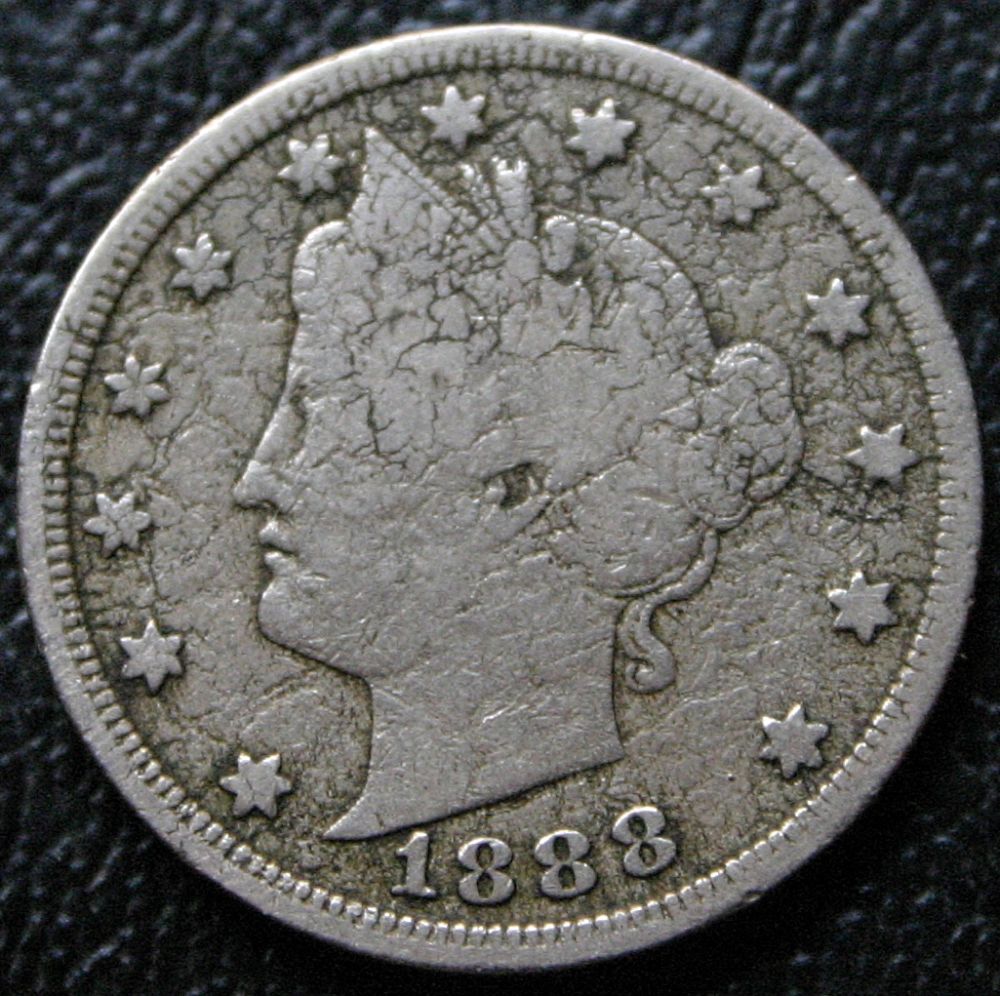
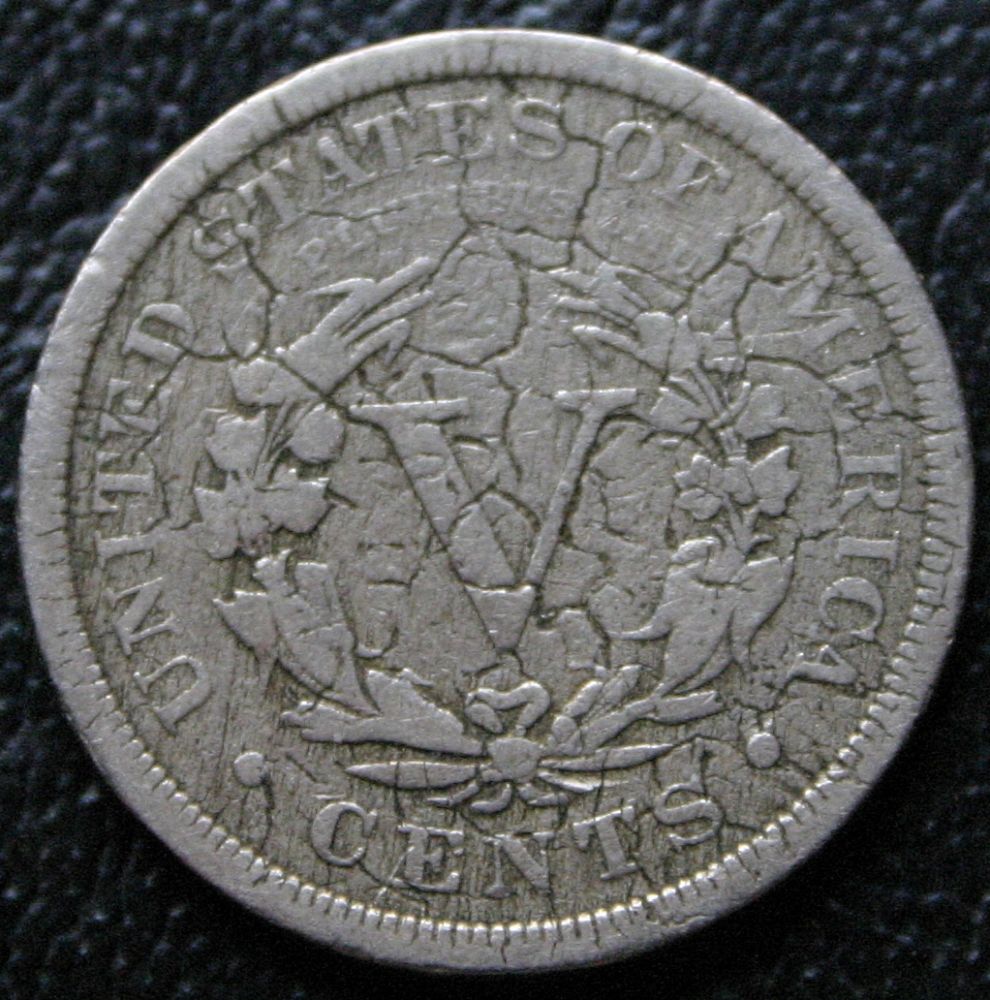
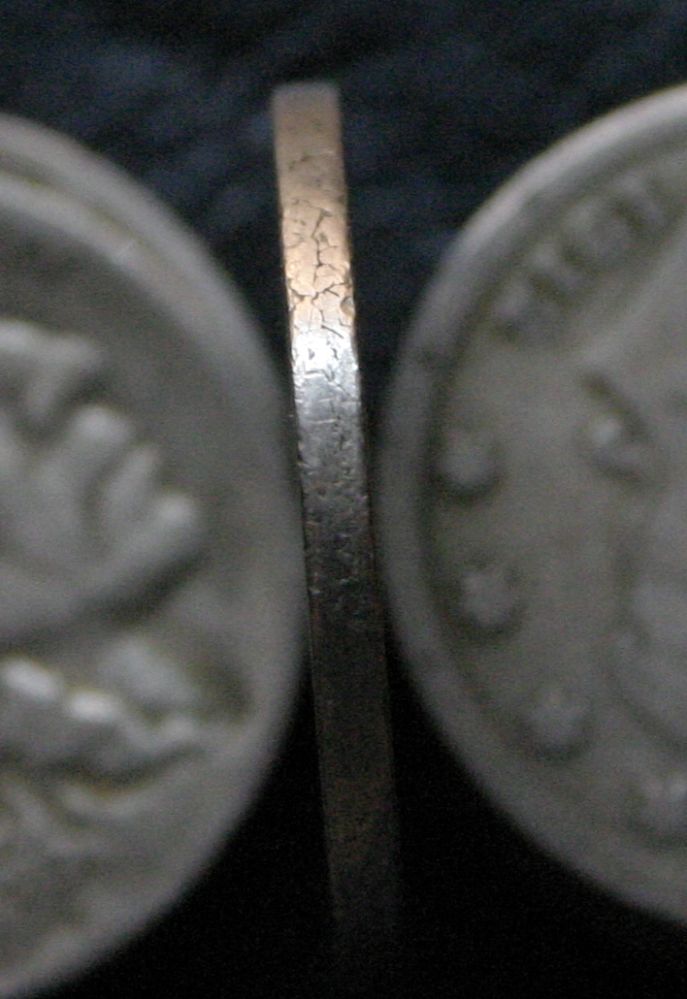
Found this in a roll of nickels. To me it looks like the last coin this die ever made. It also looks like this all the way around the edge. Lamination problem? These are definitely grooves in the coin. Your thoughts would be appreciated.
Sometimes heating up the older nickels w/ a torch then dunking to quick cool (also known as "tempering") will cause mixed ally metals to stress crack like that. See it sometimes in burned buildings where rooves w/snow on top collapse, melting snow and putting out fire, around the beams and other metal structure? Could be, or just...blowing smoke!
If trenches, then it follows that the die that made them must have ridges in the corresponding places. I am not familiar with such a manner of Die Deterioration.
Quite an impressive error, if those dark lines on the coin are ridges! Then the die would have been very close to a catastrophic shattering.
A collar die is the "ring" that the planchet sets in while the dies come together and keep the coin from being spread out. A broadstruck coin is where the collar die was not involved in the striking of the coin. Some collar dies have reeds or lettering like on the dimes and quarters edges have reeds and Presidential dollars have lettering. Others like nickels and one cent coins they are plain.
I love this video. You can see the collar die working at 8:18 in the video. But the whole video awesome. I like where they are making a 1938 Jefferson master die around 2:45. Can I have that die set please?
Quote: Some collar dies have reeds or lettering like on the dimes and quarters edges have reeds and Presidential dollars have lettering. Others like nickels and one cent coins they are plain.
I know this is straying off topic but, the reason I asked is because I don't think I've heard it referred to as a collar die, just collar. It does make sense in the case of adding reeding or lettering.
However, I thought I remembered watching a video of the edge lettering being added in a separate process similar to upsetting (at least on modern coins). I did a quick search and found this on smalldollars.com:
Quote: RIGHT SIDE UP vs. UPSIDE DOWN EDGE LETTERING
For business strikes, the edge lettering is being applied in a seperate process after the obverse and reverse are struck. The struck coins are run through the edge lettering machine at a high speed without reguard to whether they are facing obverse up or reverse up.
...
The edge lettering on proof coins is applied by a different process than on business strikes. It is applied when the coin is struck.
I assume that proof edge-lettering is applied with the strike to avoid damage being run through a high-speed machine and to insure that the lettering orientation is consistent.
In Memory of Crazyb0 12-26-1951 to 7-27-2020 In Memory of Tootallious 3-31-1964 to 4-15-2020 In Memory of T-BOP 10-12-1949 to 1-19-2024
Disclaimer: While a tremendous amount of effort goes into ensuring the accuracy of the information contained in this site, Coin Community assumes no liability for errors. Copyright 2005 - 2026 Coin Community Family- all rights reserved worldwide. Use of any images or content on this website without prior written permission of Coin Community or the original lender is strictly prohibited. Contact Us | Advertise Here | Privacy Policy / Terms of Use









 Posted 05/25/2017 9:04 pm





