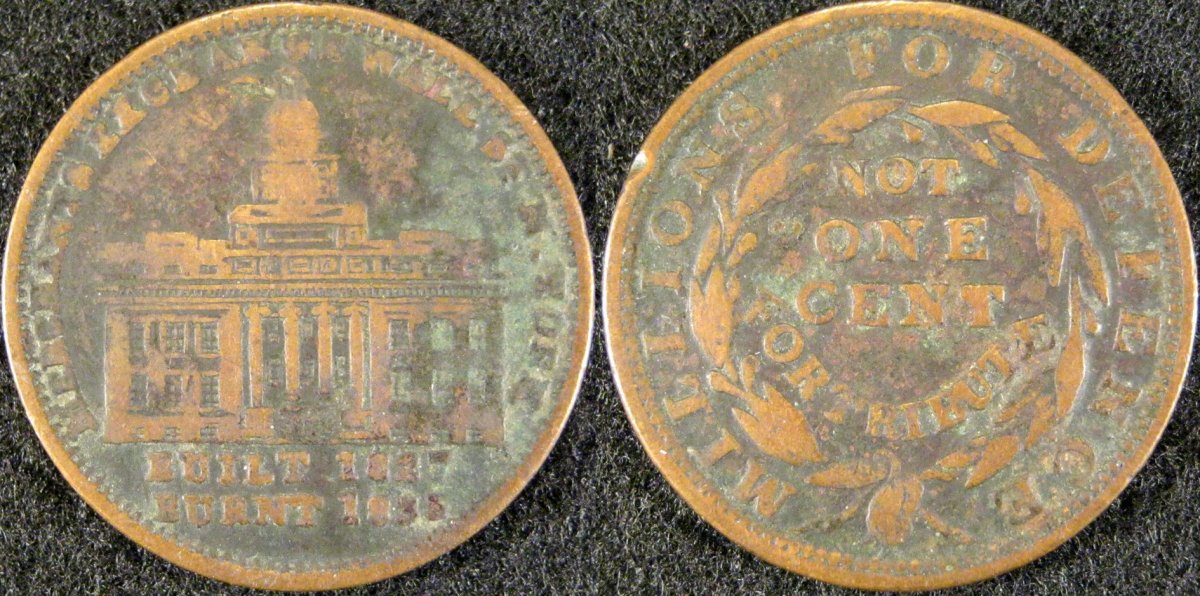
Just won this Hard Times token. A Bit different than the standard fare, this one references The Stock Exchange Building, on Wall Street in NYC that burned down in 1835. So I decided to look up some history on it. The following article describes the financial times of that era. Funny how it seems to go in 100 year cycles, a boom and a bust. And no, the bubbles aren't the bust, just market stabilization's. I'm afraid this rapid rise of such tradings is the boom of our times. History DOES repeat itself in ever so many ways. Here's the backstory of the buildup to the financial bust of the mid-1830s, as drastic of a "depression" as our grandparents or parents went through prior to WW2.
Quote:
"The NYSE took shape in New York City in the 1790s, where merchants and brokers held public auctions and negotiated deals in and around the landmark Tontine Coffee House at the corner of Wall and Water Streets. New York proved a particularly rich market for the government securities which had helped fund the Revolutionary War. As New York commerce evolved, the budding securities market grew accordingly in complexity and scope. On May 17, 1792, two dozen brokers signed the "Buttonwood Agreement," founding the Exchange on lower Wall Street. They agreed to avoid public auctions, to collect minimum commissions on federal bonds (public stock), and to "give preference to each other" in their trading deals.
Following the War of 1812, the stock market experienced unprecedented growth. Increased trade with Britain transformed New York into the leading American port. Private and commercial banks proliferated. Key brokers decided to establish a steady forum—with a fixed location and regular hours—and on March 8, 1817, they adopted a constitution and the name "New York Stock & Exchange Board" (NYS&EB).
The NYS&EB was governed by distinct rules and procedures. Members were elected on the basis of a ballot-style election process. The exchange followed rules regarding sales and delivery procedures, commission rates, and business ethics. Stipulations also controlled absenteeism, distractions during bidding, and even the wearing of hats. Daily trading consisted of members bidding on securities from designated seats, while the president "called" out each stock or bond.
The stock market fed off a flow of new capital from the 1820s to the 1830s. Trading of federal securities financed the construction of roads, bridges, canals, and municipal water, sewerage, and lighting systems. New laws brought governmental charters within closer reach of young companies. Consequently, trading volume at the NYS&EB rose from an average of 100 shares per day in 1827 to 5000 shares per day in 1834. By the late 1830s, however, the securities market followed the overall economy into a slump. British cutbacks in American investment, rampant speculation in land and securities, and the 1836 closing of the federally-chartered Second Bank of the United States culminated in the Panic of 1837. Though it lost the momentum it had gathered in the 1820s and early 1830s, the NYS&EB managed to survive until the down cycle reversed in 1843."
(Excerpt from: encyclopedia.com , "New York Stock Exchange")
Hope you found this a bit "illuminating" on the times of yesteryear and the Hard Times tokens of then. If anyone has any online references for the types of these tokens it would be appreciated. Seem to be getting quite a pile of them lately and would like to identify the type!









 Posted 11/25/2017 8:01 pm