| Author |
 Replies: 16 / Views: 3,688 Replies: 16 / Views: 3,688 |
|
Pillar of the Community
Singapore
631 Posts |
Hi guys, Opinions on whether this piece is fake or just damaged ? The area in question is top rim on reverse. 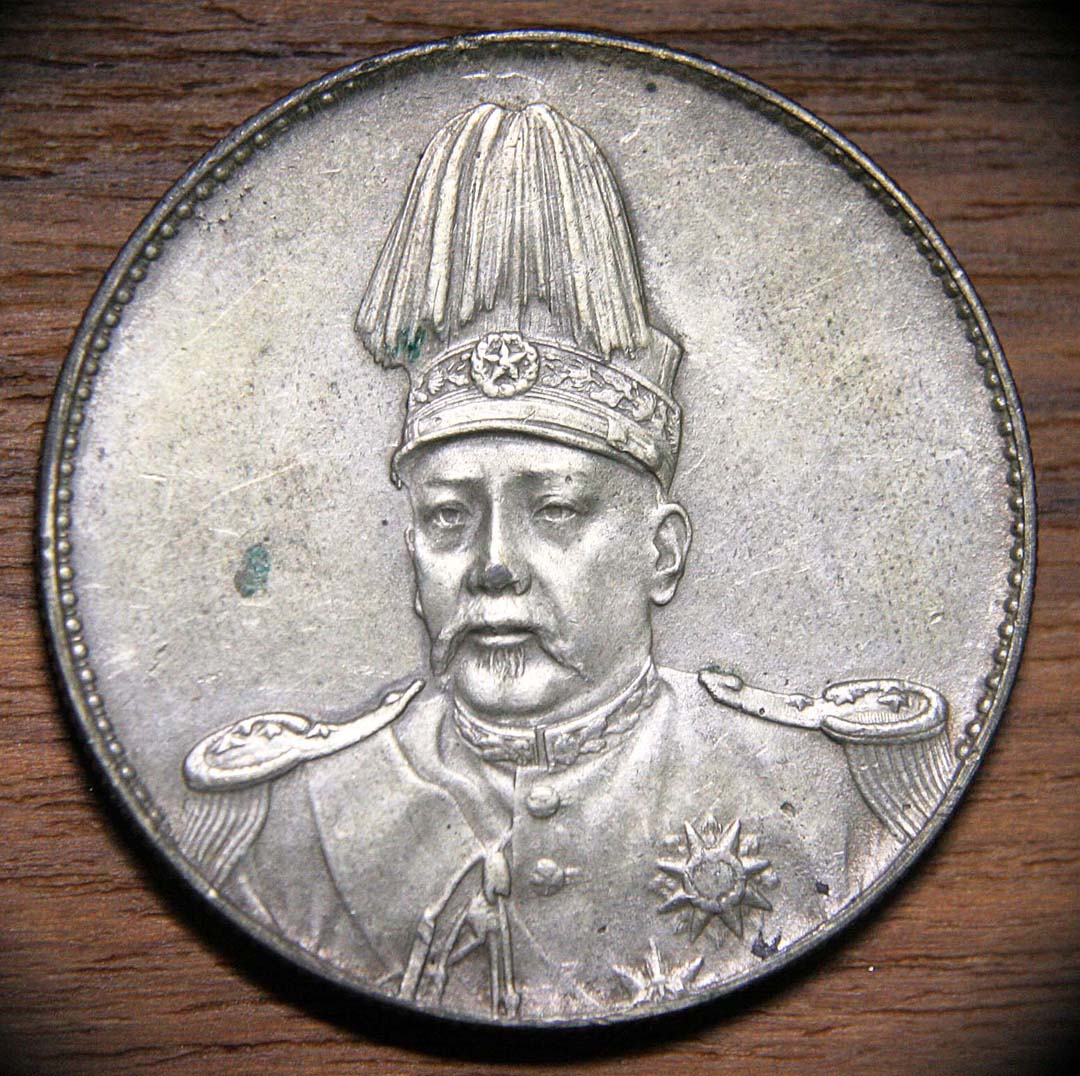 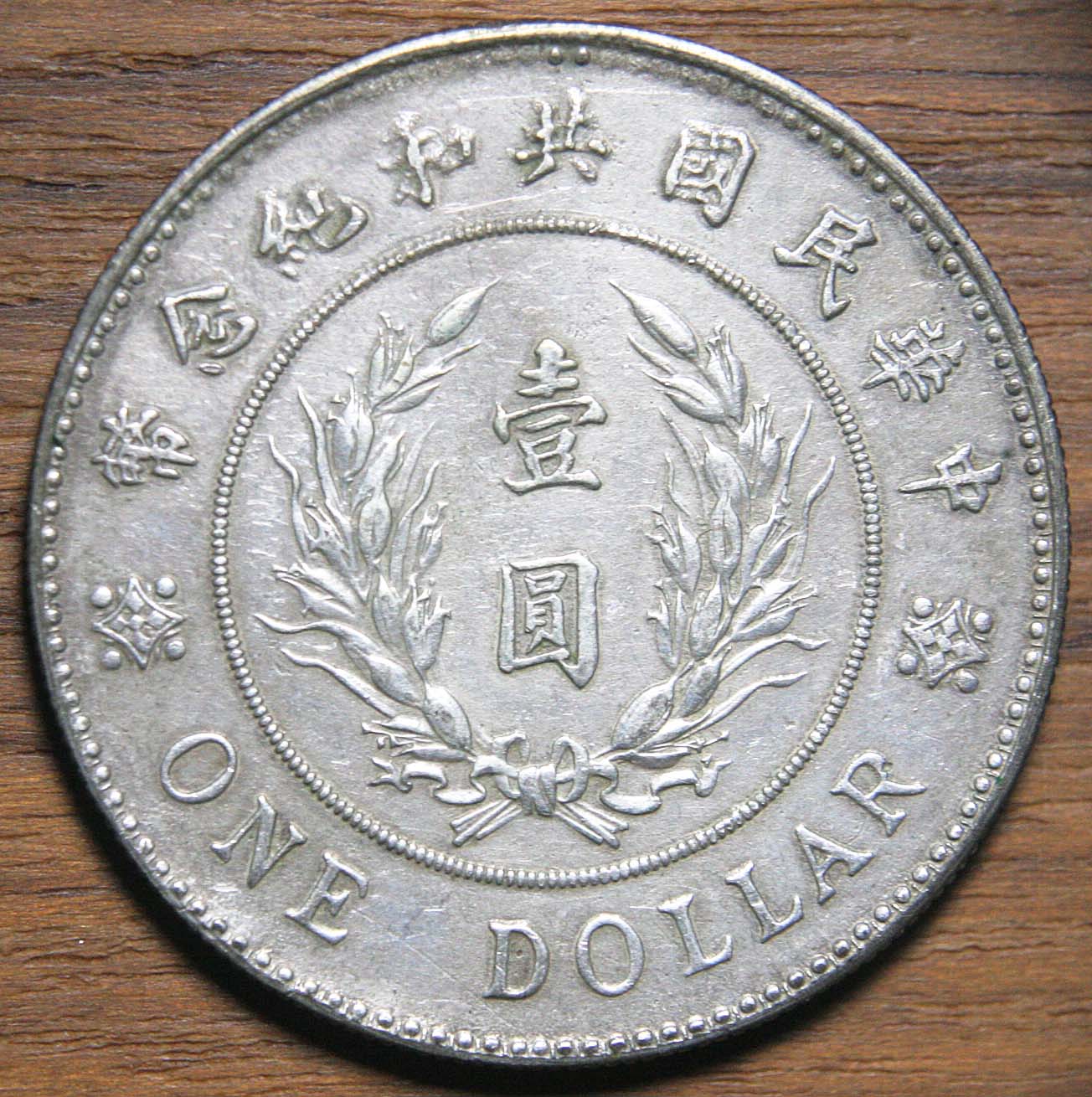 Edited by Numister
02/24/2018 11:36 pm
|
|
|
|
Pillar of the Community
United States
5362 Posts |
Numister There is the definite appearance of damage as you indicate. However, there are also places on the fields look wrong and the fine raised lines of die damage in the plume of the hat point to a likely forgery made from a decent quality transfer image.
In hand I would check weight, magnetic properties, density and of course the edge of the coin looking for anomalies.
|
|
Bedrock of the Community
Australia
21789 Posts |
Beads on both circles (reverse), inconsistent.
Not happy with some of the script characters 11 o'clock reverse.
Green spot next to the face on the obverse doesn't enthrall me.
Very flat appearance with good detail no wear, but no luster either.
I am leaning towards centrifugal pressure cast fake.
|
|
Moderator
 United States
54297 Posts |
The obverse (bust side) concerns me more than the reverse. 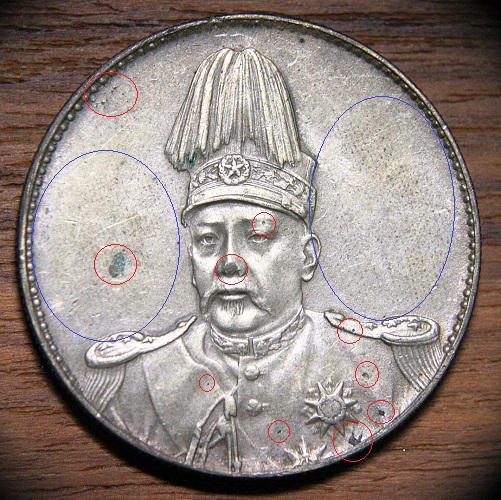 Is this something you own or are thinking of buying? Is it offered on a reputable site? If the latter, is the seller asking an appropriate amount for it? |
|
Pillar of the Community
United States
4883 Posts |
A coin for which many fakes exist. I think this example should be regarded presumptively as a forgery until proven otherwise, based upon the somewhat porous/uneven appearance of the surfaces coupled with the inconsistently rendered dentils. Quote:
In hand I would check weight, magnetic properties, density and of course the edge of the coin looking for anomalies.  Colligo ergo sum
|
|
Pillar of the Community
United States
1962 Posts |
How is the idea even being entertained that this garbage is anything other than a crummy Chinatown dollar bin replica?!!
|
|
Pillar of the Community
 Singapore
631 Posts |
Ok guys, looks like it's a fake. But I think at least it's made from silver ?
|
|
Pillar of the Community
Australia
3840 Posts |
Why should it struck in silver? Could easy be plated lead.
|
|
Pillar of the Community
United States
5362 Posts |
Numister This is where a density check will prove what metal you have. It should be about 10.3. The coin is large enough to use even a 1/100 gram scale and get a 1 decimal point answer. It might even be accurate enough to measure since it is a machine strike.
So don't guess - check scientifically.
|
|
Bedrock of the Community
Australia
21789 Posts |
Could be a reasonably thick silver plate flan, over a copper core. In this case, XRF test would be of little use.
The compensate for the lower density of copper (Cu s.g. 8.93, Ag s.g. 10.5), the flan may be around 15% thicker to get to the correct weight.
A lead copper alloy of around 60% lead - 40% copper can be used to mimic the s.g. of .900 silver to get to the correct weight and thickness, but the ping tone may well be different.
If it is cast, (those pimples suggest that), then it should be a tiny bit less in diameter than a genuine piece. A copy will shrink a little a tiny amount after casting.
Suggest centrifugal pressure cast fake, - the detail is reasonably sharp, with no bubbles.
These comments would be of value to the discussion of any suspected fake of a .900 silver coin, including American silver coins.
Edited by sel_69l
02/27/2018 06:31 am
|
|
Pillar of the Community
Singapore
631 Posts |
Hi guys, I did the density test, came in at a paltry 8.27
I did tests on my other dragon coins and one came in at 9.88,
means its not silver ?
Edited by Numister
02/27/2018 09:21 am
|
|
Pillar of the Community
United States
4883 Posts |
Quote:
Hi guys, I did the density test, came in at a paltry 8.27 I did tests on my other dragon coins and one came in at 9.88, means its not silver ? It's difficult to get completely accurate values without employing a laboratory grade scale under extremely well controlled conditions. On your tabletop you're simply looking for "ballpark" figures. I'd surmise that your procedure might've yielded numbers consistently a bit under what is true. But it clearly shows that one cannot be genuine while the other may well be, which is the whole point of the exercise. Colligo ergo sum
|
|
Pillar of the Community
Singapore
631 Posts |
Would a pure silver coin have a higher density reading than a lower content silver one ? If so, is there a easy to follow chart ?
|
|
Pillar of the Community
Australia
3840 Posts |
Again, it could easily be plated lead, leading to heavier density reading.
|
|
Pillar of the Community
United States
4883 Posts |
Quote:
Would a pure silver coin have a higher density reading than a lower content silver one ? If so, is there a easy to follow chart ? So long as your other alloy component is copper, then, yes, you have that right. There's a chart of the sort you're asking for on this webpage: http://www.attilacoins.com/Calculat...ity_coin.asp Colligo ergo sum
|
|
Pillar of the Community
United States
5362 Posts |
Density readings are basically as accurate as the scale you use to calculate them. The formula is weight of the object in air in grams divided by the volume of the object in cubic centimeters. Water displacement is used because conveniently pure water has an SG of 1.00. So the weight lost (apparently lost due to the effect of buoyancy) by a coin exactly equals the volume of the coin. A scale that is accurate to 0.1 gram as most cheap scales are will yield a raw SG accurate to whole numbers. You did not supply the scale type so I must make an assumption. Presuming for a minute that it was a typical under $100 Chinese electronic scale you have enough accuracy to determine if a coin falls properly in the coin silver range. You present two readings 8.27 and 9.88. Those must be rounded to 8 and 10 in terms of scientific notation. The expression 8.27 is a false level of accuracy. The denser coin SG=10 +/- 0.5 is within the range of a genuine coin. A reading of 8 is with no doubt counterfeit or a numismatic forgery (I prefer the latter term because the object illustrated is not a circulating counterfeit of the period). This concept of Specific Gravity is not rocket science, nor is it magic. Coin silver has a laboratory density of 10.31, however, to get that level of accuracy you must use an analytical balance that is accurate to 0.001 grams. That does not mean a scale that simply reads to 0.001 grams. There is a world of difference between accuracy and read out. There is no scale made today that can reliably read to 0.001 grams that costs under roughly $500. A really good lab scale costs $3,000 or more and is accurate to about 0.0001 gram. These are the scales typically used in a compounding drug store or graduate school laboratory. These scales are equipped with full shields so that air movement does not alter the readings. At that level of accuracy you also need to do a temperature correction and you must use distilled (demineralized) water. Following the scientific logic of the process an SG reading of 10.3 requires a scale accurate to 0.01 gram. This is the level used by the Chinese in 1835. It is close to the US mint standard in 1839 used for day to day work. For those interested the actual laboratory scale used by Dr. Riddell in New Orleans is on display in the mint museum. It is a large boxed scale - very elaborate and it stands over 5 feet tall on the floor. The working scales in China and the US were able to detect a coin that was 10% deficient in silver. That is why the UK standard for copies of Mexican 8 reales was -5% or 850 fine silver. It is also the reason they introduced the concept of SG to the Chinese in 1835. Before the Chinese calculated SG debased 8Rs using 800 fine or even lower purities was in circulation. The Royal Mint did not want to receive coins debased more than the ones they were passing to the Chines. Most 0.01 reading digital scales from China are in reality 0.1 gram scales. As far as a table of values, the plot of the equation of a two element alloy is a graph in the form of a straight line connecting the SG of pure silver (work hardened) with the SG of work hardened copper. From the work of Riddell which was used at the New Orleans mint from 1839 onward pure hammered silver is 10.55 and pure hammered copper is 8.84. So each of you can make your own graph as large as you like. Interpreting the graph can not be more accurate than your scale. 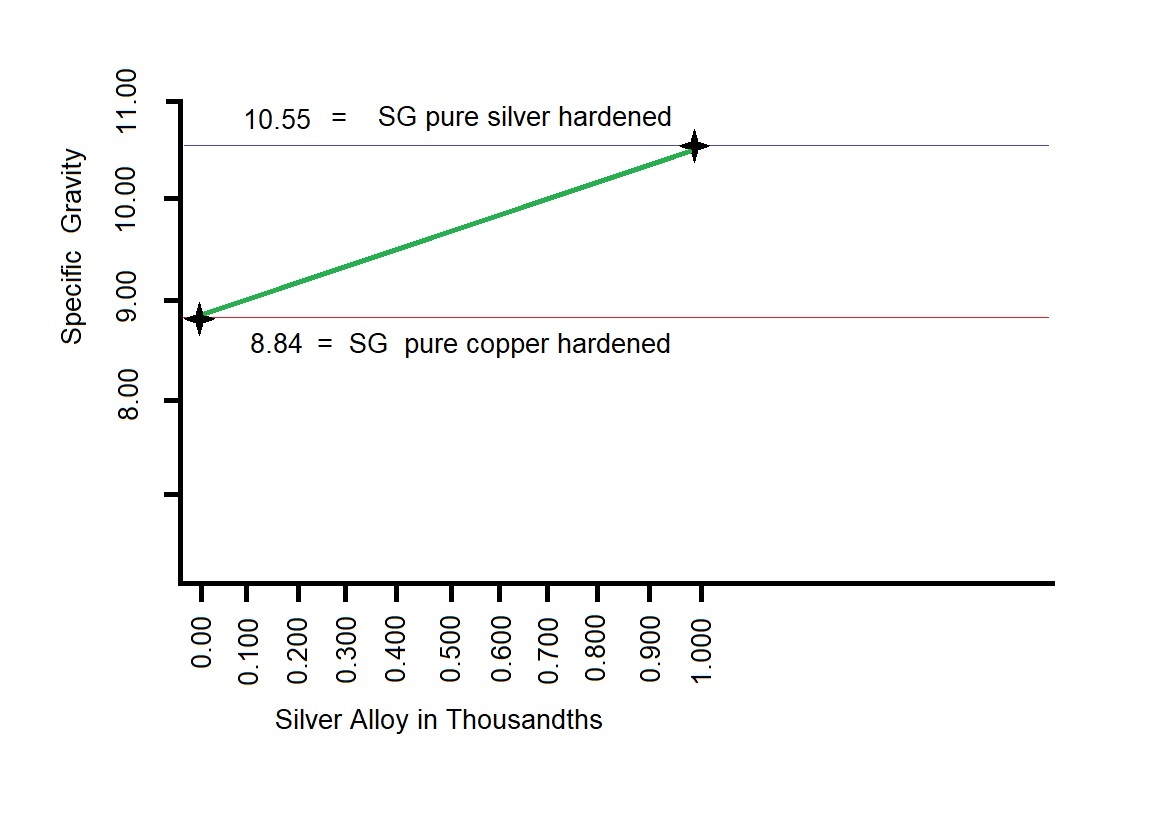 |
| |
Replies: 16 / Views: 3,688 |








 Posted 02/25/2018 06:01 am


