| Author |
 Replies: 30 / Views: 3,739 Replies: 30 / Views: 3,739 |
|
|
|
Pillar of the Community
 United States
4614 Posts |
All of the data (and more) is at uspapermoney.info at least back to series 1935D
-----Burton 50+ year / Life / Emeritus ANA member (joined 12/1/1973) Life member: Numismatics International, CONECA Member: TNA, FtWCC, NETCC, EveryCountry (online) coin club Owned by three cats and a wife of 40+ years (joined 1983) Author: 3rd Edition of the Sample Slabs book, https://www.sampleslabs.info/ |
|
Pillar of the Community
United States
655 Posts |
I'm not going to check every possible but let's just take one more sample, the 1928A $20, which indeed has a very low total production across all districts. My price guide lists 2051-J, Kansas City, with a scant 114k production, at $650 in CU; it lists Philadelphia, 2051-C, with the largest production of 1.7 mil, at $550 in CU. Not much difference.
In actual auction results on HA, the last ones listed, from 2018-late 2017, show a 2051-E (production 1.5 mil) going for $288 in 64, a 2051-H (production .6 mil) going for $264 in 64, and two 2051-A's going for $456 and $446 in 64 (production 1.3 mil). Further along, there was a 2051-G that went for just $211 in 64 (production .8 mil) and a 2051-K for $258 (production 1 mil).
I'm really not seeing any significance to these numbers. Prices seem to be 90% based on note's grade and eye-appeal, centering, paper quality, etc but not district. The fact that the Boston notes went for such a large premium, even with their higher production, shows this.
|
|
Pillar of the Community
United States
655 Posts |
I would guess that none of these notes are especially scarce.
|
|
Moderator
 Australia
16956 Posts |
Quote:
My assumption was that the City
was from the particular branch of Federal Reserve Bank that the Note was issued from. Not quite, Sel. Rather, the terminology you're using isn't quite right. There are 12 note-issuing "Banks" which combine to form the Federal Reserve Bank - these are the twelve cities you'll find on the notes. Each Bank is responsible for a District, within which that Bank's notes are issued. Larger districts have Branches, which act as more localized distribution centres for that District's Bank. There are 24 Branch cities throughout the country; these Branches do not get named on the notes. Some Districts are large and have numerous Branches; District 12, San Fransisco, has four Branches (Seattle, Portland, Los Angeles and Salt Lake City). The smaller Districts don't have any. You might find Wikipedia's Map of the Federal Reserve System useful; black squares are Banks; red dots are Branches. The layout of the Districts was set down by the Federal Reserve Act of 1913 and reflects the population density of America at that time. Apparently, getting it changed to more accurately reflect the current population density of the country is more trouble than it's worth. Don't say "infinitely" when you mean "very"; otherwise, you'll have no word left when you want to talk about something really infinite. - C. S. Lewis
|
|
Bedrock of the Community
United States
94367 Posts |
ron - As is often the case with low-print issues, stashes can have a big impact on prices - such is the case, I believe, with the $20 1928-A KC issue (Fr. 2051-J), which never seems to live up to its tiny printing the few times I've seen it sell of late. The toughest in this group (in my experience) are the New York and St. Louis issues in 65 or better, but I've not researched them like you.
This particular series represents just a type note for most collectors and, to me, seems undervalued when you compare printings with either the 1928 or 1928-B issues.
Edited by Coinfrog
04/02/2018 7:00 pm
|
|
Bedrock of the Community
Australia
21789 Posts |
Thanks, Sap.
Quite informative for those of us that have less than perfect knowledge on the subject.
|
|
Bedrock of the Community
United States
94367 Posts |
Name me one person who has perfect knowledge on this subject!  Edited by Coinfrog
04/02/2018 7:02 pm
|
|
Bedrock of the Community
United States
12907 Posts |
This is a very informative thread, even for those of us that have been around a bit.  |
|
Pillar of the Community
United States
655 Posts |
I didn't know that about the branch banks, Sap. Living next to a larger district, what I'd like to know is if any of those branches do direct transactions with the public. I'd like to eliminate the middleman and get such things as an original bag of coins or stack of bills.
|
|
Pillar of the Community
United States
655 Posts |
Coinfrog, you're right inasmuch as the small-sized bills seem to be collected as types, more than anything. I know that's what I do, rarely checking on the signature combinations.
Aside from the well known 1933 $10 SC and the 1934 NAs, I didn't know of any rare series among the small-sized $10 & $20s. But I checked some more and found the 1928C $10s are scarce and the 1928C $20s are rare in CU. Only 4 districts printed them for the $10s and just 2 districts for the $20s.
|
|
Bedrock of the Community
United States
94367 Posts |
You've identified some of the toughest series for sure. But some of the more common series have some very difficult districts in high grade as well, like the $20 1928-B Atlanta. My point here, really, is that I think there are a lot of sleepers in early FRN note districts that (as you point out) seem not to bring much of a premium today despite wide printing disparities..
|
|
Pillar of the Community
United States
4637 Posts |
I agree with what Mr.Frog just said,and reminds me of an extraordinary low print run on a modern star note.
Series 2004A $10 Atlanta Star (GF*). A measly 9,600 or so printed and just about everyone I know has at least one. Released at a major Coin/Currency show in sheet form, these went directly into collectors hands. Some were kept in sheet form, but many individual notes exist today in high grade holders. Print run totals don't always tell the whole story.
|
|
Pillar of the Community
United States
655 Posts |
The $20 1928B dgs from F and, also, K, both with lower prod of 2 mil, must really be scarce because I can hardly find an auction record of them. Not to say they don't deserve a premium, it's just that when reselling such a bill it would require having really savvy buyers; otherwise, people will just pay the type price for the date.
What's surely lacking is a book of estimates of what may still exist. It's easy enough to look up print runs but how many were redeemed, retired, lost, etc? Of course, anybody would be guessing but, based on some factors, they may be able to make a pretty reasonable one (better than I could, anyway).
|
|
Bedrock of the Community
United States
94367 Posts |
All it takes is two savvy buyers to push a price up, so I'm trying to scurry around now before they start doing so. I really think the early FRNs are a fertile field, and if you want to talk about rarity, the stars are out of sight. A recent pickup is this 1928-A St. Louis note, with a print run of only 573K. Great margins, super embossing and will be on its way to PMG shortly. 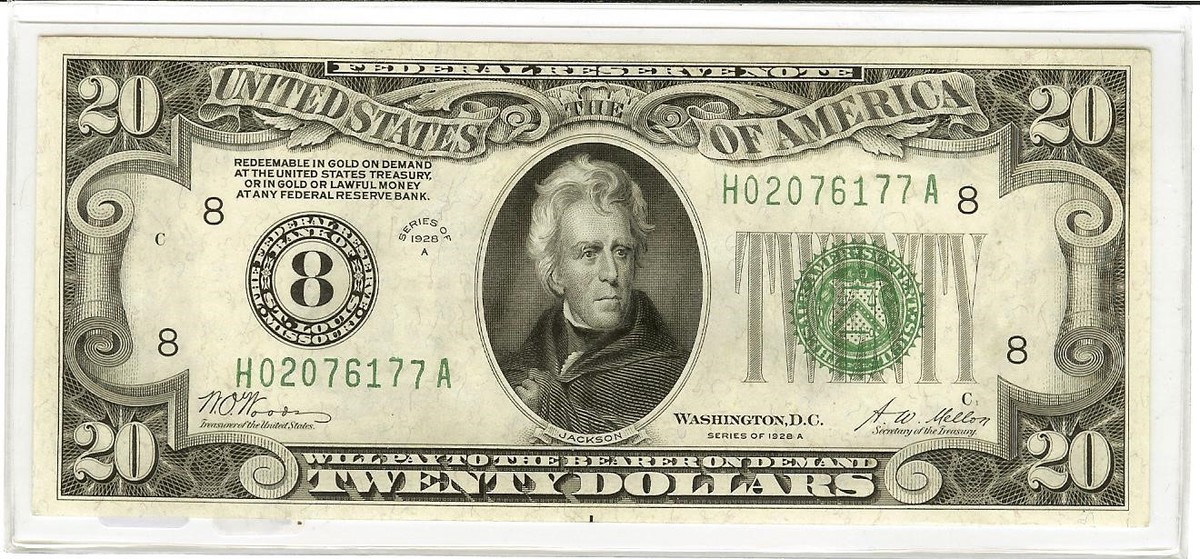 |
|
Moderator
Australia
16956 Posts |
Quote:
I didn't know that about the branch banks, Sap. Living next to a larger district, what I'd like to know is if any of those branches do direct transactions with the public. I'd like to eliminate the middleman and get such things as an original bag of coins or stack of bills. I'm pretty sure the answer is "no". The Federal Reserve Bank does not have a retail arm or deal directly with any individual people. The Mint and the Bureau of Engraving and Printing are both part of the US Treasury Department and are the people that actually make the coins and notes, respectively; the FRB's job is merely to distribute that currency to the banks that need it. I'm sure if you asked, as a coin/note collector, how to obtain coins and notes for your collection, they'd tell you to go to the Mint and BEP and buy their made-for-collector sets and products. The only way to "cut out the middleman" here is to go get a job at a bank, and even then I'm pretty sure most banks have policies against staff picking through and swapping out the currency. Don't say "infinitely" when you mean "very"; otherwise, you'll have no word left when you want to talk about something really infinite. - C. S. Lewis
|
| |
Replies: 30 / Views: 3,739 |








 First Page


 Posted 04/02/2018 09:50 am


