| Author |
 Replies: 47 / Views: 6,279 Replies: 47 / Views: 6,279 |
|
|
|
Pillar of the Community
United States
1156 Posts |
It does not match the Calbeto plate coin.
|
|
Pillar of the Community
United States
1962 Posts |
Jack - does not match as in a different specimen... or totally different die(s)?
|
|
New Member
 United States
16 Posts |
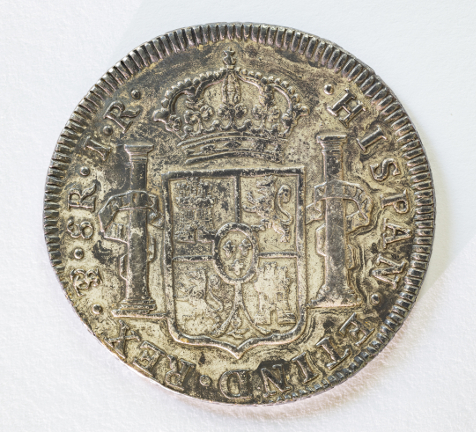
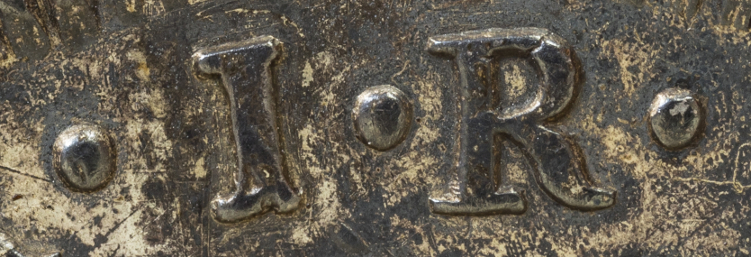
I also have the Calbeto, and as mentioned before it is the only other place I have seen a photo. It's a different coin though, as jgenn mentions. What immediately jumps out is its greater spacing between the "ET" and the "IND" among other things. Does that spacing vary between coins of the same year? Despite the poor quality of the photo I will also note that its J in the assayer initials is similar, so I still believe the J on my piece may be real.
|
|
Pillar of the Community
Czech Republic
803 Posts |
nm
Edited by TwoKopeiki
06/08/2020 2:54 pm
|
|
Pillar of the Community
United States
1156 Posts |
Yes, different dies -- very noticeable differences in punch spacing of areas of the legends on both sides.
Edited by jgenn
06/08/2020 2:49 pm
|
|
Pillar of the Community
Czech Republic
803 Posts |
double post
Edited by TwoKopeiki
06/08/2020 2:55 pm
|
|
Pillar of the Community
Czech Republic
803 Posts |
Here's the Calbeto plate. 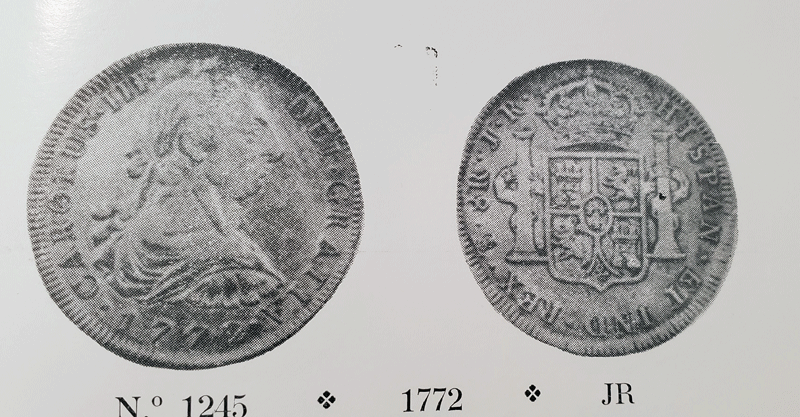 |
|
Pillar of the Community
United States
1962 Posts |
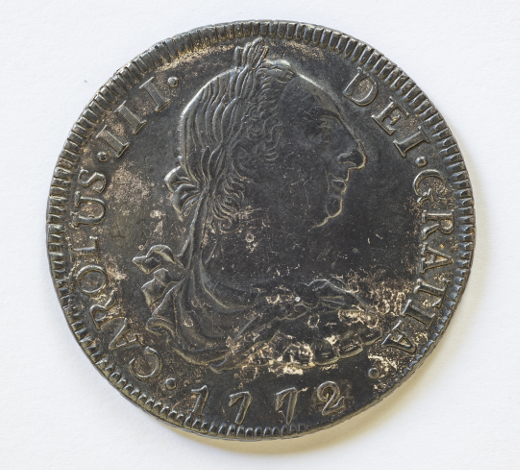
So the pictures thus far are not nearly enough to judge by... but as you seem to have known already, maetx, and as the replies from some pretty decent Spanish Colonial collectors are indicating, this is a coin that is essentially not known to exist in the market.
Also understand that as Potosi is kind of an oddball among the higher-output mints (Mexico, Lima, Potosi... even Guatemala) in that it didn't produce 1772-dated Portrait-style pieces)... it creates a natural forgery/alteration target.
The one thing we can see for certain is that the surface of this specimen is a bit odd... particularly on the obverse, the surface texture has the look of a piece that's been worked on.
PS - can someone post a decent scan or pic of that Calbeto plate coin?
PPS - I'd be curious to know what knowledge/possible experience the important "names" in Spanish Colonial coinage have on a possible 1772 Potosi portrait issue. Ponterio Sr., Dunigan, Sedwick... perhaps published researchers like Menzel, Proctor, Carlos Jara.
|
|
New Member
United States
16 Posts |
realeswatcher, yes, I do understand how odd this coin seems considering the mixed documentation of its existence. I absolutely appreciate everyone's input thus far and look forward to the continued investigation. Again, many thanks to all.
My father did speak to me about the output differences between the various mints, so I know that this coin being a Potosi exacerbates the situation. I will continue to look through some materials I have here to see if I can find any further documentation. At one point I found a chart of Potosi coins, and for the Portrait 1772 it only listed the 8 Reales. The 4 Reales down there were no coins produced. I thought that was an interesting document as it might further speak to its rarity. I need to track it down again, but I will post it here if I do find it.
I'm not knowledgeable about surface textures, so I will take your word on it. Hopefully the better photos I post later will shed some more light into those areas of concern.
|
|
New Member
United States
16 Posts |
|
|
Pillar of the Community
United States
1156 Posts |
Edited by jgenn
06/08/2020 8:12 pm
|
|
New Member
United States
16 Posts |
Burzio's book from 1958 also has the 1772 plate. It is the same plate that Calbeto uses. In fact, my father says the plate was originally used by Medina. All are the same coin. 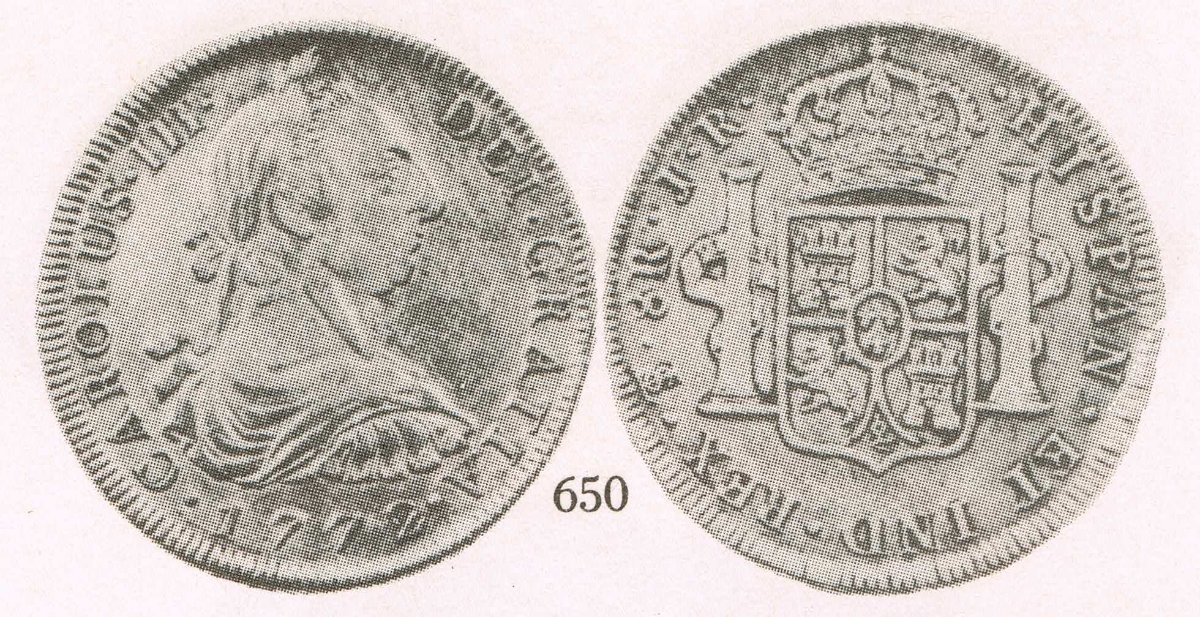 |
|
Pillar of the Community
United States
5362 Posts |
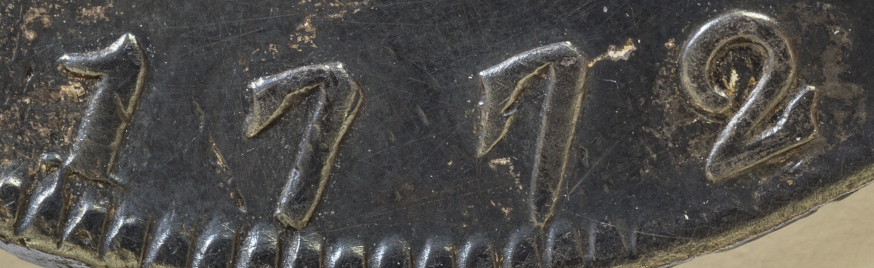
maetx You are correct about the typos, I was trying to reply before we went out last night and in my haste did not review the post fully. The Calbeto picture adds another issue. The J itself in the Calbeto picture is a substantially different font than in the object coin. So I compared the font used on the J in the years 1773, 1774 and 1775 in coins from the Heritage Archive. 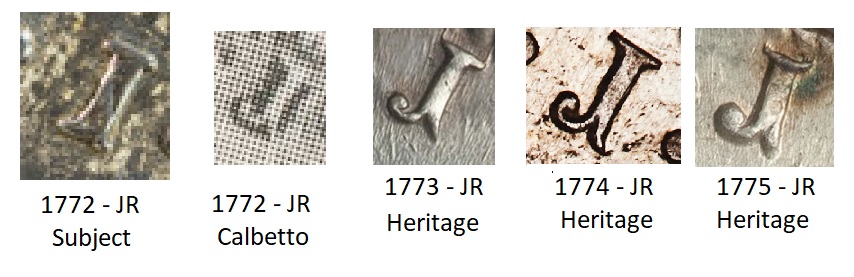 The subject coin uses a J design from a later period. It is the straight J and it is completely different from the J seen on Calbetto's coin and on the later Heritage issues. So That in my opinion is wrong. TwoKopeiki I did notice the first 7 was repunched on the die with a shallow first impression under the second bold 7. The second in the date 7 looks, in my opinion, like the 7 was added to the coin because the shape could not be produced by repunching the 7 in the die face. To explain, the working die face is punched with a negative image of the 7 creating an incuse hole in the die surface the exact size and shape of the punch face. The die metal that did not contact the punch remains approximately level with the die field (not counting the small ridge around the punch shape caused by stress displacement which is removed when the die face is polished). So I was thinking what the second 7 impression would have to look like. After experimenting with my own numeric punch set in soft metal I realized that the top bar of the second seven would invariably have to contact and displace the die metal under the crossbar of the first 7. To demonstrate the result here is a rough line drawing I made along side the 7 from the subject coin (reversed). The 7 on the subject coin was simply not made with a repunched die. 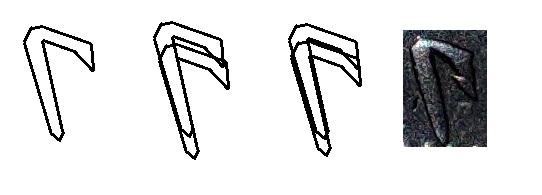 This means, in my opinion, that the 7 that appears on the coin was not produced from a normal die. It was most likely added to the host coin after the 8 was planed off. maetx The edge photos provided show the correct design and the overlaps are identical length, so provided they are 180 degrees apart the host coin itself is likely genuine. Weight, density and XRF tests should yield confirming results. These tests will prove nothing about authenticity if a 1782 Pts coin was used. I also noticed on the larger file shots of the coin much clearer indications of tooling on the coin face around the J than appeared on the earlier photos. I believe it is fairly clear from what we have been presented that the coin is an altered original - a Numismatic Fraud. maetx you also asked if the spacing between letters could vary during the same year. The answer is yes. Each die was punched using quite a few different punches. There was a standard layout of course but each die is slightly different. At Potosi some of the die sinkers are known to be far less careful with spacing than is observed in say Mexico City. Only coins struck with dies created from complete hubs match die to die. That use of hubs started decades after this series of coins was produced. It is therefore very unlikely to find many identical coins unless they come from a group called a hoard which were saved together since striking.
Edited by swamperbob
06/08/2020 10:08 pm
|
|
Pillar of the Community
United States
1156 Posts |
I'll add a few other comparisons to what swamperbob has shown using a 1773 PTS that I own. 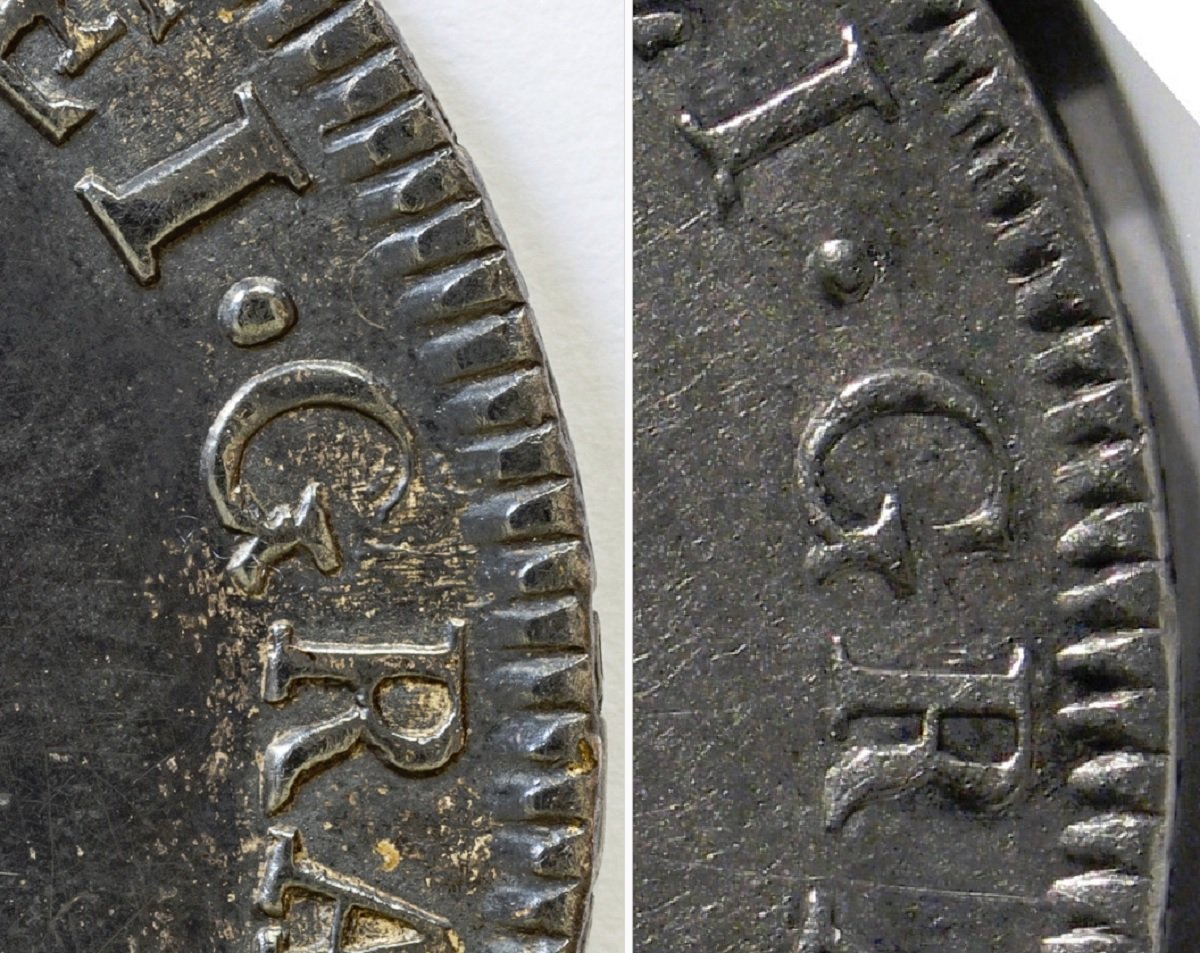 The I and G punches look wrong and the R punch with the oval rather than D shape upper section looks unusually worn. 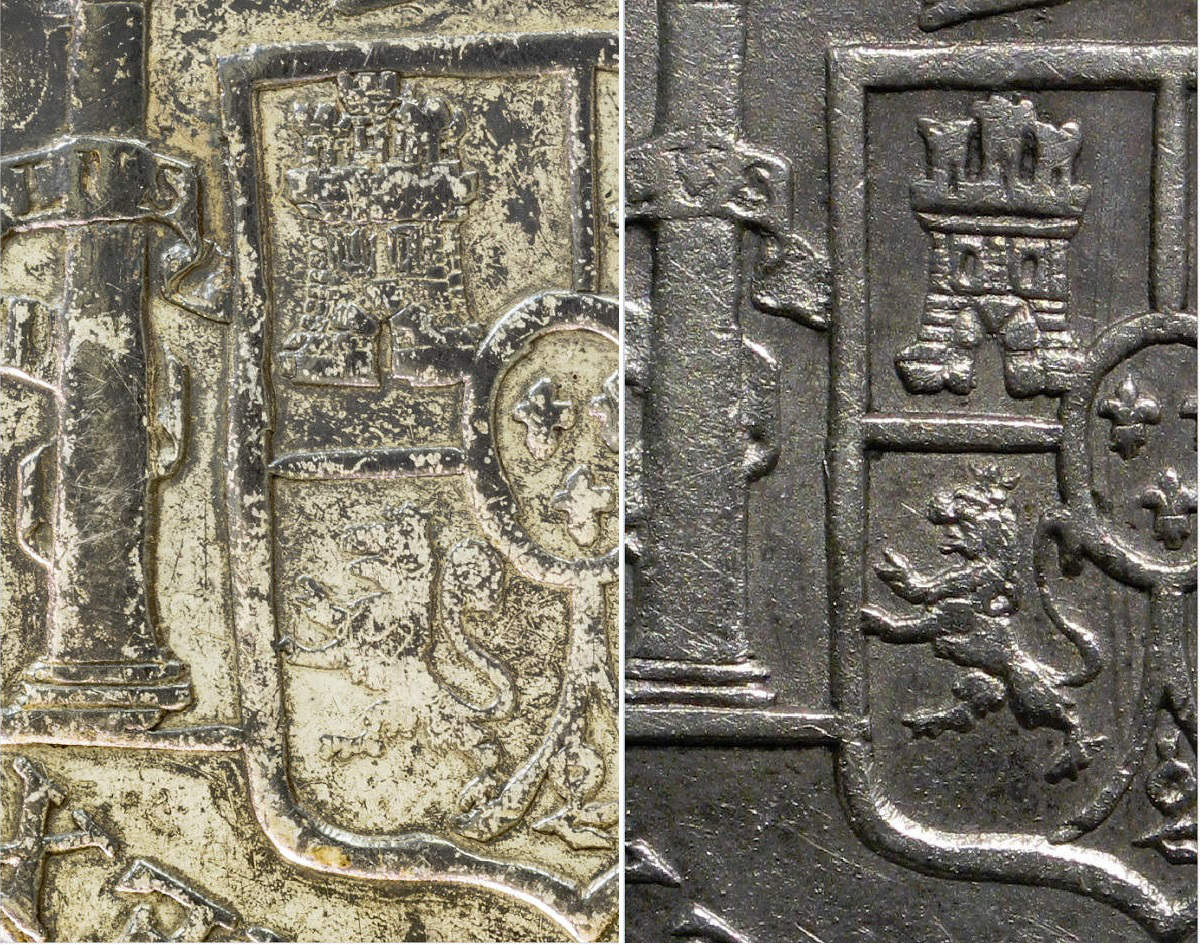 Crudeness in the shaping of the shield outline and the piece under the column makes me think these were hand engraved -- these elements are supposed to come from a punch. Or maybe these were punched with worn punches and reworked. I would expect to see brand new punches in 1772. Edited by jgenn
06/09/2020 12:58 am
|
|
Pillar of the Community
United States
5362 Posts |
That would make it a forgery from some time before 1970.
Difficult to reconcile with typical forgeries of that time period.
|
| |
Replies: 47 / Views: 6,279 |







 First Page


 Posted 06/08/2020 2:42 pm