| Author |
 Replies: 17 / Views: 2,920 Replies: 17 / Views: 2,920 |
|
Valued Member
United States
129 Posts |
A very nice example of a double-struck Lincoln Memorial cent. Toned cherry red. In my opinion, this is not a conventional error coin, but a deliberate "error" produced by a rogue US Mint employee. There are too many examples of similar coins around, and they are not particularly expensive to buy. I got this one about 35 years ago from a coin dealer in NYC.  |
|
|
|
Bedrock of the Community
United States
19583 Posts |
All things aside, the toning is cool.
|
|
Bedrock of the Community
United States
94367 Posts |
|
|
Moderator
 United States
34553 Posts |
Spectacular is a great way to describe this. Thx for posting!
"If you climb a good tree, you get a push."
-----Ghanaian proverb
"The danger we all now face is distinguishing between what is authentic and what is performed."
-----King Adz
|
|
Pillar of the Community
United States
3207 Posts |
Nice example. All sorts of things can go wrong where high speed presses are involved, but sometimes coins are so deformed that I too wonder how they got out of the mint.
|
|
Pillar of the Community
United States
3003 Posts |
hello thegrendel excellent error  If you get the chance, please upload a picture of the reverse. thanks |
|
Pillar of the Community
United States
5887 Posts |
What a great error! Amazing coin!
-CH27
Collector of U.S. Coins, Varieties, and Colonial Coinage
|
|
Pillar of the Community
United States
664 Posts |
Very nice!  |
|
Pillar of the Community
United States
4618 Posts |
Is the second strike full or is it uniface? Could you post a shot of the reverse? Nice error! ANA ID: 3203813 - CONECA ID: N-5637 Clean a coin that may be worth collecting? Please DON'T! When in doubt, leave it dirty!! 
|
|
Pillar of the Community
 United States
8946 Posts |
Quote:
but a deliberate "error" produced by a rogue US Mint employee Incorrect. An off center double strike occurs when a coin fails to fully eject and a second planchet is fed into the chamber. Given there are 2 planchets in the chamber, the collar cannot close and because of that the planchet is not centered, which is why the secondary strike is off center. If the coin is biface and not uniface, that indicates there was not a second planchet fed into the chamber, but the initial coin did not eject and was struck out of the collar. |
|
Bedrock of the Community
United States
17884 Posts |
Quote:
An off center double strike occurs when a coin fails to fully eject and a second planchet is fed into the chamber. Correct Quote:
Given there are 2 planchets in the chamber, the collar cannot close and because of that the planchet is not centered, which is why the secondary strike is off center. Incorrect, the collar is a solid piece of metal it does not open or close. The improperly ejected coin is simply on top of the collar and overhanging the coining chamber. Quote:
If the coin is biface and not uniface, that indicates there was not a second planchet fed into the chamber, Correct. [quote]In my opinion, this is not a conventional error coin, but a deliberate "error" produced by a rogue US Mint employee. There are too many examples of similar coins around, and they are not particularly expensive to buy. It is a legitimate error. The reason there are so many of them is because the mint makes so many coin and back them the quality control was a little more lax. The coins were bagged and shipped out to the rolling facilities. The workers at these places knew that dealers would pay a premium for errors so they would keep any they found and then sell them. If they have an error rate of .001%, by the time the worker rolls 200 bags, he'll have 10 of them. So every month he takes what he gathers and sell 1 - 2 hundred to the coin dealer. So the errors are spread out very thinly among all the production, the rolling worker concentrates them, and then they are further concentrated in the dealers hands and HE will probably bulk sell them to an error specialist dealer. So a significant quantity of all the errors like this made eventually wind up in just a few hands which makes it seems like there are a lot of them. And frankly that estimate of an error rate of .001% is way too high. A rate like that would mean a production of over 60,000 of them for 1979 P alone. |
|
Bedrock of the Community
United States
10635 Posts |
Thanks for the detailed explanation, Conder101 Quote:
the mint makes so many coin and back them the quality control was a little more lax. The coins were bagged and shipped out to the rolling facilities. The workers at these places knew that dealers would pay a premium for errors so they would keep any they found and then sell them. If they have an error rate of .001%, by the time the worker rolls 200 bags, he'll have 10 of them. So every month he takes what he gathers and sell 1 - 2 hundred to the coin dealer. So the errors are spread out very thinly among all the production, the rolling worker concentrates them, and then they are further concentrated in the dealers hands and HE will probably bulk sell them to an error specialist dealer OK, wait... we are talking U.S. currency here. This makes the process sound like some back-alley operation. There is no oversight involved here? How is it someone can keep these coins then resell them? And, there is no quality control at the Mint? Even a .001 error rate sounds like a lot to me. And tell me again (I'm slow) how these are allowed to ever leave the Mint? Even if quantities are simply weighted to verify numbers going out the door at the Mint, certainly these one-and-a half coins must throw the weights counters off? Somebody at The Mint has to be responsible for these error coins, yes? Or maybe not?  Please excuse my curiosity, I find this all fascinating! |
|
Valued Member
 United States
129 Posts |
Sorry for not originally posting a pic of the reverse. I had taken a couple, but inadvertently deleted them. Pulled out my trusty, rusty camera and took another. Taking a close look at the second strike on the reverse, it's a distortion, not at all like the clear second strike on the obverse. Don't know what to make of that, but I'm sure the experts here will be able to figure it out. Enjoy! 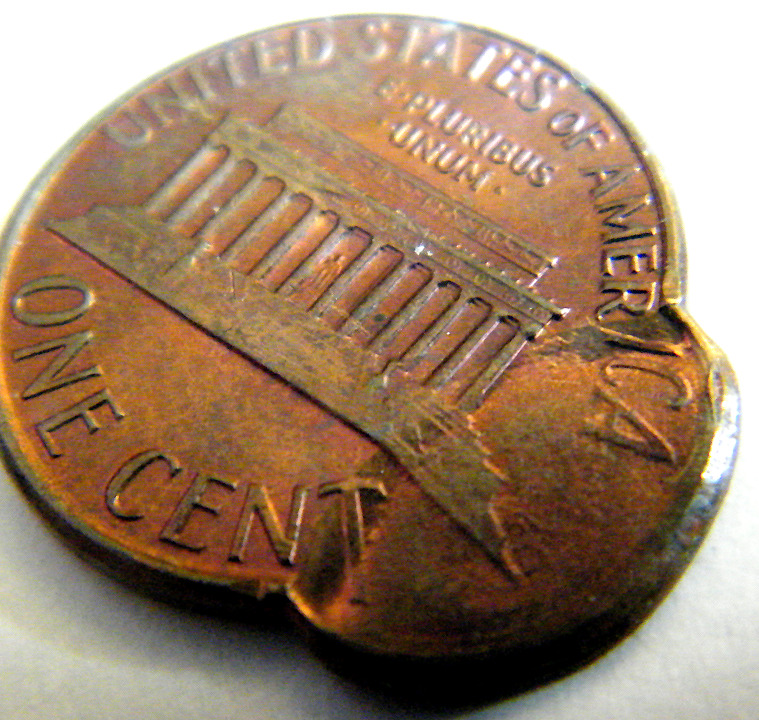 |
|
Valued Member
United States
129 Posts |
>> And tell me again (I'm slow) how these are allowed to ever leave the Mint? <<
My guess is that mint employees are not strip searched on their way out at the end of the shift. And the guards are their poker buddies, right? Probably don't even check their lunchboxes, much less socks and underwear.
|
|
Bedrock of the Community
United States
10065 Posts |
I was always under the impression these make it out of the mint in the large bags coins are shipped in. They obviously won't fit into bank rolls.
How much squash could a Sasquatch squash if a Sasquatch would squash squash? Download and read: Grading the graders Costly TPG ineptitude and No FG Kennedy halveshttps://ln5.sync.com/dl/7ca91bdd0/w...i3b-rbj9fir2 |
|
Pillar of the Community
United States
3207 Posts |
Anyone curious about the coin production process can take a tour, when available, of the mint's production lines. It is largely automated. There are no people carefully hand inpecting every coin made. Doubly-struck coins weigh the same as the others, so weight is not a way to check for errors of this type. One extra coin in a bag of thousands would not be detetctable by weight anyhow because one extra coin weighs less than the sum of the planchet Weight Tolerance of all the others in the bag. Reducing the error rate from 0.001%, or whetever it is, is deemed not worth the cost. |
| |
Replies: 17 / Views: 2,920 |





 Posted 07/22/2020 4:15 pm





