| Author |
 Replies: 10 / Views: 1,202 Replies: 10 / Views: 1,202 |
|
|
Pillar of the Community
United States
6196 Posts |
Found this one in a bag of wheats last night. Yet another rim Cud for 1919-S, which I think makes something like 10 of them now for that year. Just sent the images to JC and figured since I had the pics I'd post it up here as well. 1919-S Lincoln Wheat cent mint error - rim Cud   |
|
|
|
Pillar of the Community
United States
5897 Posts |
That's a nice one. A good example for many new to this hobby what a rim Cud should look like. |
|
Pillar of the Community
United States
3281 Posts |
My my, and a large one at that!
Great find.
|
|
Bedrock of the Community
United States
94367 Posts |
|
|
Pillar of the Community
 United States
5715 Posts |
Rim Cud or not, that's an impressive find in a bag of wheats! |
|
Bedrock of the Community
United States
10065 Posts |
|
|
Pillar of the Community
 United States
6196 Posts |
Thanks folks! These 1919-S rim Cuds keep coming my way, and that works for me. |
|
Bedrock of the Community
United States
62064 Posts |
So how dis the happen?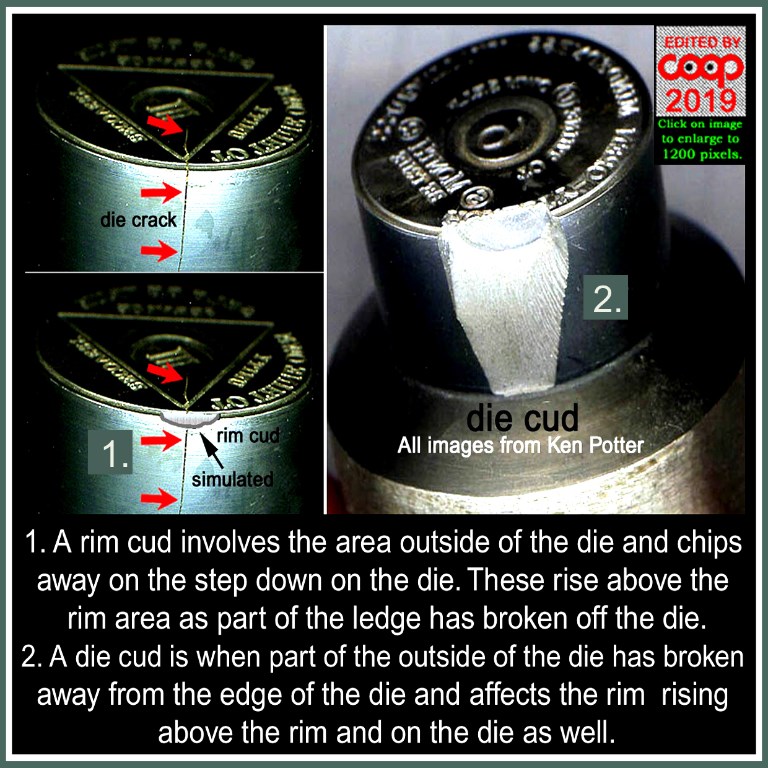 Note the die on the right, that would create a Die Cud. The image on the left in the back would create a die crack. Note how even something a small as a crack, will leave a raised area on the coins struck with that die. The from image on the left is a simulation what would cause a rim Cud. Note where the edge of the dies shelf area. (gutter) was made to look like it was chipping off. The chipping off of the die, will leave that raised area on the top of the rim. That is how a Die Cud starts to happen. CoopHome : How are rim Cuds formed?
|
|
Moderator
 United States
195203 Posts |
Excellent find!  |
|
Pillar of the Community
Canada
6244 Posts |
Coop, nice topic.
What it is and how can happens? This phenomena could be explained by the physic's of resistance of materials and molecular structure.
Yours photos show very well:
1. CLOUD. The anvil is not perfect parallel with the hammer die. Result of more pressure on one side. Striking, due to the compression, the molecules will compress then decompress, creating internal heating which result in separation of the molecules. More stress strikes on that point will finish with complete separation of that part.
2. CRACK. Same phenomena is produce but with the difference that the strike is applied first on two opposite points, which will end with separation of the median between those points.
The way of separation on your photos tell me that the mint try to have the most cubic molecular in theirs materials (look at the parallelly and straits lines left after separation of the material).
Excellent question and topic. Much more to say and debate on. This it is the physic.
To add more, some times the mix of alloy is not osmogene which result in material structure default.
Edited by silviosi
03/08/2021 10:57 pm
|
|
Pillar of the Community
Canada
6244 Posts |
To add more explicit and simple:
Imagine you hammer nails. You hit the nails with the same part and point of the hammer (side part). will result of deformation first and then separation of that part. Simply explanation.
|
| |
Replies: 10 / Views: 1,202 |
|





 Posted 03/08/2021 05:03 am





