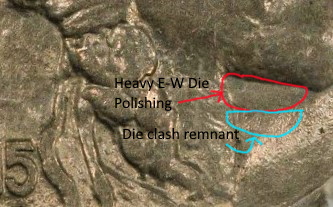
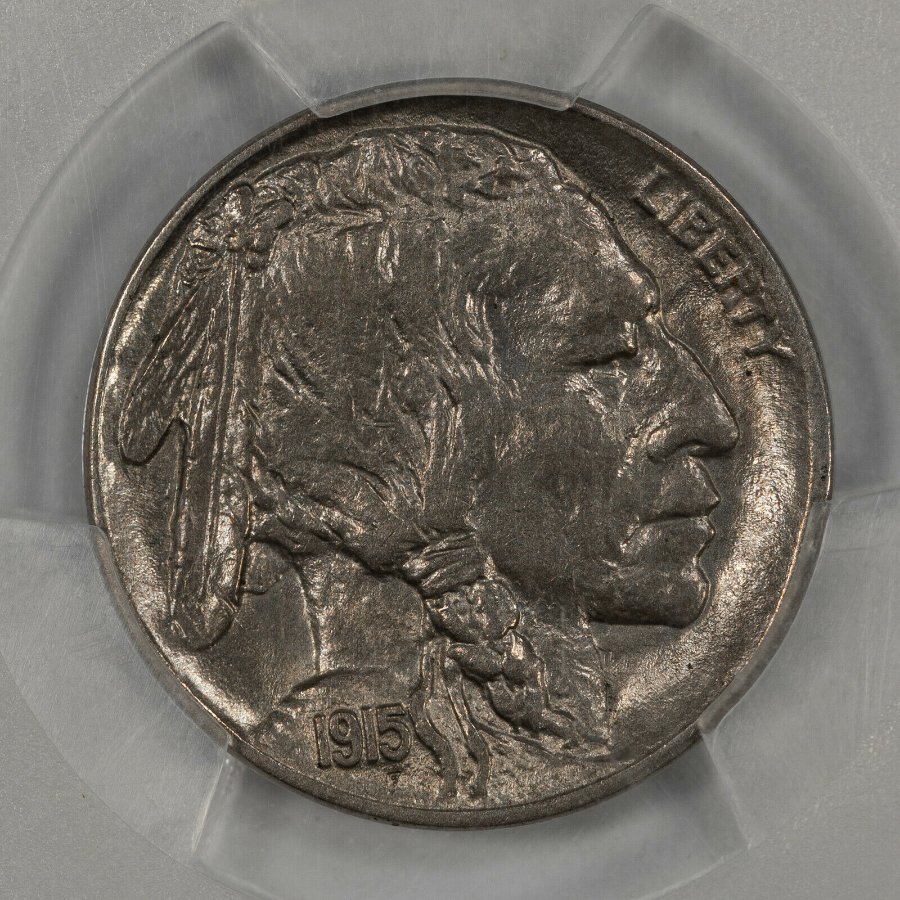
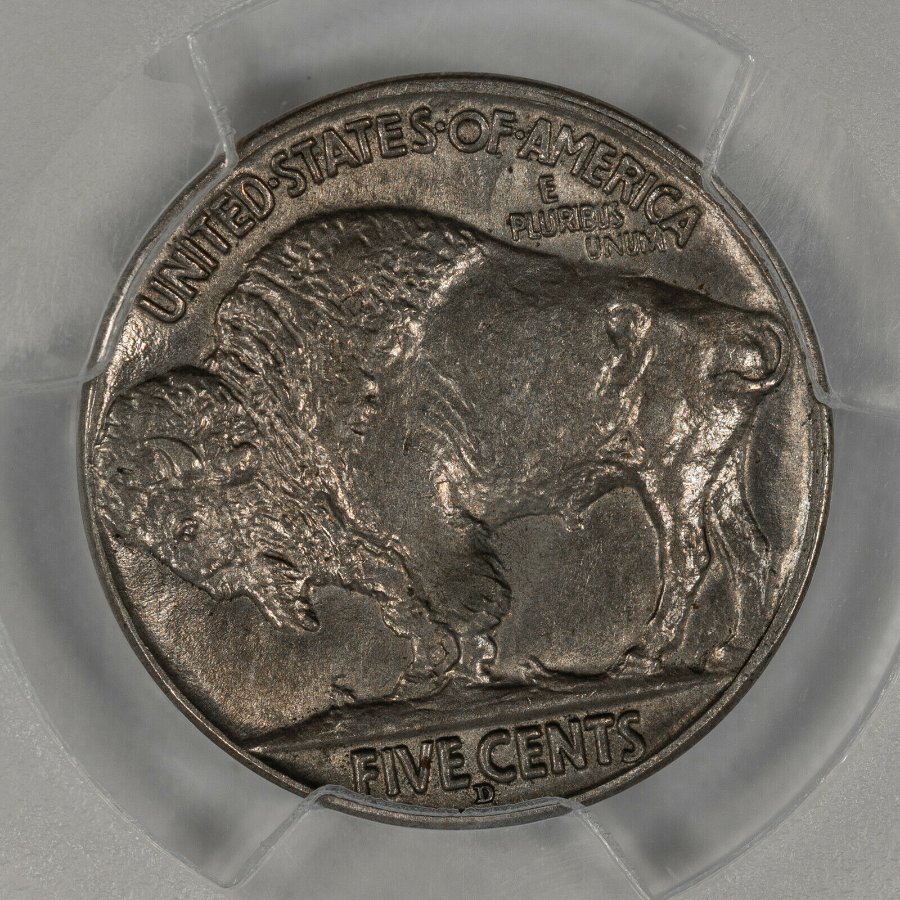
Interesting 1915-D. LMDS obverse, EMDS reverse, very slightly rotated dies at the time of the obverse clashing. Heavy rotated die clashing and die polishing on the obverse, moderate correctly aligned clashing and little polishing on the reverse. This suggests that the reverse die was swapped out after the heavy obverse die clashing occurred, but still well before this coin was struck. Average strike for 1915-D. Good original luster, minimal contact marks.
On the obverse, notice the rotated clashing. The part in the Indian's hair normally directly aligns with the level ground. Here, the ground clash runs SW-NE across the part, and is plainly visible. The Indian's chin normally has a "comb" effect from EPU. Here, PLURIBUS is almost readable well below the chin, and there has been exceptionally heavy polishing directly below the chin. The second feather / buffalo's head clash completely missed the head, and the contact evidence for the head is SE of the second feather tip. The Indian's neck / buffalo's back clash is also rotated east. The LIB of LIBERTY / buffalo's right rear leg clash shows the hoof inside the LI of LIBERTY, rather than in the B of LIBERTY. (The weak LIBERTY is a design issue for 1913-14-15 Buffs, and is not due to strike or circulation.) There were two small laminations on the obverse. Neither would detail the coin.
In terms of grade, there is some disruption of the luster on the obverse high points. Quite a bit of the obverse weakness is die state, die polishing, and strike weakness. The reverse does not show much disruption of luster, but it can be seen on the lower shoulder and left front leg, the flank, and the buffalo's upper back. The big question is whether the luster disruption is cabinet rub or circulation. IMHO, the reverse rubs are not where they would be expected from circulation, but are close. The obverse rub is spot on with circulation wear, and seems a tad too much for cabinet wear.
I would grade this one as AU-58 obverse, AU-58 reverse, net AU-58. That said, I could well see a grader looking at the minimal contact marks and luster, and calling this a low MS, perhaps MS-62. There is very little price differential from EF-45 to AU-55 or from MS-60 to MS-62. The outlier in the middle is AU-58, and that's the high middle grade that has the most to lose or gain from a wide call.









 Posted 04/05/2021 4:18 pm





 ...
...