newguy22 You asked:
Quote:
what kind of modern counterfeiting tech are you talking about?
In this particular case, the term modern is relative. The seller is an ancient coin specialist and his familiarity with technologies more modern than that of the fouree is extremely limited. He believed the coin was genuine. The coin is struck, it is the correct weight and the drill hole discloses that it was a solid alloy. By ancient standards that could mean it was genuine. Die details or variations are often considered to be of secondary importance.
However, in the 1840's when this counterfeit was circulated, there were other technologies employed by counterfeiters to make their bogus coins.
Just in case you do not know the term fouree it refers to an ancient method of applying a silver foil over a core of base metal and then striking the silver wrapped lump with false dies. There is a mechanical bond created by the striking pressure between the silver foil and the copper. Fourees were successful until the bond broke (often at the edge) by the agency of dirt, grease or circulation.
That technology was status quo effectively until Sheffield plate technology was discovered in 1770. This technology involved a bond created by heating a sandwich of copper with silver outer layers in a furnace until the metals fused together in an unbreakable bond. Once fused, the metal could be rolled to the proper thickness then cut and struck by false dies. The edge (which still showed the copper core) was covered variously until 1785 when Matthew Boulton developed the application of a silver edge ribbon to the planchet before striking. The ribbon was rolled on to the Sheffield blank using an edger mill (Castang machine) that applied the security milling to the edge. The completed planchet was then struck in a screw press. This combination of Sheffield and Fouree technologies was the state of the art from 1785 until the middle 1830s.
In 1830, the Germans discovered how to replicate Chinese white copper (PakTong). This Chinese alloy (Copper, Nickel and Zinc) had been smuggled into Europe and the aristocracy favored it above sterling silver because it was rare, expensive and unlike silver did not tarnish. The value of PakTong was driven by the fact that it was illegal to export from China therefore very rare and because it was a "popular fad". The actual cost of the metal in the alloy was minimal and once the technology to produce the alloy was commercially available in quantity it became the favorite of counterfeiters. So solid alloy struck coins could now be made cheaply using German silver. The dates vary but between 1830 and 1836 the discovery was introduced across Europe and even into the US by Feutchwanger.
The seller in this case was unaware of these technologies or when they were in vogue. Collectors of counterfeits have long realized that no counterfeit can date to a point before the technology used was invented. This historic correlation of technological developments provides the date ranges for most counterfeits used in the period from 1770 to the present. If you know how a counterfeit was made and what it was made from you have a no earlier than series of dates. The transition from Sheffield Plate to German Silver and from GS to Electro-plated replicas can be dated to within a few years. Combine that with the historic costs of labor and the economic forces at work at the time and you can create a complete set of dates when a counterfeit was made.
When you apply those clues to other known tendencies of counterfeiting and economics and conclusions can be reached as to how the fake coin fits into the overall picture.
Even today the cost of making a forgery is critical to whether or not a counterfeiter will risk arrest in order to make the coin or bill.
Then you say:
Quote:
Seeing all the counterfeit posts make me really sick to the stomach
I believe you are mixing up topics needlessly. Fake coins come in Two major types. Counterfeits and Forgeries.
Counterfeits were made to circulate as money alongside the items being copied. These are historic items and with the exception of money now circulating counterfeits are not only legal but they comprise a finite class of copies that is NO LONGER BEING PRODUCED.
Forgeries are made to defraud collectors. These are usually not old historic items but rather are illegal, fraudulent items that are still being made in almost unlimited numbers.
So while all collectors need to worry about Forgeries (NUMISMATIC FORGERIES or NF) they have nothing to fear from Circulating Contemporaneous Counterfeits (CCC). The threat to the hobby is a lack of understanding about how to properly examine coins or bills to distinguish between the two types. Most CCC's are quite simply valuable whereas NF's are trash that should be melted.
The use of science (mostly High School level technologies) can make the process rather simple. Keep this in mind and follow the topics presented here and you will be far safer than purchasing coins at bargain prices and only discovering later that you have been defrauded.
January1May You say:
Quote:
...does that "CoA" really say 1891? That's kinda weird. I wouldn't expect even a counterfeiter to be that sloppy.
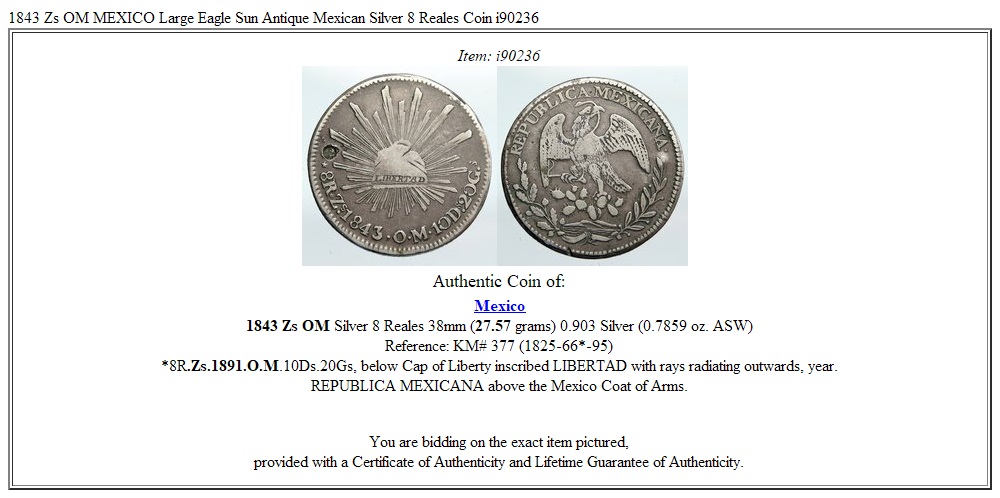
As someone indicated earlier, this seller issues the CofA himself based on using the NGC data base. In this case, he copied the NGC entry for an 1891 C&R 8 Reales and modified it to match his coin. Of course that certificate is 100% worthless by itself, you are reliant on the honesty and the word of the seller. So this error is a typo. However, it points to an industry wide problem about overconfidence on the part of dealers (even big professionals) who do not fully understand the essential points of authentication. The education needed to become an "expert" in the field takes years of dedication and training as well as an understanding of science and history that is simply missing or NOT ALLOWED to come into play even at the
TPG's.
Authentication unlike grading can be TIME CONSUMING. It may often seem like it takes only a second or two, but it may have taken years to reach that level on one single type. So unless the
TPG's stop insisting that the process be completed in 60 seconds or less they will make errors - just like the typo above. Their process should include at least the following:
1. All coins should be accurately weighed and the weight shown on the slab and recorded in the database along with photographs.
2. All coins should be checked using density tests (1/1000 th gram accuracy) with the results recorded as in 1.
3. All historic coins should be XRF tested to look for traits of forgery. These data either raw or reduced should be published.
4. All actually rare coins should be authenticated by a trained professional authenticator familiar with the type based on 1-3 above.









 Posted 04/12/2021 8:13 pm





