| Author |
 Replies: 50 / Views: 5,249 Replies: 50 / Views: 5,249 |
|
Valued Member
United States
358 Posts |
Poll Question
 Here is a coin ive kept in my collection for a while now due to the fact that I cannot explain or determine how exactly this is possible and/or achieved. I have posted this in a couple of reliable groups in hopes to get some answers, and have received alot of mixed opinions.... Ive yet to post it here,and would love you guys to have a look at it. I value everyones input and look forward to what you guys think may have happened to this coin to be able to achieve the appearance shown in the photos below. Notable details:1.No visible points of impact on the obverse or reverse 2.No evidence of pushed over metal on obverse or reverse 3.No evidence at all of any pressure points or bent edges of the "crack"... eliminating the possibility of snips ect. 4.The inside surface of the "crack" are clean as a whistle...no rugged or ridged appearance at all. 5.A very tiny impression shows on the rim of the coin where the "crack" begins. 6. A very straight and uninterruped line shows on the reverse of the coin going thru ONE and CENT with no evidence of damage. 7. The coin is slightly bent (as shown in photos) but only in the particular area effected. Highlighted opinions*Leading expert in errors,Mike diamond,suggested it was damage..but could not determine how it was accomplished,nor was it relevant. *Die variety expert and owner of the coppercoins website Chuck Daughtry suggested it is a genuine error caused by issues involving the striking chamber,and stressed how there isn't a tool in existence that can possibly achieve this look without damaging to the coins surface. My initial impression was a split planchet or a lamination that was tampered with after leaving the mint...but I cannot prove either...leading me to nothing more than....damage.. due to lack of supporting evidence of its authenticity  So...what do YOU think? More pics can be posted upon request. I tried my best to highlight everything that I could. please FEEL FREE TO SUBMIT A SIMPLE ANSWER IN THE POLL BELOW          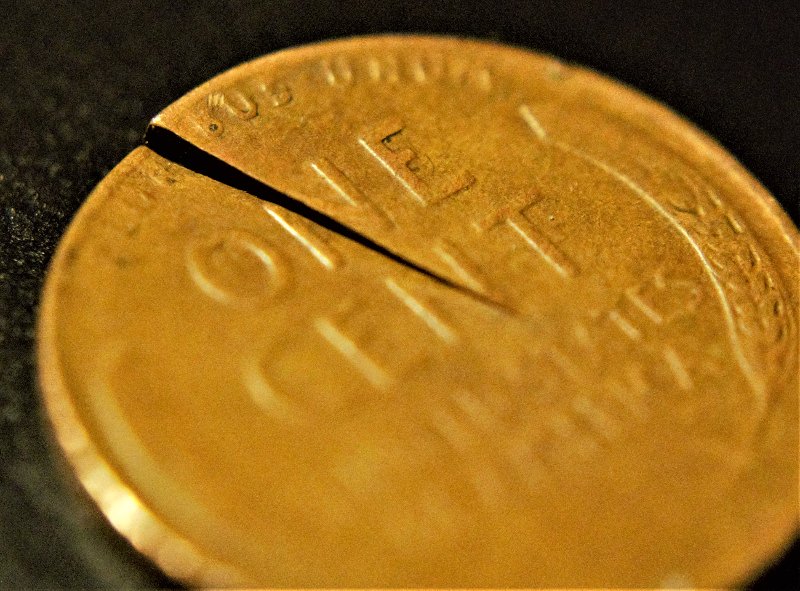
Edited by KeepTheChange
06/12/2021 10:51 am
|
|
|
|
Bedrock of the Community
United States
62064 Posts |
Looks deliberate because of the location exactly on the same N devices. Some areas showing slight chipping. Possibly cut with diamond coated thread or wire. The location was the tip off for me. Never seen this before, just guessing how it could be accomplished. Like they would use to cut off a ring or even metal in a physical injury to cut metal in a hospital.
Edited by coop
06/12/2021 11:21 am
|
|
Pillar of the Community
United States
2189 Posts |
Looks like it was an incomplete shear job in a machine shop. notice to the right of the split the rim has been flattened. Someone started to shear it off but stopped. IMOH
|
|
Valued Member
 United States
358 Posts |
@coop A thread or wire would have to extend the entire surface length to get as clean of a cut as this,the only other way would be using the wire/thread starting at the rims edge...which would show clean evidence on both sides,not just the reverse...which it does not. It is interesting at the very least.
Edited by KeepTheChange
06/12/2021 10:45 am
|
|
Valued Member
United States
358 Posts |
@jasper shears would dent the copper inward due to pressure from the tool. which I do not see here. Plausible ,but not probable imo. Look how clean that edge is.  Edited by KeepTheChange
06/12/2021 10:44 am
|
|
Pillar of the Community
United States
2255 Posts |
 Maybe some sort of lamination in the stock ? |
|
Pillar of the Community
 United States
5695 Posts |
Interesting defect. There's virtually no space where the crack tapers off to indicate a wire saw cut. Is the obverse crack jagged, or is that just an illusion from the contour of Lincoln's jacket? Maybe some kind of planchet defect that was intact when the coin was struck, then was separated and twisted afterwards?
|
|
Pillar of the Community
United States
549 Posts |
Just a cracked planchet IMO. After years of circulation it could easily be bent a bit.
|
|
Pillar of the Community
United States
2255 Posts |
I was looking at your second forth image. The "cut" is jagged and the metal inside the edges edges of the 'cut" is not smooth but rough and textured. A saw cut would be straight and the edge would be smooth. Somehow the planchet cracked. There was a weak spot in the metal. i.e. a lamination. IMO
Edited by 11997755
06/12/2021 11:39 am
|
|
Bedrock of the Community
United States
62064 Posts |
Note how he covered that area so no one could see them?
|
|
Rest in Peace
United States
18456 Posts |
My opinion is a defective planchet, coin was struct and entered circulation thus defect got bigger . |
|
Pillar of the Community
United States
1513 Posts |
It's cut. Just not 100% sure how. There's a guy on this forum who cuts coins into friendship necklaces and such. He posted in the last month or two with some new work. Can't remember his username, though.
|
|
Pillar of the Community
United States
1513 Posts |
|
|
Pillar of the Community
United States
3686 Posts |
@KeepTheChange, Would you be able to take a clearer photo of this area from this angle? Thanks!  |
|
Valued Member
United States
358 Posts |
@fortcollins sure thing,ill get you a good image when I get off work
|
|
New Member
United States
1 Posts |
How about a possible errant cut on the original planchet sheet?  |
| |
Replies: 50 / Views: 5,249 |






 Posted 06/12/2021 10:34 am





